


Hip Disability and Osteoarthritis Outcome Score (HOOS)
The HOOS allows patients to rate their hip pain and physical function. This survey helps doctors assess osteoarthritis severity and track improvements over time.

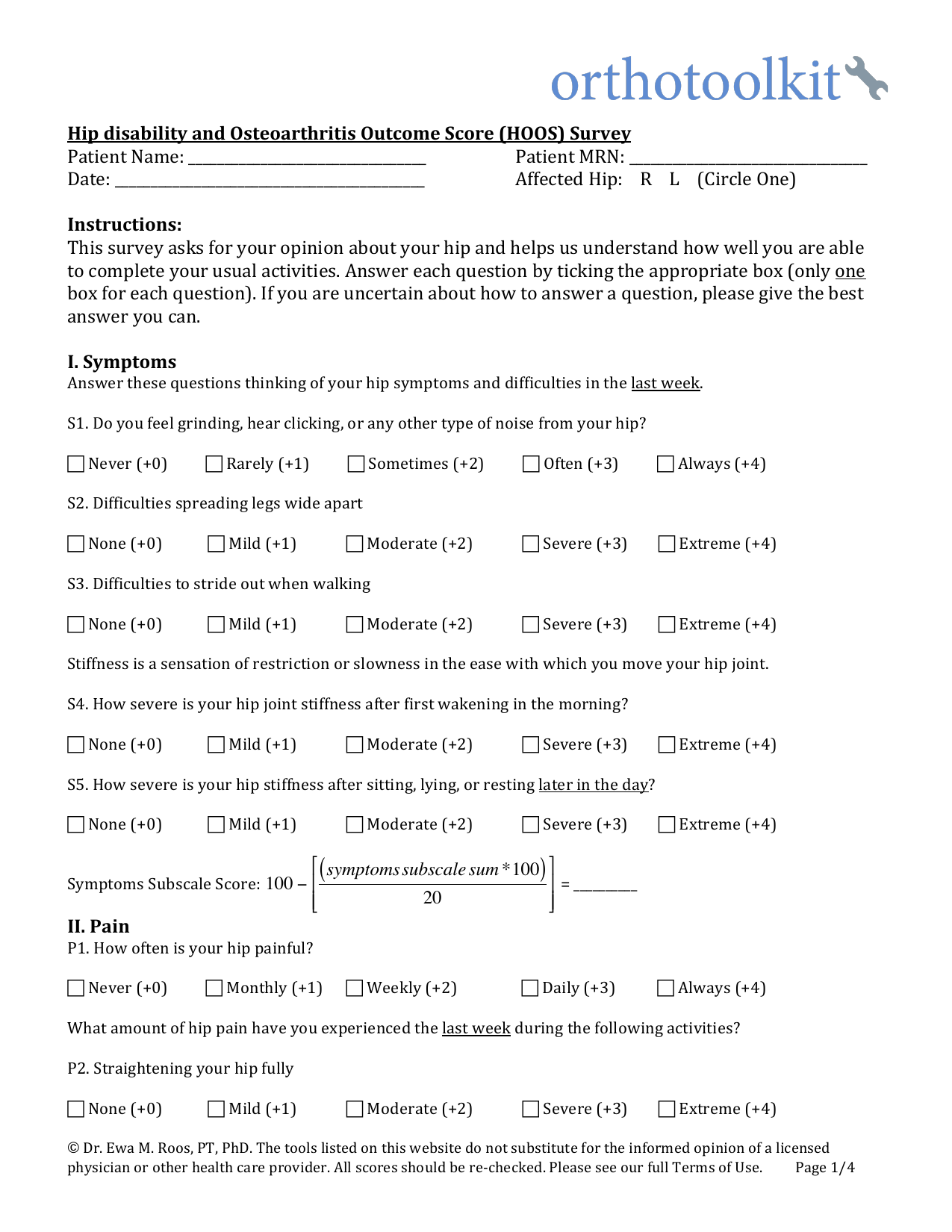
Hip Disability and Osteoarthritis Outcome Score (HOOS)
The Hip Disability and Osteoarthritis Outcome Score (HOOS) evaluates hip health, covering pain, daily function, and quality of life. It’s a key tool for monitoring osteoarthritis, helping clinicians understand how hip problems affect a patient's recreational activities and general wellbeing.
Category
Disease
Source
What is Hip Disability and Osteoarthritis Outcome Score (HOOS)

The Hip Disability and Osteoarthritis Outcome Score (HOOS) is a reliable survey for checking hip health. It tracks progress in osteoarthritis cases effectively. This patient reported outcome measure consists of 40 items. It expands on the WOMAC to cover a broader range of physical concerns relevant to active and younger patients. The survey looks at five specific areas including pain, symptoms, daily living activities, sport and recreation function, plus hip related quality of life. Patients answer using a simple Likert scale ranging from no problems to extreme difficulties. It is self administered and usually takes roughly ten minutes to finish. Since it covers higher level activities, it is great for younger or more active people. Clinicians use the results to guide treatment plans or evaluate surgical outcomes, making it a practical choice for improving long term hip care.

The Hip Disability and Osteoarthritis Outcome Score (HOOS) can be scored using one main standardised approach covering five distinct subscales. First, assign a value from 0 to 4 to each user response, where 0 means no problems and 4 indicates extreme difficulties. Next, sum the raw scores for each domain, such as Pain, Daily Living, or Quality of Life. You then transform these raw totals into a normalised 0 to 100 scale using a standard formula. On this final scale, a score of 100 represents perfect hip health, while 0 points to extreme symptoms. This method lets physios spot specific recovery trends without needing a total aggregate score.

Advantages
.svg)
Measures treatment effectiveness through standardised tools.
.svg)
Provides consistent measurements for clinical research.
.svg)
Serves diverse clinical needs effectively.
.svg)
Strengthens evidence through systematic measurement approaches.
.png)

Related Instruments

Digital counterpart
Digital biomarkers that measure the same thing with sensors rather than a questionnaire.
Streamline Hip Disability and Osteoarthritis Outcome Score collection with WeGuide
.jpg)

Support Your patient in no time - all under your own brand
Our platform combines the knowledge of 100+ digital health solutions built, letting you easily build your patient engagement app for research or clinical use. Collect PROMs, support patients on waiting lists, or gather vital signs data. This is how:
Learn More.png)
Program Builder
.png)
.png)
Whitelabelling
.svg)
.svg)
.png)
Turn on components, dependent on your usecase
.svg)
.png)
Support The Full Journey
.png)
.png)
%20(1).png)
.png)
It’s your turn
Every WeGuide project, saves researchers and clinicians - 9 months and $450,000 - creating impactful digital health solutions.
