


Functional Ambulation Categories (FAC): Assessing Walking
The Functional Ambulation Categories scale measures how much help a patient needs to walk. Clinicians use this observation tool to evaluate mobility in stroke survivors and track their recovery.

Functional Ambulation Categories (FAC)
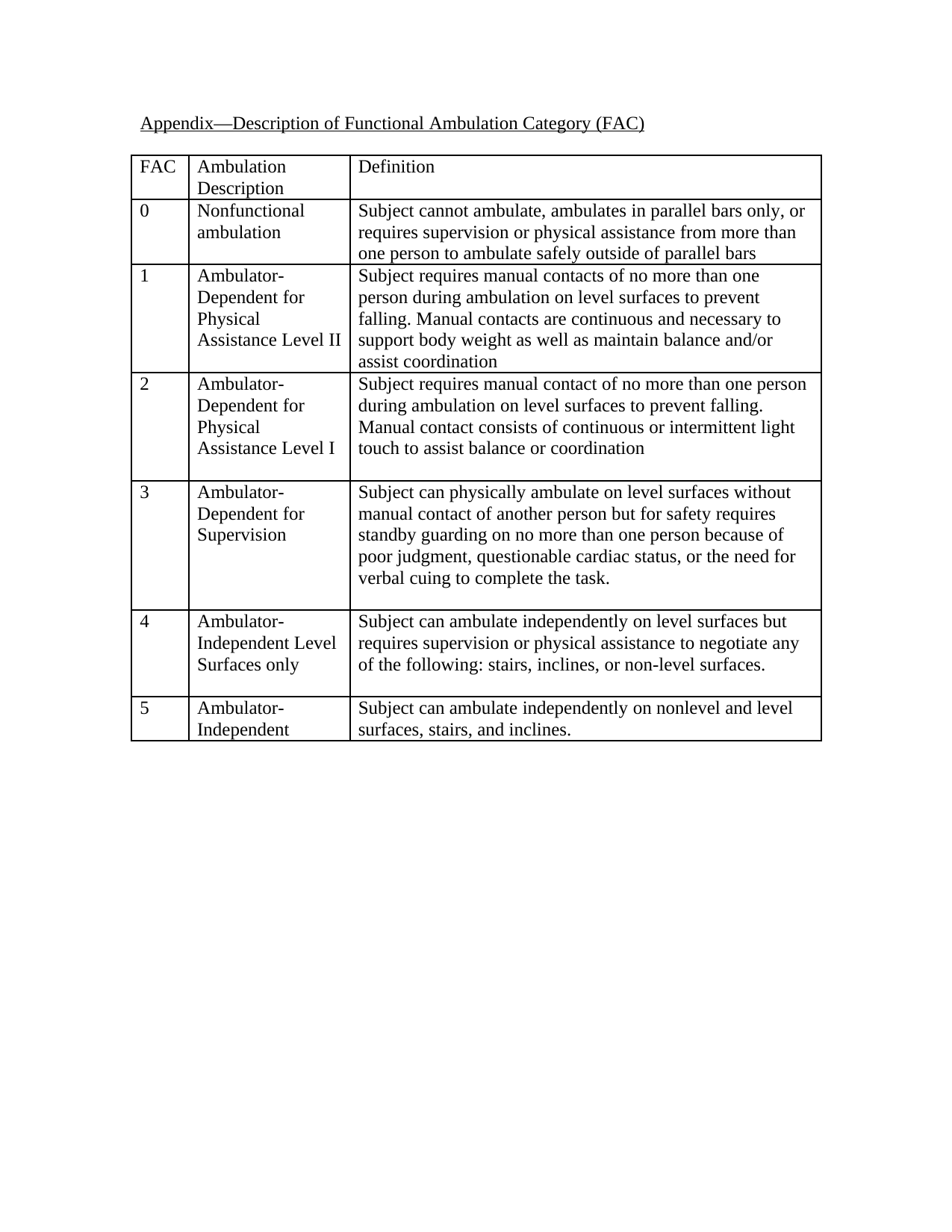
Used to evaluate walking ability, the Functional Ambulation Categories (FAC) classifies how much physical support a patient requires. This six-point scale helps physios track mobility progress, ranging from non-functional to independent gait. It's essential for planning rehabilitation.
Category
Disease
Source
What is Functional Ambulation Categories (FAC)

The Functional Ambulation Categories (FAC) is a practical tool for assessing walking ability. It helps clinicians check exactly how much support a patient needs. This six-point scale evaluates ambulation status by looking at how much human assistance is required. It focuses on physical help rather than just speed or distance walked. Scores range from zero to five. A zero means the patient cannot walk or needs two people to help, while a five shows full independence on any surface like stairs. The middle scores cover continuous or intermittent support and supervision without physical contact. Clinicians like physios use this often because it is quick and easy to score. It works well for stroke recovery and multiple sclerosis. You can use it to track progress over time and set clear goals for therapy. It is a solid way to measure if someone is ready to walk alone in the community.
Functional Ambulation Categories can be scored using a single approach based on physical support needs: Clinicians rate a patient's walking ability on a six point scale ranging from 0 to 5. A score of 0 means the patient cannot walk or needs two helpers, while a score of 5 shows total independence on any surface. Scores 1 through 3 reflect varying levels of physical help or supervision from one person. You simply observe the patient walking to pick the category that best fits their skills. This quick check helps physios track recovery in rehab settings without needing complex tools.
Advantages

Develops personalised strategies based on assessment data.
.svg)
Measures healthcare intervention results systematically.
.svg)
Streamlines research data gathering process.
.svg)
Promotes active participation in healthcare assessment.
.png)

Related Instruments

Digital counterpart
Digital biomarkers that measure the same thing with sensors rather than a questionnaire.
Collect Functional Ambulation Categories data with WeGuide, the all in one platform
.jpg)

Support Your patient in no time - all under your own brand
Our platform combines the knowledge of 100+ digital health solutions built, letting you easily build your patient engagement app for research or clinical use. Collect PROMs, support patients on waiting lists, or gather vital signs data. This is how:
Learn More.png)
Program Builder
.png)
.png)
Whitelabelling
.svg)
.svg)
.png)
Turn on components, dependent on your usecase
.svg)
.png)
Support The Full Journey
.png)
.png)
%20(1).png)
.png)
It’s your turn
Every WeGuide project, saves researchers and clinicians - 9 months and $450,000 - creating impactful digital health solutions.
