


Modified Postural Assessment Scale for Stroke (M-PASS)
Therapists use the M-PASS to evaluate balance and posture in stroke survivors. This clinician-administered tool checks sitting, standing, and lying down abilities to guide recovery plans.

Modified Postural Assessment Scale for Stroke (M-PASS)
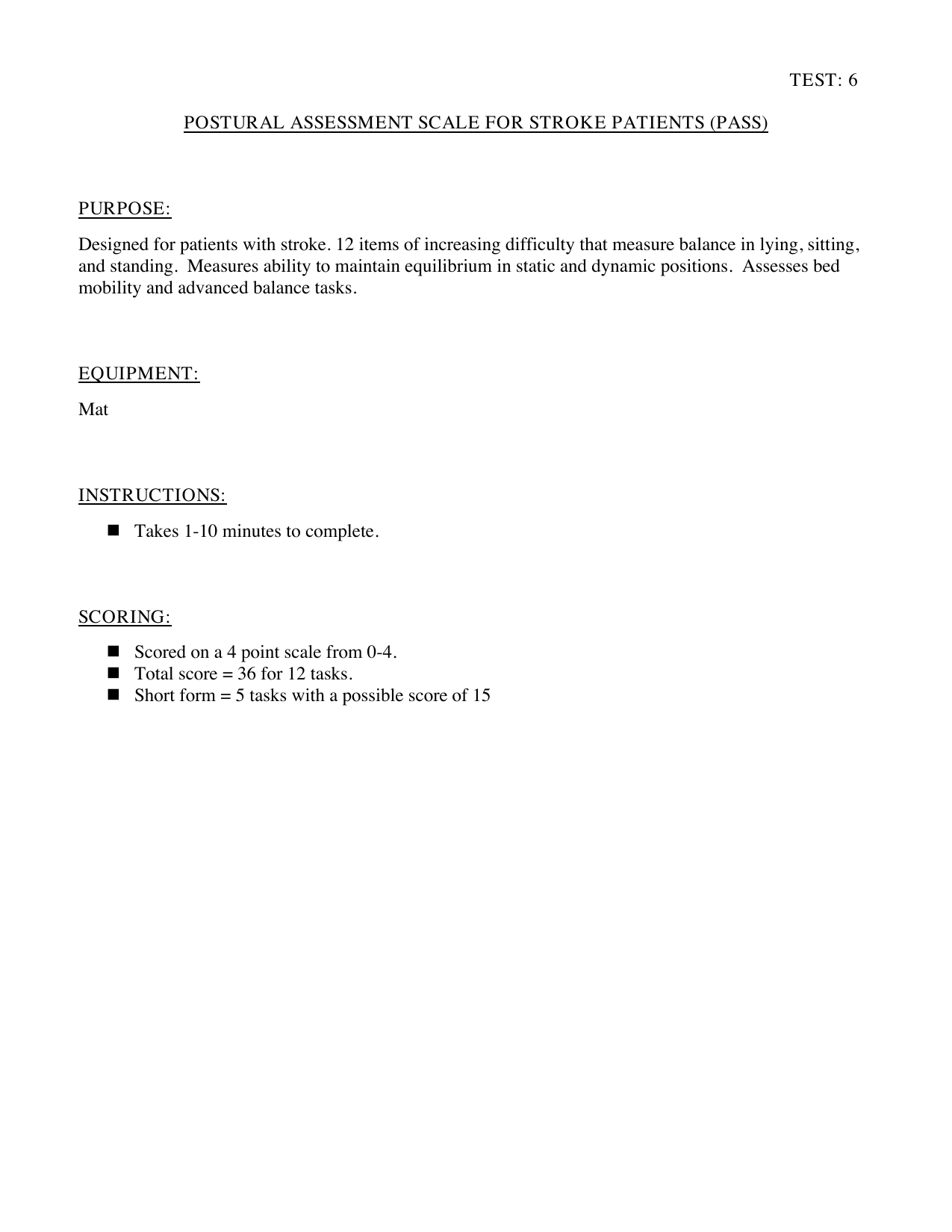
The Modified Postural Assessment Scale for Stroke (M-PASS) evaluates postural control in patients recovering from a stroke. It measures the ability to maintain or change positions, ranging from lying down to standing up. This tool helps clinicians track progress and adjust therapy plans to support better mobility.
Category
Disease
Source
What is Modified Postural Assessment Scale for Stroke (M-PASS)

The Modified Postural Assessment Scale for Stroke (M-PASS) is a key tool for checking balance after a stroke. It helps physios track recovery well. This scale looks closely at how well a patient keeps their posture steady. It breaks down movements into maintaining a position and changing between them quite safely. Clinicians score items from zero to three based on the level of help needed. It covers tasks like rolling over, sitting up without support, and standing on one leg. The scoring is simple, making it easy to spot changes in trunk control over time. It’s great for acute care and rehab settings since it doesn't take long to do. Physios use it to set goals and check if treatments are working. Since it focuses on real movements, it gives a clear picture of functional mobility. It’s a practical choice for busy clinics needing reliable data.

The Modified Postural Assessment Scale for Stroke can be scored using a comprehensive cumulative approach. This tool evaluates 12 items divided into maintaining posture and changing posture. For every task, you rate the patient's performance on a 0 to 3 scale. A score of 0 means they cannot do it, while 3 shows they manage without help. You sum these up for a total between 0 and 36. The first five items cover static balance, and the last seven check dynamic movements. Higher scores suggest better functional mobility, giving physios a clear picture of how a patient is tracking during rehab.

Advantages

Enables precise identification of patient health status.
.svg)
Measures healthcare intervention results systematically.

Develops personalised strategies based on assessment data.
.svg)
Provides consistent measurements for clinical research.
.png)

Related Instruments

Digital counterpart
Digital biomarkers that measure the same thing with sensors rather than a questionnaire.
Streamline Modified Postural Assessment Scale for Stroke data collection with WeGuide
.jpg)

Support Your patient in no time - all under your own brand
Our platform combines the knowledge of 100+ digital health solutions built, letting you easily build your patient engagement app for research or clinical use. Collect PROMs, support patients on waiting lists, or gather vital signs data. This is how:
Learn More.png)
Program Builder
.png)
.png)
Whitelabelling
.svg)
.svg)
.png)
Turn on components, dependent on your usecase
.svg)
.png)
Support The Full Journey
.png)
.png)
%20(1).png)
.png)
It’s your turn
Every WeGuide project, saves researchers and clinicians - 9 months and $450,000 - creating impactful digital health solutions.
