


Morse Fall Scale: Inpatient Fall Risk Screening
The Morse Fall Scale screens hospital inpatients for fall risk using six weighted items that a nurse can score in under a minute.

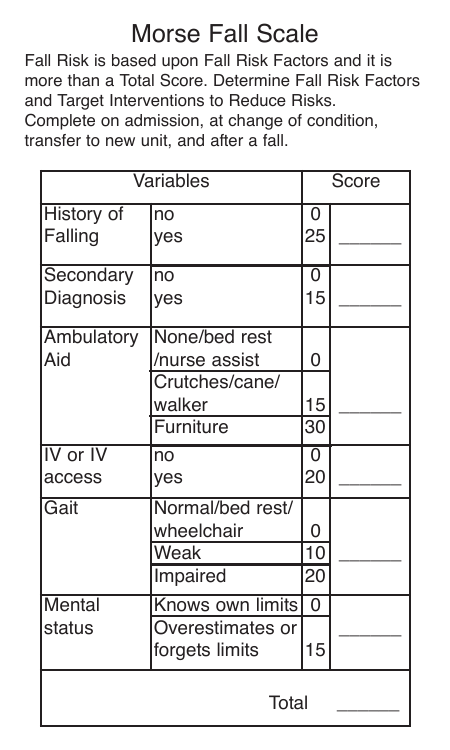
Morse Fall Scale (MFS)
The Morse Fall Scale is a six item screening tool for predicting falls in hospital inpatients. It scores history of falling, secondary diagnosis, ambulatory aid, intravenous therapy, gait and mental status, producing a weighted total used to assign a risk level.
Category
Disease
Source
What is the Morse Fall Scale

The Morse Fall Scale scores six items with unequal weights: history of falling within three months, presence of a secondary diagnosis, use of an ambulatory aid, intravenous therapy or a saline lock, gait, and mental status meaning whether the person's self-assessment of their own mobility is accurate. The weights reflect how strongly each predicted falls in the original derivation rather than clinical importance.
It was built for speed and for use by any nurse on admission, and it is repeated after a fall, on transfer between units and on a change in condition. Two design points are worth understanding. The mental status item is not a cognitive test: it asks whether the patient's belief about their ability to move safely matches reality, and overestimation is the risk. And the intravenous therapy item is a proxy for tethering to equipment rather than a statement about the drug.
Item scores are summed for a total that typically ranges from zero to 125. The commonly cited bands are 0 to 24 for no risk, 25 to 44 for low risk and 45 or above for high risk, but the original work is explicit that thresholds should be calibrated locally, because the proportion of patients falling into each band depends heavily on the case mix of the unit.
The scale is a prognostic screen, not a diagnosis and not a care plan. A high score indicates elevated probability over the admission and should trigger a multifactorial assessment. Reporting the proportion of screen-positive patients as a fall rate confuses risk with outcome.
Advantages
.svg)
Minimizes mistakes in clinical data collection.
.svg)
Identifies health issues during initial stages.
.svg)
Quick completion with minimal burden.
.svg)
Improves overall healthcare delivery standards.
.png)

Related Instruments

Digital counterpart
Digital biomarkers that measure the same thing with sensors rather than a questionnaire.
Collect Morse Fall Scale data with WeGuide, the all in one patient engagement platform
.jpg)

Support Your patient in no time - all under your own brand
Our platform combines the knowledge of 100+ digital health solutions built, letting you easily build your patient engagement app for research or clinical use. Collect PROMs, support patients on waiting lists, or gather vital signs data. This is how:
Learn More.png)
Program Builder
.png)
.png)
Whitelabelling
.svg)
.svg)
.png)
Turn on components, dependent on your usecase
.svg)
.png)
Support The Full Journey
.png)
.png)
%20(1).png)
.png)
It’s your turn
Every WeGuide project, saves researchers and clinicians - 9 months and $450,000 - creating impactful digital health solutions.
