


Modified Ashworth Scale: Grading Muscle Spasticity
The Modified Ashworth Scale grades resistance to passive movement on a six point ordinal scale. It is the most used spasticity measure and one of the most debated.

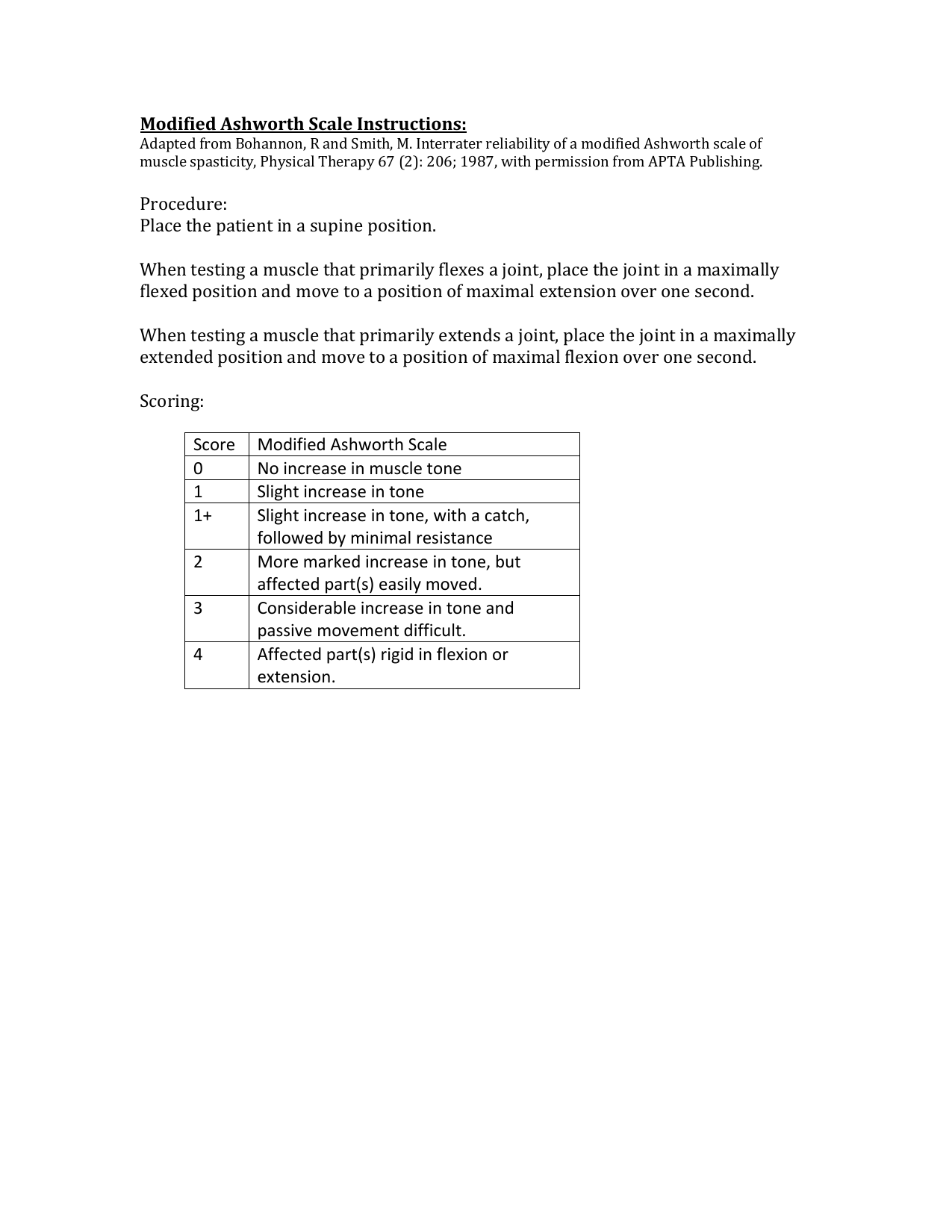
Modified Ashworth Scale (MAS)
The Modified Ashworth Scale grades muscle tone by the resistance a clinician feels when moving a limb passively through its range. It uses six ordinal grades from zero to four, with an added 1+ grade, and is the most widely used clinical measure of spasticity.
Category
Disease
Source
What is the Modified Ashworth Scale

The examiner moves the limb through its full range in about one second and grades the resistance felt. Grade 0 is no increase in tone; 1 is a catch and release or minimal resistance at the end of range; 1+ is a catch followed by minimal resistance through less than half the range; 2 is a marked increase through most of the range with the limb still easily moved; 3 is considerable increase making passive movement difficult; 4 is a rigid limb.
The 1+ grade was Bohannon and Smith's 1987 addition to the original Ashworth scale, intended to make the crowded lower end more discriminating. Its usefulness is that it needs no equipment and takes seconds. Its limitation is that it measures resistance to passive movement, which combines neural spasticity with soft tissue stiffness and contracture, and it cannot separate the two.
Grades are recorded per muscle group and per side, not as a total. Because the scale is ordinal and the intervals are not equal, grades should not be averaged or summed across muscle groups, although this is done often enough to be worth naming as an error.
Reliability is the main practical concern. Agreement between examiners is only moderate, is better for the upper limb than the lower, and depends on the speed of the passive movement, the starting position and the time of day relative to medication and activity. Studies using the scale should standardise the position and movement speed, record which limb and muscle group was tested, and where possible keep the same examiner across timepoints.

Advantages
.svg)
Measures healthcare intervention results systematically.

Develops personalised strategies based on assessment data.
.svg)
Quick completion with minimal burden.
.svg)
Allow for comparisons between different groups.
.png)

Related Instruments

Digital counterpart
Digital biomarkers that measure the same thing with sensors rather than a questionnaire.
Collect Modified Ashworth Scale data with WeGuide, the all in one patient engagement platform
.jpg)

Support Your patient in no time - all under your own brand
Our platform combines the knowledge of 100+ digital health solutions built, letting you easily build your patient engagement app for research or clinical use. Collect PROMs, support patients on waiting lists, or gather vital signs data. This is how:
Learn More.png)
Program Builder
.png)
.png)
Whitelabelling
.svg)
.svg)
.png)
Turn on components, dependent on your usecase
.svg)
.png)
Support The Full Journey
.png)
.png)
%20(1).png)
.png)
It’s your turn
Every WeGuide project, saves researchers and clinicians - 9 months and $450,000 - creating impactful digital health solutions.
