


Community Integration Questionnaire (CIQ): Participation
The CIQ assesses how well people with brain injuries return to home and community life. It helps clinicians track social participation and daily functioning throughout rehabilitation.

Community Integration Questionnaire (CIQ)
The Community Integration Questionnaire (CIQ) evaluates social roles, mainly for traumatic brain injury patients. Covering home integration, social activities, and productivity, this 15-item tool helps clinicians track recovery. It’s a practical way to measure how well patients re-engage with their daily lives.
Category
Disease
Source
What is Community Integration Questionnaire (CIQ)

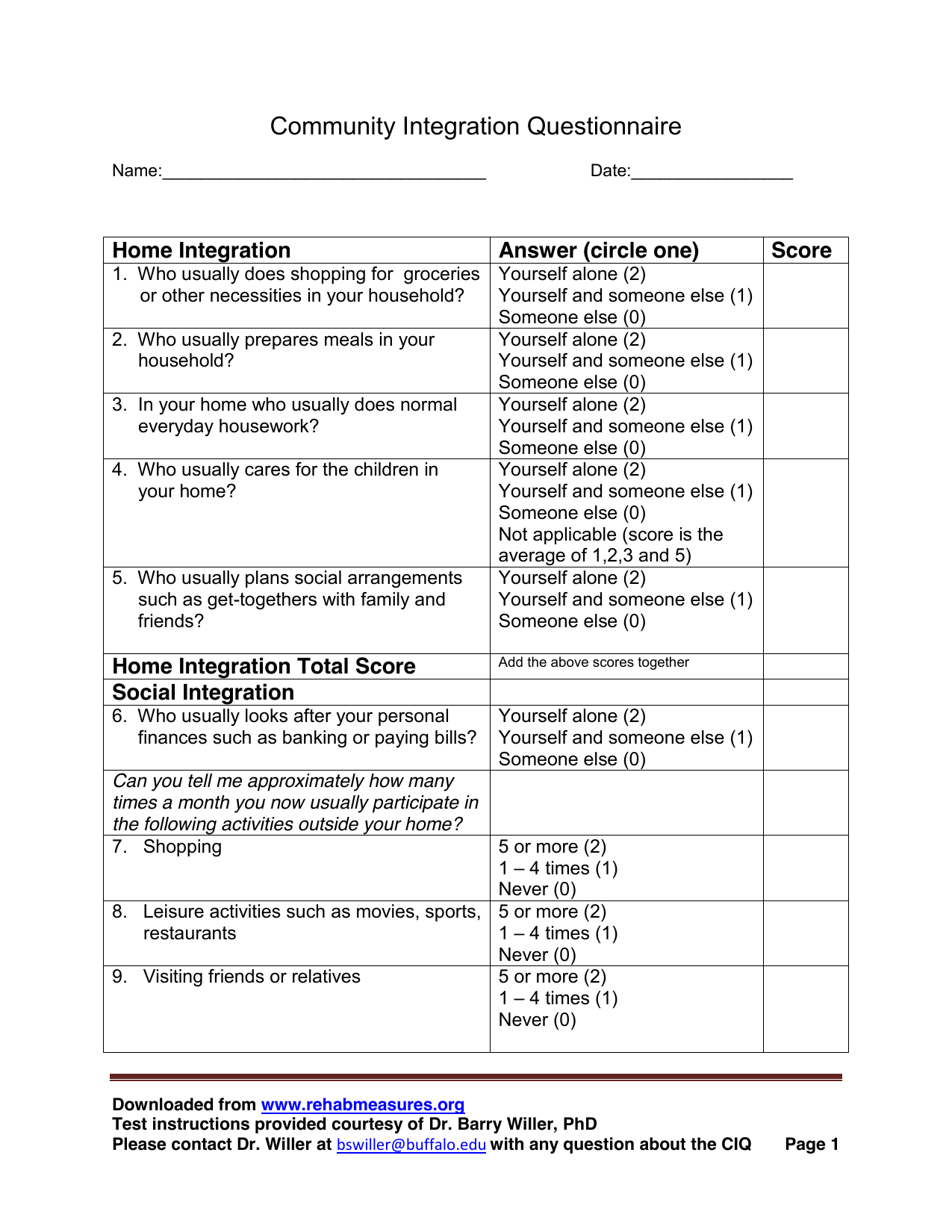
The Community Integration Questionnaire (CIQ) is a trusted instrument for measuring how well people with brain injuries reconnect with daily life. Developed specifically for traumatic brain injury recovery, this fifteen-item scale looks closely at limitations in personal performance and everyday social roles. It breaks things down into three main areas: home integration, social integration, and productive activity like work or school. The scoring is simple, ranging from zero to twenty-nine, where higher numbers mean better independence and community involvement. Clinicians can administer it quickly, or patients can fill it out themselves. It's reliable even when family members answer as proxies. This flexibility makes it a top choice for tracking rehab progress, helping teams spot where a person needs extra support to get back into the swing of things.
The Community Integration Questionnaire can be scored using a standard method that sums up three specific subscales. This tool covers 15 items split into Home Integration, Social Integration, and Productivity. You'll rate answers from 0 to 2, depending on frequency or if tasks are done jointly. For the Productivity section, jobs and volunteering get weighted differently. Add these up for a total between 0 and 29, where higher scores show better community involvement. It's a solid way to spot changes in a patient's daily life after a brain injury, giving you a clear picture of their independence without needing fancy calculations.

Advantages
.svg)
Measures treatment effectiveness through standardised tools.
.svg)
Streamlines research data gathering process.
.svg)
Provides consistent measurements for clinical research.
.png)

Related Instruments

Digital counterpart
Digital biomarkers that measure the same thing with sensors rather than a questionnaire.
Streamline Community Integration Questionnaire data collection with WeGuide
.jpg)

Support Your patient in no time - all under your own brand
Our platform combines the knowledge of 100+ digital health solutions built, letting you easily build your patient engagement app for research or clinical use. Collect PROMs, support patients on waiting lists, or gather vital signs data. This is how:
Learn More.png)
Program Builder
.png)
.png)
Whitelabelling
.svg)
.svg)
.png)
Turn on components, dependent on your usecase
.svg)
.png)
Support The Full Journey
.png)
.png)
%20(1).png)
.png)
It’s your turn
Every WeGuide project, saves researchers and clinicians - 9 months and $450,000 - creating impactful digital health solutions.
