


Fatigue Severity Scale (FSS): Measuring Fatigue Impact
This nine-item self-report survey measures how fatigue affects daily functioning. Clinicians use the Fatigue Severity Scale to assess tiredness in patients with chronic medical conditions.

Fatigue Severity Scale (FSS)
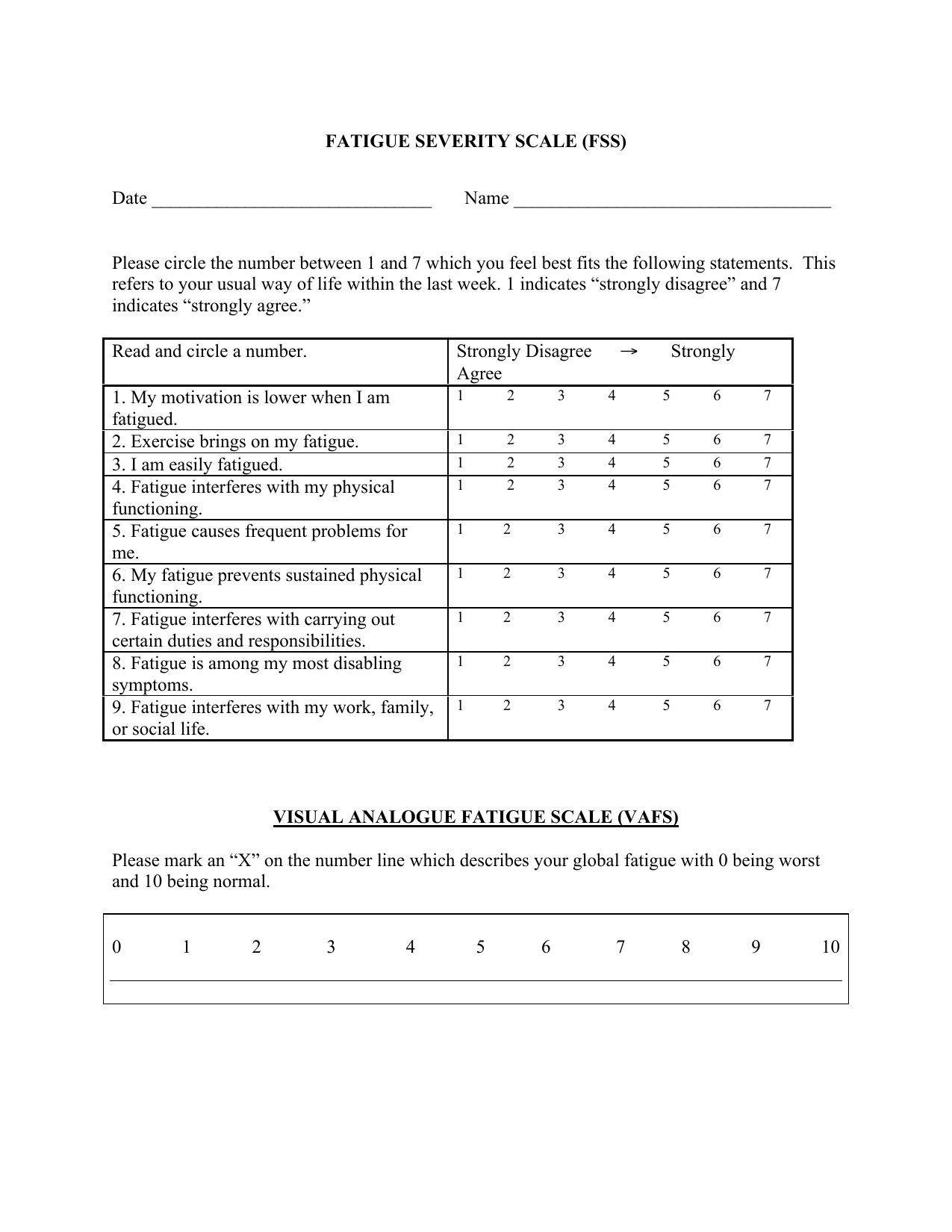
The Fatigue Severity Scale (FSS) is a nine-item questionnaire measuring the impact of fatigue on daily life. This self-report tool helps clinicians understand how tiredness affects a patient's motivation and physical functioning. It's a reliable way to track symptom severity across many chronic medical conditions.
Category
Disease
Source
What is Fatigue Severity Scale (FSS)

The Fatigue Severity Scale (FSS) is a trusted tool for measuring how tiredness impacts daily life. It helps clinicians track energy levels in many patients. This nine-item questionnaire focuses on the physical and social consequences of fatigue. It looks at how being tired stops people from doing their normal tasks. Patients rate their agreement with statements on a seven-point Likert scale. Scores range from one to seven, where higher numbers mean more severe fatigue. This simple scoring method makes it easy to spot changes over time or check if a specific treatment works. Commonly used for conditions like Multiple Sclerosis and Parkinson's disease, the FSS is quick to administer. It takes just a few minutes, making it great for busy clinics. Doctors use the results to adjust therapy plans and support patients who struggle with low energy during their day.
The Fatigue Severity Scale can be scored using one main approach: calculating the mean item score. First, patients rate nine specific statements about how tiredness impacts their routine, using a scale from 1 (strongly disagree) to 7 (strongly agree). You'll add up every response to get a total sum, then divide that figure by nine to find the average. This produces a final score between 1 and 7, where higher numbers indicate worse fatigue severity. Most doctors reckon a score greater than 4 signals clinically significant fatigue that requires further attention in a healthcare setting. It is a handy tool for tracking energy levels over time.
Advantages
.svg)
Provides consistent measurements for clinical research.
.svg)
Streamlines research data gathering process.
.svg)
Applicable across multiple diseases and conditions.
.svg)
Measures healthcare intervention results systematically.
.png)

Related Instruments

Digital counterpart
Digital biomarkers that measure the same thing with sensors rather than a questionnaire.
Collect Fatigue Severity Scale data with WeGuide, the all in one patient engagement platform
.jpg)

Support Your patient in no time - all under your own brand
Our platform combines the knowledge of 100+ digital health solutions built, letting you easily build your patient engagement app for research or clinical use. Collect PROMs, support patients on waiting lists, or gather vital signs data. This is how:
Learn More.png)
Program Builder
.png)
.png)
Whitelabelling
.svg)
.svg)
.png)
Turn on components, dependent on your usecase
.svg)
.png)
Support The Full Journey
.png)
.png)
%20(1).png)
.png)
It’s your turn
Every WeGuide project, saves researchers and clinicians - 9 months and $450,000 - creating impactful digital health solutions.
