


Palliative Performance Scale: Grading Functional Decline
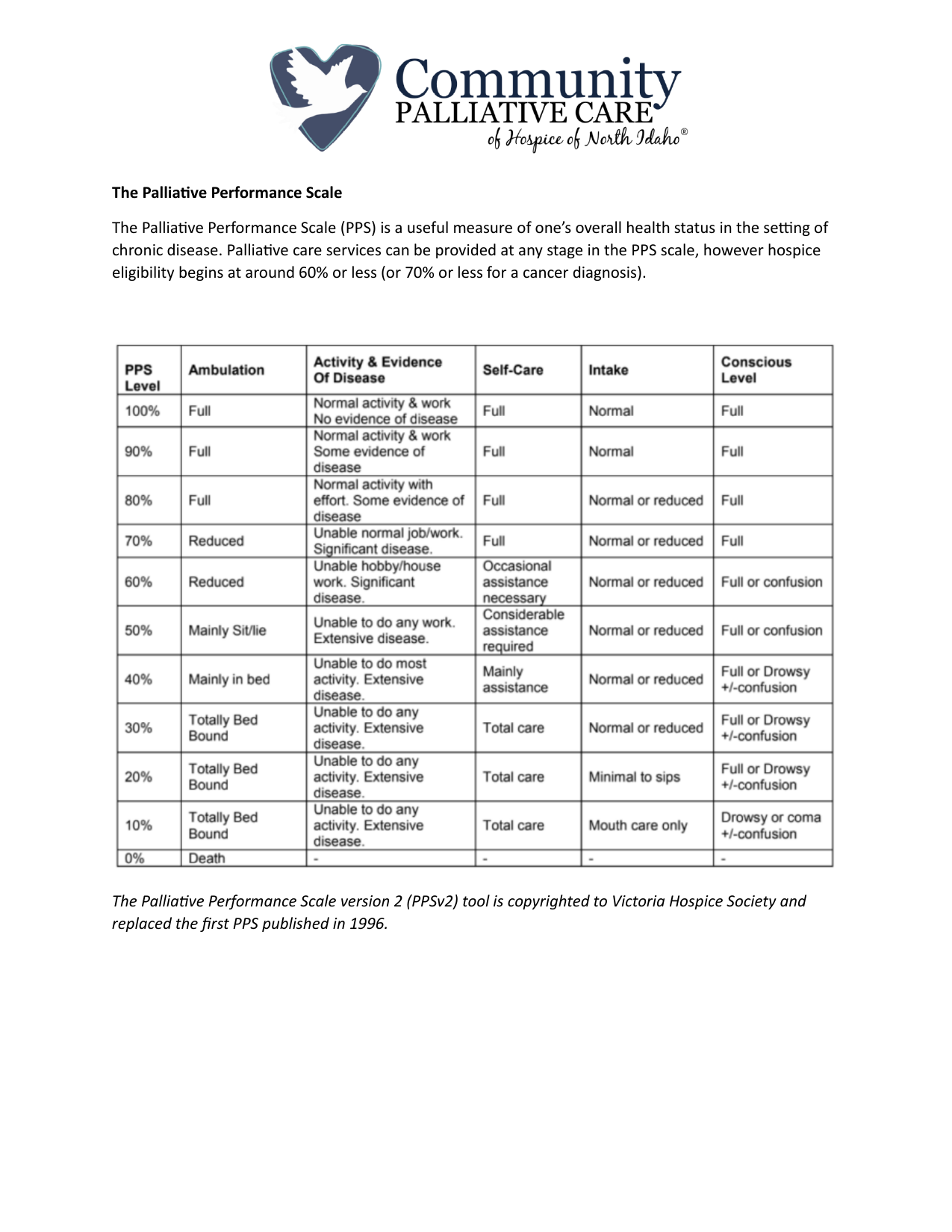
The Palliative Performance Scale grades functional status in palliative care in 10 percent bands, from fully ambulatory down to death.

Palliative Performance Scale (PPS)
The Palliative Performance Scale grades functional status in palliative care across five domains: ambulation, activity and evidence of disease, self-care, intake and level of consciousness. Scores run from 100 percent down to 0 percent in 10 percent steps and are widely used for care planning and eligibility decisions.
Category
Disease
Source
What is the Palliative Performance Scale

The scale reads left to right across five columns: ambulation, activity level and evidence of disease, ability to perform self-care, oral intake and level of consciousness. The assessor starts at the ambulation column, finds the row that fits, then checks the remaining columns and assigns the level that best matches overall. Scores descend in 10 percent steps from 100 percent, meaning full ambulation and normal activity, to 0 percent, meaning death.
It was adapted from the Karnofsky Performance Status specifically for palliative populations, where the Karnofsky's emphasis on work and hospitalisation fits poorly. Its practical value is that a single number communicates a great deal quickly between teams, and that serial scores describe a trajectory. Median survival by PPS band has been published in several cohorts, which is why the score is often used in prognostic conversations.
A single percentage is recorded. Assessment moves left to right, and the leftmost columns take precedence when a person does not fit one row cleanly, which is the rule most often applied inconsistently between assessors.
Two cautions. Survival estimates attached to PPS bands come from specific populations, most often hospice inpatients with cancer, and do not transfer unchanged to other diagnoses or settings; quoting a median survival to a family without that context overstates the precision available. And because the score is used to decide service eligibility in some systems, inter-rater agreement matters practically as well as scientifically, which is an argument for recording the basis of the rating alongside the number.
Advantages
.svg)
Enhances communication between healthcare providers.

Develops personalised strategies based on assessment data.
.svg)
Promotes active participation in healthcare assessment.
.svg)
Monitors clinical data throughout extended study periods.
.png)

Related Instruments

Digital counterpart
Digital biomarkers that measure the same thing with sensors rather than a questionnaire.
Collect Palliative Performance Scale data with WeGuide, the all in one patient engagement platform
.jpg)

Support Your patient in no time - all under your own brand
Our platform combines the knowledge of 100+ digital health solutions built, letting you easily build your patient engagement app for research or clinical use. Collect PROMs, support patients on waiting lists, or gather vital signs data. This is how:
Learn More.png)
Program Builder
.png)
.png)
Whitelabelling
.svg)
.svg)
.png)
Turn on components, dependent on your usecase
.svg)
.png)
Support The Full Journey
.png)
.png)
%20(1).png)
.png)
It’s your turn
Every WeGuide project, saves researchers and clinicians - 9 months and $450,000 - creating impactful digital health solutions.
