


GAD-7: Anxiety Screening and Severity
The GAD-7 scores seven anxiety symptoms over the past two weeks. It was built for generalised anxiety disorder and performs reasonably as a screen for three other anxiety disorders.

Generalised Anxiety Disorder-7 (GAD-7)
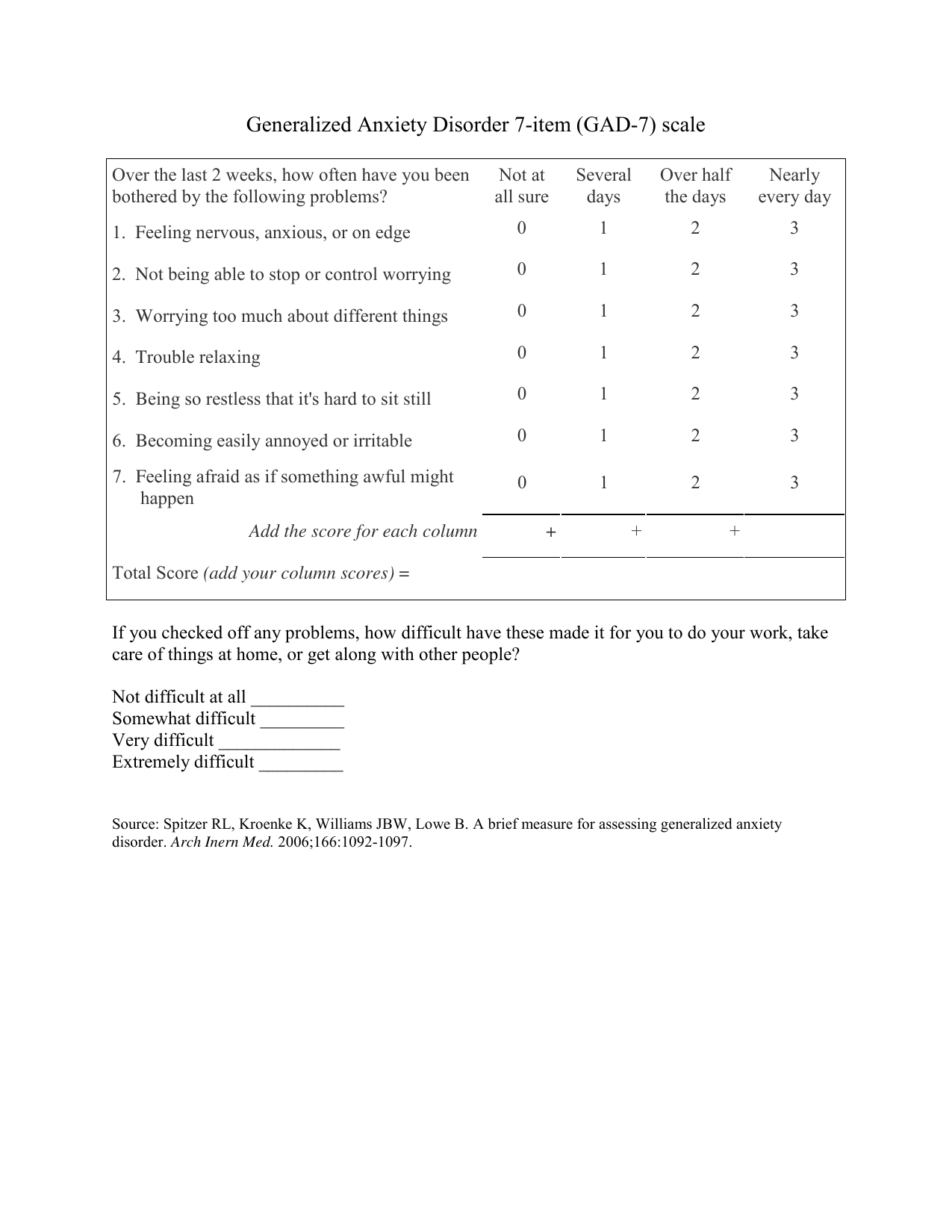
The GAD-7 is a seven item self-report scale measuring anxiety symptoms over the previous two weeks. Developed to identify generalised anxiety disorder, it also has acceptable screening performance for panic disorder, social anxiety disorder and post-traumatic stress disorder, and is free to use.
Category
Disease
Source
What is the GAD-7

The GAD-7 asks how often, over the last two weeks, the person has been bothered by seven symptoms: feeling nervous or on edge, being unable to stop worrying, worrying too much about different things, trouble relaxing, restlessness, irritability, and feeling afraid that something awful might happen. Each scores zero to three for a total out of 21.
It is usually deployed alongside the PHQ-9, and the pairing is deliberate: anxiety and depression co-occur often enough that measuring one without the other gives an incomplete picture. Although it was constructed for generalised anxiety disorder, the original validation reported useful sensitivity and specificity for panic, social anxiety and post-traumatic stress disorder, which is why it is often used as a general anxiety screen rather than a disorder-specific one.
Scores of 5, 10 and 15 mark mild, moderate and severe anxiety. A cut-off of 10 or above is the usual threshold for further assessment. Because the seven items cover worry and tension rather than the full range of anxiety presentations, a low score does not rule out a specific anxiety disorder, and a high score is a reason to assess further rather than a diagnosis.
The instrument is sensitive to change and is commonly used to track treatment response. As with any two week recall measure, the window must stay fixed across timepoints, and self-completed and interviewer-administered versions should not be mixed within a study.
Advantages
.svg)
Measures healthcare intervention results systematically.
.svg)
Streamlines research data gathering process.
.svg)
Quick completion with minimal burden.
.svg)
Provides consistent measurements for clinical research.
.png)

Related Instruments

Digital counterpart
Digital biomarkers that measure the same thing with sensors rather than a questionnaire.
Collect GAD-7 data with WeGuide, the all in one patient engagement platform
.jpg)

Support Your patient in no time - all under your own brand
Our platform combines the knowledge of 100+ digital health solutions built, letting you easily build your patient engagement app for research or clinical use. Collect PROMs, support patients on waiting lists, or gather vital signs data. This is how:
Learn More.png)
Program Builder
.png)
.png)
Whitelabelling
.svg)
.svg)
.png)
Turn on components, dependent on your usecase
.svg)
.png)
Support The Full Journey
.png)
.png)
%20(1).png)
.png)
It’s your turn
Every WeGuide project, saves researchers and clinicians - 9 months and $450,000 - creating impactful digital health solutions.
