


Fagerström Test: Measuring Nicotine Dependence
The Fagerström Test grades how dependent a smoker is on nicotine using six questions about when and how much they smoke.

Fagerström Test for Nicotine Dependence (FTND)
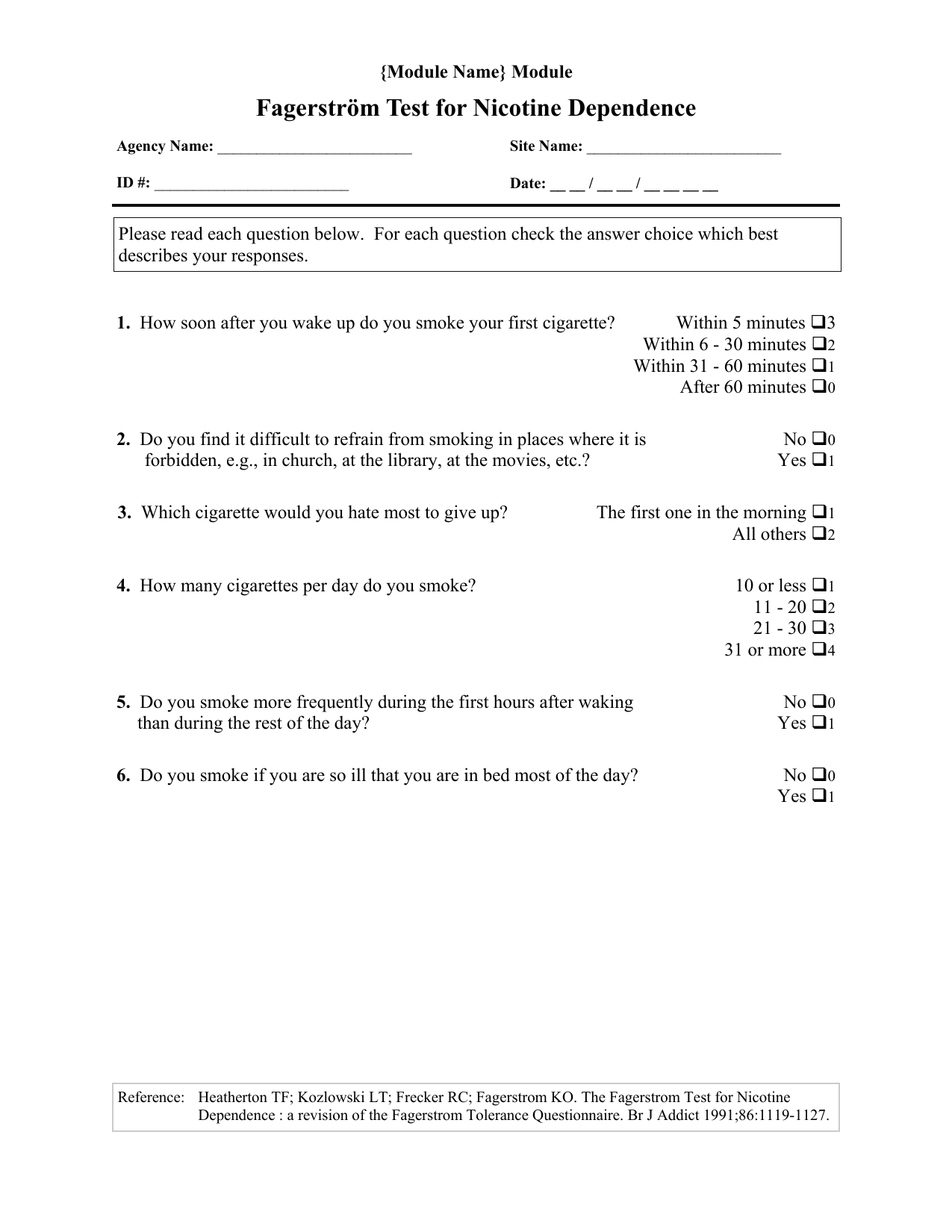
The Fagerström Test for Nicotine Dependence is a six item self-report measure of physical dependence on cigarettes. It asks how soon after waking the person smokes, how many cigarettes they smoke a day and how hard it is to go without, giving a score from 0 to 10. It is widely used to plan cessation treatment and to characterise smokers in research.
Category
Disease
Source
What is the Fagerström Test for Nicotine Dependence

The six questions cover how soon after waking the first cigarette is smoked, whether it is hard to refrain in places where smoking is forbidden, which cigarette would be hardest to give up, how many cigarettes are smoked a day, whether more is smoked in the first hours after waking, and whether the person smokes when ill enough to be in bed. The time to first cigarette and daily cigarette count carry the most points.
Heatherton, Kozlowski, Frecker and Fagerström published it in 1991 as a revision of the older Fagerström Tolerance Questionnaire, dropping items that performed poorly. Those two heaviest items, time to first cigarette and cigarettes per day, carry most of its predictive value, and together they form the Heaviness of Smoking Index, a two question short form. In 2012 Fagerström proposed renaming the test the Fagerström Test for Cigarette Dependence, to reflect that it was built around cigarettes rather than nicotine in general.
Scores range from 0 to 10. Bands vary between sources, but a common scheme treats 0 to 2 as very low dependence, 3 to 4 as low, 5 as medium, 6 to 7 as high and 8 to 10 as very high. Higher scores predict greater difficulty quitting and are used to guide the dose and type of nicotine replacement therapy.
Internal consistency is modest, which reflects that the six items measure related but distinct aspects of smoking behaviour rather than one underlying trait. The test was built for cigarettes and should not be applied unchanged to e-cigarettes, heated tobacco or smokeless products, where the questions about counting and timing do not map onto how the product is used; separate dependence measures exist for e-cigarettes. Studies with mixed product use should record each product separately.
Advantages

Develops personalised strategies based on assessment data.
.svg)
Measures healthcare intervention results systematically.
.svg)
Quick completion with minimal burden.
.svg)
Allow for comparisons between different groups.
.png)

Related Instruments

Digital counterpart
Digital biomarkers that measure the same thing with sensors rather than a questionnaire.
Collect Fagerström Test data with WeGuide, the all in one patient engagement platform
.jpg)

Support Your patient in no time - all under your own brand
Our platform combines the knowledge of 100+ digital health solutions built, letting you easily build your patient engagement app for research or clinical use. Collect PROMs, support patients on waiting lists, or gather vital signs data. This is how:
Learn More.png)
Program Builder
.png)
.png)
Whitelabelling
.svg)
.svg)
.png)
Turn on components, dependent on your usecase
.svg)
.png)
Support The Full Journey
.png)
.png)
%20(1).png)
.png)
It’s your turn
Every WeGuide project, saves researchers and clinicians - 9 months and $450,000 - creating impactful digital health solutions.
