


COWS: Grading Opioid Withdrawal Severity
The COWS grades opioid withdrawal across eleven signs and symptoms. It is most often used to decide when to start buprenorphine.

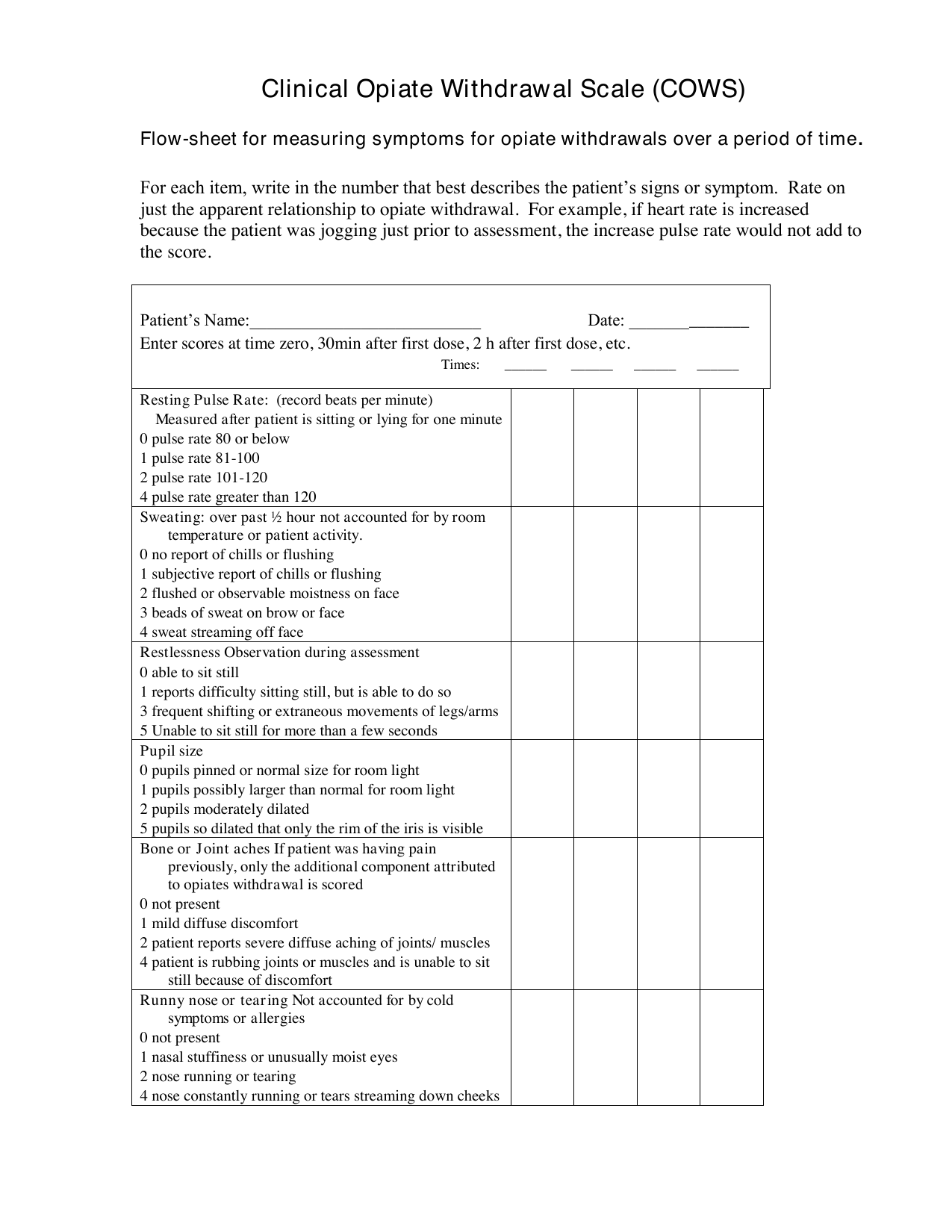
Clinical Opiate Withdrawal Scale (COWS)
The Clinical Opiate Withdrawal Scale is an eleven item clinician-administered scale for rating the signs and symptoms of opioid withdrawal. It scores items such as resting pulse, sweating, pupil size, yawning and gooseflesh, giving a total from 0 to 48. It is repeated over time and is widely used to time the first dose of buprenorphine.
Category
Disease
Source
What is the Clinical Opiate Withdrawal Scale

The eleven items are resting pulse rate, sweating, restlessness, pupil size, bone or joint aches, runny nose or tearing, gastrointestinal upset, tremor, yawning, anxiety or irritability, and gooseflesh skin. Each has its own anchored range. Several are objective observations, pulse, pupils, sweating and gooseflesh among them, which makes the scale less dependent on self-report than purely subjective withdrawal measures.
Wesson and Ling described it in 2003, and it has become the standard tool for starting buprenorphine. Buprenorphine given while a person still has a full opioid agonist on their receptors can cause precipitated withdrawal, which is sudden and severe; waiting until withdrawal is objectively present lowers that risk. The original paper describes the scale rather than reporting a full psychometric validation, and later work has compared it with other withdrawal measures.
Item scores are summed for a total from 0 to 48. Totals of 5 to 12 are rated mild, 13 to 24 moderate, 25 to 36 moderately severe and more than 36 severe withdrawal. Buprenorphine induction protocols commonly wait for a score of around 8 to 12 before the first dose, though the exact threshold is set locally.
The spread of fentanyl in the illicit drug supply has changed how the score should be read. Because fentanyl accumulates in body fat, precipitated withdrawal can occur even at scores that were traditionally considered safe for induction, and many services now use low dose induction approaches that do not depend on reaching a threshold. Pulse and pupil items are also affected by other drugs, pain and anxiety, so the total should be read alongside the clinical picture rather than as a standalone trigger.
Advantages

Develops personalised strategies based on assessment data.
.svg)
Minimizes mistakes in clinical data collection.
.svg)
Maintains uniform healthcare delivery standards.
.svg)
Enhances communication between healthcare providers.
.png)

Related Instruments

Digital counterpart
Digital biomarkers that measure the same thing with sensors rather than a questionnaire.
Collect COWS data with WeGuide, the all in one patient engagement platform
.jpg)

Support Your patient in no time - all under your own brand
Our platform combines the knowledge of 100+ digital health solutions built, letting you easily build your patient engagement app for research or clinical use. Collect PROMs, support patients on waiting lists, or gather vital signs data. This is how:
Learn More.png)
Program Builder
.png)
.png)
Whitelabelling
.svg)
.svg)
.png)
Turn on components, dependent on your usecase
.svg)
.png)
Support The Full Journey
.png)
.png)
%20(1).png)
.png)
It’s your turn
Every WeGuide project, saves researchers and clinicians - 9 months and $450,000 - creating impactful digital health solutions.
