


AUDIT-C: Three Question Alcohol Screening
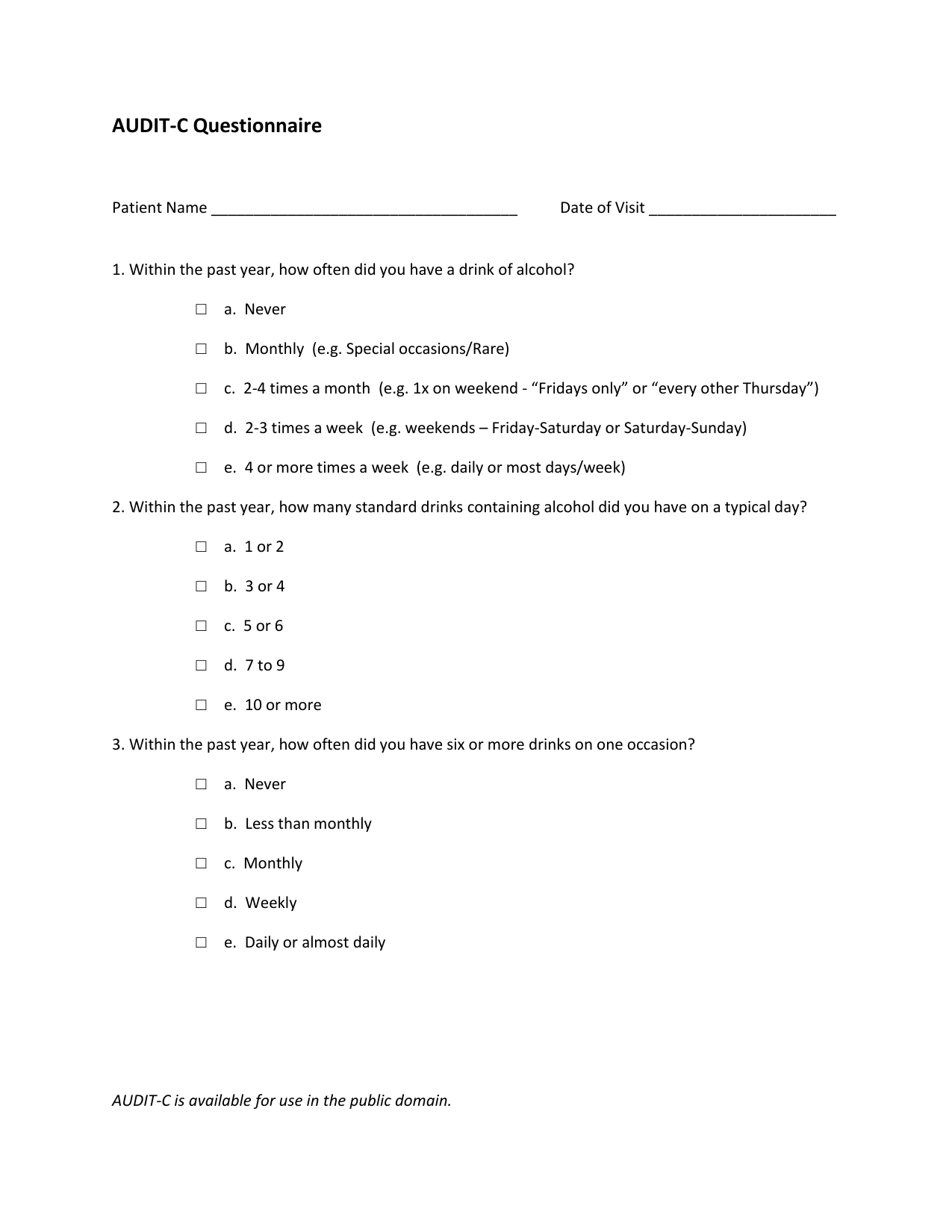
The AUDIT-C uses the three consumption questions from the full AUDIT to screen for hazardous drinking in under a minute.

Alcohol Use Disorders Identification Test-Consumption (AUDIT-C)
The AUDIT-C is a three item alcohol screening questionnaire made up of the consumption questions from the ten item Alcohol Use Disorders Identification Test. It asks how often a person drinks, how much they drink on a typical day, and how often they have six or more drinks on one occasion, giving a score from 0 to 12. It is in the public domain.
Category
Disease
Source
What is the AUDIT-C

The three questions cover drinking frequency over the past year, the number of standard drinks on a typical drinking day, and how often the person has six or more drinks on a single occasion. Each is scored from 0 to 4. The full AUDIT adds seven questions about dependence and alcohol related harm; the AUDIT-C keeps only consumption, which is what makes it short enough for routine use in primary care and at scale in research.
Bush and colleagues showed in 1998 that the three consumption questions alone identified heavy drinking and active alcohol use disorders about as well as the full ten item test in their population. It has since become one of the most widely used alcohol screens, including as the standard annual screen in the United States Veterans Health Administration. A positive result is a prompt for a conversation or the full AUDIT, not a diagnosis.
Scores range from 0 to 12. The most widely used thresholds are 4 or more for men and 3 or more for women, reflecting differences in how alcohol is metabolised. Higher scores indicate greater risk, and scores of 8 or above are often used to flag a high likelihood of an alcohol use disorder. When the whole score comes from the frequency question alone, with zero on the other two, the person is usually drinking within recommended limits and the result should be interpreted with that in mind.
The second question depends on what counts as a standard drink, and that differs between countries: roughly 14 grams of alcohol in the United States, 10 grams in Australia and 8 grams for a United Kingdom unit. A study running across countries needs one definition shown to every participant, ideally with pictures of common drinks, or the same answer will mean different amounts of alcohol in different places.
Advantages
.svg)
Streamlines research data gathering process.
.svg)
Quick completion with minimal burden.
.svg)
Identifies health issues during initial stages.
.svg)
Meets international clinical assessment requirements.
.png)

Related Instruments

Digital counterpart
Digital biomarkers that measure the same thing with sensors rather than a questionnaire.
Collect AUDIT-C data with WeGuide, the all in one patient engagement platform
.jpg)

Support Your patient in no time - all under your own brand
Our platform combines the knowledge of 100+ digital health solutions built, letting you easily build your patient engagement app for research or clinical use. Collect PROMs, support patients on waiting lists, or gather vital signs data. This is how:
Learn More.png)
Program Builder
.png)
.png)
Whitelabelling
.svg)
.svg)
.png)
Turn on components, dependent on your usecase
.svg)
.png)
Support The Full Journey
.png)
.png)
%20(1).png)
.png)
It’s your turn
Every WeGuide project, saves researchers and clinicians - 9 months and $450,000 - creating impactful digital health solutions.
