


DASH-Work: Assessing Upper Limb Work Ability
This self-report tool measures how arm, shoulder, or hand problems impact a person's ability to work. It helps clinicians track job performance and recovery progress during rehabilitation.


Disabilities of the Arm, Shoulder and Hand - Work Module (DASH-Work)
The DASH-Work module is an optional four-item survey assessing how upper-limb issues impact a patient's job performance. It's a practical tool for measuring occupational disability in arm, shoulder, and hand injuries. Clinicians use the score to monitor recovery and guide return-to-work decisions.
Category
Disease
Source
What is Disabilities of the Arm, Shoulder and Hand - Work Module (DASH-Work)

The Disabilities of the Arm, Shoulder and Hand - Work Module (DASH-Work) helps clinicians assess how upper limb issues affect job performance. This optional four-item scale sits alongside the main DASH survey to zoom in on specific occupational challenges facing workers managing arm, shoulder or hand injuries. It asks patients to rate difficulty maintaining their usual work technique and productivity levels. Responses use a simple one to five Likert scale, which converts into a score out of one hundred where higher numbers mean more trouble handling the job. Clinicians find it handy for tracking return to work progress or deciding if duties need changing. It is self-administered and quick to finish, making it easy to fit into busy clinic schedules. This tool gives you clear data to support decisions about vocational rehabilitation or necessary modified duties.
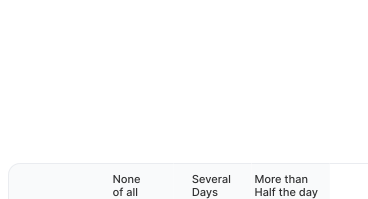
The DASH Work Module can be scored using a standard formula that turns raw answers into a clear percentage. First, patients rate four specific items from 1 for no difficulty to 5 for unable. You must answer every single question to get a valid result. To calculate, add up the assigned values, divide by four, take away one, then multiply by 25. This gives a final score ranging from 0 to 100. A higher number points to greater disability in your job tasks. It is a handy way for clinicians to track how upper limb injuries impact daily work life.
Advantages
.svg)
Measures healthcare intervention results systematically.
.svg)
Applicable across multiple diseases and conditions.
.svg)
Streamlines research data gathering process.
.svg)
Provides consistent measurements for clinical research.
.png)

Related Instruments

Digital counterpart
Digital biomarkers that measure the same thing with sensors rather than a questionnaire.
Collect DASH-Work data with WeGuide, the all in one patient engagement platform
.jpg)

Support Your patient in no time - all under your own brand
Our platform combines the knowledge of 100+ digital health solutions built, letting you easily build your patient engagement app for research or clinical use. Collect PROMs, support patients on waiting lists, or gather vital signs data. This is how:
Learn More.png)
Program Builder
.png)
.png)
Whitelabelling
.svg)
.svg)
.png)
Turn on components, dependent on your usecase
.svg)
.png)
Support The Full Journey
.png)
.png)
%20(1).png)
.png)
It’s your turn
Every WeGuide project, saves researchers and clinicians - 9 months and $450,000 - creating impactful digital health solutions.
