


Disabilities of the Arm, Shoulder and Hand (DASH)
The DASH is a self-report survey measuring physical function and symptoms in the upper limbs. It helps clinicians track recovery for patients with arm, shoulder, and hand conditions.


Disabilities of the Arm, Shoulder and Hand Questionnaire (DASH)
The Disabilities of the Arm, Shoulder and Hand Questionnaire (DASH) is a 30-item self-report tool measuring physical function and symptoms in upper limb disorders. It helps clinicians track recovery and assess how well a patient performs daily tasks, making it a key resource for accurate orthopaedic assessments.
Category
Disease
Source
What is Disabilities of the Arm, Shoulder and Hand Questionnaire (DASH)

The Disabilities of the Arm, Shoulder and Hand Questionnaire (DASH) is a trusted outcome measure for assessing upper limb function and tracking recovery. This 30-item self-report survey treats the whole arm as a single functional unit. It covers a broad range of musculoskeletal conditions and injuries effectively across the upper extremity. Patients rate their ability to perform daily tasks plus the severity of symptoms like pain or tingling. They use a simple five-point scale ranging from no difficulty to unable to perform the activity. These scores are then converted to a scale out of one hundred to show disability levels. Clinicians can also use optional modules for work or sports to get a clearer picture of specific demands. It is great for monitoring changes over time in clinical settings. The DASH helps you understand the impact of treatment on a patient's daily life and guides better care decisions.
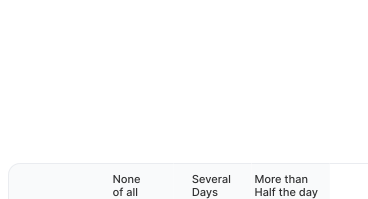
The Disabilities of the Arm, Shoulder and Hand Questionnaire (DASH) is scored using a standard calculation method. You assign values from 1 to 5 for the 30 items, where 1 means no difficulty and 5 means unable to do the task. To get the Disability/Symptom score, sum the responses, subtract 30, and divide by 1.20. This gives a result between 0 and 100, where higher numbers mean more disability. You need at least 27 answers to make the maths work. Optional work or sports modules are scored separately to help clinicians track specific functional limits.
Advantages
.svg)
Applicable across multiple diseases and conditions.
.svg)
Measures healthcare intervention results systematically.
.svg)
Strengthens evidence through systematic measurement approaches.
.svg)
Meets international clinical assessment requirements.
.png)

Related Instruments

Digital counterpart
Digital biomarkers that measure the same thing with sensors rather than a questionnaire.
Collect DASH data with WeGuide, the all in one patient engagement platform
.jpg)

Support Your patient in no time - all under your own brand
Our platform combines the knowledge of 100+ digital health solutions built, letting you easily build your patient engagement app for research or clinical use. Collect PROMs, support patients on waiting lists, or gather vital signs data. This is how:
Learn More.png)
Program Builder
.png)
.png)
Whitelabelling
.svg)
.svg)
.png)
Turn on components, dependent on your usecase
.svg)
.png)
Support The Full Journey
.png)
.png)
%20(1).png)
.png)
It’s your turn
Every WeGuide project, saves researchers and clinicians - 9 months and $450,000 - creating impactful digital health solutions.
