


The Columbia Suicide Severity Rating Scale (C-SSRS)
The C-SSRS helps clinicians identify suicide risk by assessing the severity of thoughts and behaviours. This evidence-based tool supports safety planning in clinical and research settings.

Columbia Suicide Severity Rating Scale (C-SSRS)
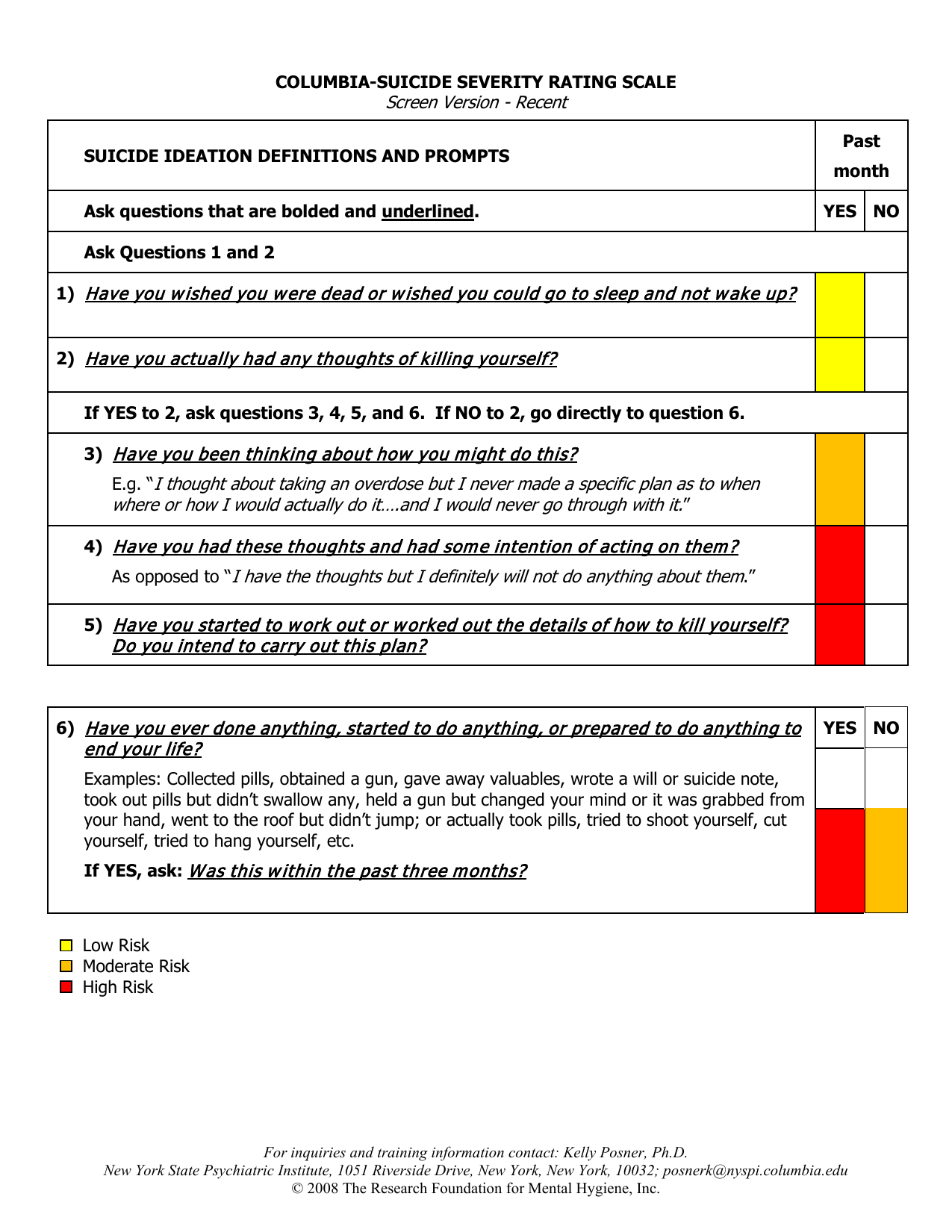
The Columbia Suicide Severity Rating Scale, or C-SSRS, assesses suicidal ideation and behaviour to determine risk levels. This questionnaire supports clinicians in identifying at-risk patients and planning appropriate care. It’s a standard tool for ensuring safety in clinical settings.
Category
Disease
Source
What is Columbia Suicide Severity Rating Scale (C-SSRS)

The Columbia Suicide Severity Rating Scale (C-SSRS) is a key tool for checking suicide risk. It helps clinicians spot warning signs early on. This scale cleverly separates suicidal ideation from actual behaviour. It uses a series of simple questions to track if a person has thoughts about self-harm. It looks at the severity of thoughts and the intensity of those feelings. The tool rates how specific the plan is and if there is any intent to act on it. This helps professionals understand the immediate danger level clearly without any guessing. You can use it in many settings like hospitals or schools because it requires no special mental health training. It works well for first responders who need quick answers. The evidence supports its use across different age groups. This makes it a practical choice for keeping people safe in daily practice.
The Columbia Suicide Severity Rating Scale can be scored using a categorical severity rating system. It assesses two key areas: Suicidal Ideation and Suicidal Behaviour. For ideation, items range from 1 to 5, getting more serious as you go. A "Yes" to questions 4 or 5 signals immediate risk. The behaviour section tracks actual attempts or preparatory acts. Instead of a single total, clinicians use the most severe endorsed item to triage care. There is also an intensity subscale that sums points for frequency and duration, helping you spot changes over time.
Advantages

Enables precise identification of patient health status.
.svg)
Meets international clinical assessment requirements.
.svg)
Serves diverse clinical needs effectively.
.png)

Related Instruments

Digital counterpart
Digital biomarkers that measure the same thing with sensors rather than a questionnaire.
Collect C-SSRS data with WeGuide, the all-in-one patient engagement platform
.jpg)

Support Your patient in no time - all under your own brand
Our platform combines the knowledge of 100+ digital health solutions built, letting you easily build your patient engagement app for research or clinical use. Collect PROMs, support patients on waiting lists, or gather vital signs data. This is how:
Learn More.png)
Program Builder
.png)
.png)
Whitelabelling
.svg)
.svg)
.png)
Turn on components, dependent on your usecase
.svg)
.png)
Support The Full Journey
.png)
.png)
%20(1).png)
.png)
It’s your turn
Every WeGuide project, saves researchers and clinicians - 9 months and $450,000 - creating impactful digital health solutions.
