

.svg)
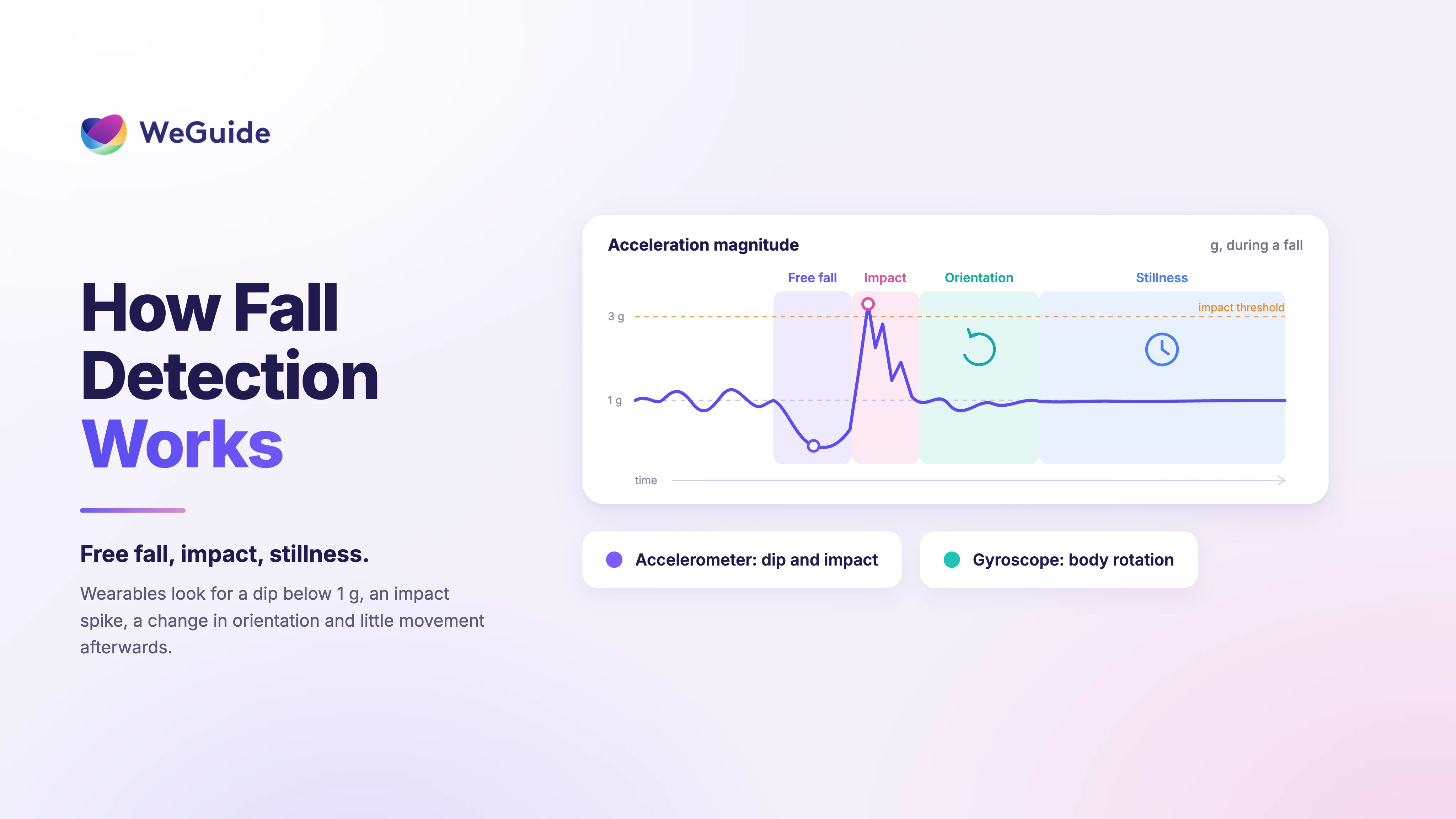


Fall detection works by watching accelerometer data, and often gyroscope data, for the signature of a fall. That signature is a brief drop below 1 g as the body loses support, a sharp spike when it hits the ground, a change in orientation, and then little or no movement. A threshold rule or a machine learning model decides whether the pattern is a fall, and the device raises an alert and calls for help if the person doesn't respond.
That description makes fall detection sound solved. It isn't. Algorithms that score highly on falls staged by young volunteers in a lab lose much of their accuracy on real falls in older adults, and every extra point of sensitivity costs false alarms. For a study team, the gap between those two settings decides whether a wearable can count falls, flag them for follow up, or only provide context.
This guide covers the signal, the algorithms, sensor placement, real world accuracy, consumer watches, and how trials count falls.
Key Takeaways
- A fall has a recognisable signature. Algorithms look for a dip below 1 g, an impact peak (published impact thresholds range from about 2 g to 3.5 g), an orientation change, and stillness. Gyroscopes add the rotation of the body as it falls.
- Lab accuracy collapses on real falls. Thirteen published algorithms averaged 57% sensitivity on 29 real world falls, mostly from people with progressive supranuclear palsy, and produced up to 85 false alarms per faller in one day of monitoring.
- Even 99.5% specificity is not enough. On 143 real falls, the best machine learning model still raised 0.56 false alarms per hour, roughly nine across a 16 hour waking day by our arithmetic.
- The wrist is the hardest place to detect a fall. One systematic review reported median sensitivity of 97.5% for trunk worn systems against 81.5% for systems on the arm, hand, ear, or foot.
- Trials still count falls with diaries. None of the Apple, Samsung, Google, or Garmin fall detection features is FDA cleared, and the accepted method remains prospective daily recording with at least monthly reporting. Sensors can complement a diary, not replace it.
How Does Fall Detection Work? The Signal of a Fall
A fall happens fast, but it leaves a pattern in motion data that is quite consistent. Researchers in the European FARSEEING consortium, who built the largest archive of sensor recorded real falls, describe five phases: a pre fall phase, a falling phase, an impact phase, a resting phase, and a recovery phase (Becker 2012).
Most wearable algorithms start from the acceleration magnitude, the combined size of the acceleration on all three axes. At rest it reads about 1 g, which is gravity. Using the magnitude rather than single axes means the result depends less on exactly how the sensor sits on the body (Bagalà 2012).
The features algorithms look for
| Phase | What the sensor sees | Published threshold examples |
|---|---|---|
| Falling | A dip below 1 g as support is lost and the body accelerates toward the ground | Start of a fall below 0.6 g in the Kangas algorithms, and a lower threshold of 0.41 g at the trunk in Bourke's lab work (Bagalà 2012) |
| Impact | A sharp peak as the body hits the ground | 3.52 g at the trunk in Bourke's 2007 lab study, 2.8 g in his 2010 work, and 2 g in a real world algorithm by Kangas (Bagalà 2012 and Palmerini 2020) |
| Timing | The dip and the impact happen close together | Impact within 1 second of the start of the fall in the Kangas algorithms (Bagalà 2012) |
| Descent speed | Vertical velocity, worked out by integrating acceleration | Faster than 0.7 m/s downward in Bourke's 2010 algorithm (Bagalà 2012) |
| Resting | The body ends up horizontal and still | Trunk angle above 60 degrees for more than 75% of the period from 1 to 3 seconds after impact in Bourke's 2010 algorithm (Bagalà 2012) |
| Rotation | Angular velocity from a gyroscope as the trunk tips over | Angular velocity above 3.1 rad/s (about 178 degrees per second) at the trunk (Bourke and Lyons 2008) |
Consumer devices add a final stage that research algorithms usually leave out: they wait for the person to stay still, then count down before calling for help. That waiting period trades speed for fewer false calls.
What the gyroscope adds
An accelerometer measures linear acceleration. A gyroscope measures rotation. During a fall the trunk rotates quickly, and that rotation is one of the clearest differences between a fall and a hard sit down.
In a lab study, three gyroscope thresholds on angular velocity, angular acceleration, and change in trunk angle separated falls from daily activities perfectly across 480 movements (Bourke and Lyons 2008). Those falls were simulated by young volunteers onto crash mats, so the number shows what the signal can do, not how a device performs in daily life.
The pairing is common in practice. An umbrella review of fall detection research counted 20 studies combining accelerometer and gyroscope, against 43 that used an accelerometer alone (Warrington 2021). Apple says its watch uses an accelerometer and gyroscope and detects falls by "analyzing wrist trajectory and impact acceleration" (Apple Newsroom, 2018).
Fall Detection Algorithms: Thresholds, Machine Learning, and Deep Learning
Every fall detection system has to turn those signals into a yes or no. There are three main ways to do it, plus two specialised variants.
Threshold algorithms
Threshold algorithms chain fixed cut offs: did the magnitude dip below a value, then spike above another value within a set time, then settle into a lying posture? The best known early work by Bourke and colleagues found that a single threshold on trunk acceleration could separate falls from daily activities in a lab set of 480 movements (Bourke 2007). A later version combining velocity, impact, and posture reached 100% sensitivity and specificity in the lab. It produced about 0.6 false alarms per waking day during unscripted activity by healthy older adults (Bourke 2010).
Thresholds are cheap. They need almost no computing power or memory, which suits a microcontroller or a watch, and anyone can explain why an alarm fired. Their weakness is that the cut offs are usually tuned on simulated falls, and every research group picks different ones (Bagalà 2012).
Fall detection with machine learning
Machine learning approaches cut the signal into windows, usually centred on the impact peak. They calculate features such as the maximum, minimum, and spread of acceleration, and train a classifier such as a support vector machine or random forest.
One of the strongest real world results comes from a model trained and tested on 143 real falls from 40 people, the largest such collection at the time: it reached 81.1% sensitivity and 99.5% specificity (Palmerini 2020). Features built around the phases of a fall beat conventional features with every classifier tested. Two of the authors cofounded and own shares in a digital health company, which the paper discloses.
Deep learning
Deep learning models such as convolutional and recurrent neural networks learn their own features from raw windows of data. They score highly on the dataset they were built for and less well elsewhere. A study testing one convolutional network across several public datasets found it hard to carry an architecture "configured and optimized for a particular dataset" to other test sets (Casilari 2020).
Models trained and tested on a single small dataset give "overoptimistic classification rates" and do not generalise to real life. That is why one 2024 study pooled three wrist datasets with more than 1,300 falls, reaching 90.6% recall and 96.9% specificity (Fula 2024).
Sensor fusion and pre impact detection
Adding sensors can help. A barometer measures air pressure, which changes with height, so it can confirm that the body ended up lower than it started. In a lab study with 20 young volunteers, adding barometric pressure to waist accelerometry raised sensitivity from 75% to 97.5% and specificity from 91.5% to 96.5% (Bianchi 2010).
Pre impact detection goes a step further and tries to recognise the fall while the person is still descending, so a protective device can act before impact. A lab system using torso and thigh sensors detected falls an average of 700 milliseconds before impact (Nyan 2008).
In April 2025 the FDA granted a De Novo request for the Tango Belt (FDA DEN240021). It is a prescription belt that detects a hip impacting fall in progress and inflates an airbag. It is a hip injury prevention device, not a general fall detector, but its De Novo created a new Class II device type for wearables that detect a fall and act on it.
Wearable Fall Detection: Why Sensor Placement Matters
Where the sensor sits has a large effect on accuracy. The trunk and lower back sit close to the body's centre of mass, so a fall produces a clean signal there. The wrist moves on its own all day.
| Placement | What the evidence shows |
|---|---|
| Waist or lower back | Best of six body sites in a lab comparison, at 99.96% sensitivity (Özdemir 2016). 72% of the real world falls in the FARSEEING archive were recorded at the lower back (Klenk 2016) |
| Trunk or chest | Median sensitivity 97.5% and specificity 96.9% across reviewed systems, from a 2014 systematic review (Chaudhuri 2014, as tabulated in Warrington 2021) |
| Head | 97% to 98% sensitivity on intentional falls by three middle aged volunteers, but with clear usability and acceptance limits (Kangas 2008) |
| Wrist | "The wrist did not appear to be an applicable site" in the same early comparison (Kangas 2008). Systems on the arm, hand, ear, or foot reached a median 81.5% sensitivity and 83% specificity in the same 2014 review (Chaudhuri 2014) |
| Several sensors | Median sensitivity 93.4% and specificity 99.8% in the same review (Chaudhuri 2014) |
| Smartphone | Placement varies between pocket, bag, and table, many phone datasets clip at 2 g, and sampling rates range from about 7 Hz to 200 Hz by model (Casilari 2017) |
The wrist is hard for two reasons. In daily life it produces sharp peaks from gestures, clapping, or dropping a hand on a table, which look like impacts. During a real fall the arm may brace, swing, or get trapped, so the wrist's path varies from one fall to the next (González-Cañete 2021).
Consumer devices still use the wrist because that is where people wear a watch all day. Our guide to consumer wearables in clinical research covers the wider trade offs.
Lab vs Real World: Why Fall Detection Accuracy Drops
Most fall detection research is built on falls that never happened to anyone at risk. In public datasets, the volunteers are mostly young adults with a mean age below 30, falling onto mats, because asking older people to fall is unsafe (Casilari 2017). The 2014 review found that only 7.1% of wearable fall detection projects reported monitoring older adults in a real world setting (Chaudhuri 2014).
What happened when algorithms met real falls
The clearest test came when Bagalà and colleagues ran 13 published algorithms, all reporting high accuracy in the lab, on 29 real world falls recorded with a lower back sensor (Bagalà 2012). Average sensitivity was 57%, with the best at 82.8%. Average specificity was 83%.
Over one day of monitoring, false alarms per faller ranged from 3 to 85. Even the best algorithm was right fewer than four times in ten when it raised an alarm.
The reasons are instructive. Real falls were gentler and messier than staged ones. To catch all 29, the authors had to lower the lab impact threshold from 3.52 g to 1.79 g, which wrecked specificity.
Many people never ended up lying flat: they landed on their knees, their buttocks, or against furniture, which defeated posture checks. And the more conditions an algorithm chained together, the less likely it was to fire. One caveat matters here: most of those falls came from people with progressive supranuclear palsy, so they are not typical older adult falls.
External validation tells the same story. A threshold algorithm that detected 80% of real falls in its own long term study (Kangas 2015) reached 30.1% sensitivity when tested on the FARSEEING falls (Palmerini 2020). And in a four month pilot with older adults, a commercial device with manufacturer reported sensitivity above 94% raised 84 alarms, 83 of them false. It detected one of the four falls that happened while it was worn (Chaudhuri 2015).
The datasets behind fall detection research
| Dataset | What it contains | Sensors and sampling |
|---|---|---|
| FARSEEING | 208 verified real world falls from 94 people with a mean age of 76 | Lower back or thigh, mostly 100 Hz (Klenk 2016) |
| SisFall | Simulated falls by 23 young adults, daily activities by 14 people over 62 | Waist device with accelerometers and gyroscope at 200 Hz (Sucerquia 2017) |
| KFall | 15 simulated fall types by 32 young adults, with video synchronised fall onset labels for pre impact work | Lower back sensor at 100 Hz (Yu 2021) |
| MobiAct and UMAFall | Smartphone based simulated falls and daily activities | Phones and external sensors, reviewed in Casilari 2017 |
Why 99% specificity is not good enough
Falls are rare, and a wearable is watching thousands of ordinary movements for every fall. That makes specificity a misleading number on its own.
In the Palmerini study, one model with 95.5% specificity raised 5.23 false alarms per hour. The best model, at 99.5% specificity, raised 0.56 per hour, and only about half of its alarms were real falls (Palmerini 2020). On our own arithmetic, 0.56 false alarms an hour over a 16 hour waking day is roughly nine false alarms per participant per day.
The same paper shows the trade off directly. Cutting false alarms to about one every 20 monitored hours meant detecting only about one fall in two. This is why a scoping review of real world evaluation recommends sensitivity, precision, and F measure rather than specificity and accuracy (Broadley 2018), and why Palmerini's team argues that false alarm rates should be reported as well.
Count falls the way trials do, then add sensor data
Run fall calendars, monthly fall reports, and follow up questionnaires in the same participant app that collects wearable data.
How Apple, Samsung, Google, and Garmin Detect Falls
Consumer watches have brought fall detection to millions of wrists. For a study team, the key facts are what each feature does, what it records, and what it is not.
| Platform | How it works and what it records | Default and response |
|---|---|---|
| Apple Watch (SE, Series 4 or later, Ultra) | Accelerometer and gyroscope, analysing wrist trajectory and impact. Falls are recorded in the Health app unless the user says they didn't fall | On automatically for users aged 55 and over. Waits about a minute of stillness, then a 30 second countdown before calling emergency services (Apple Support) |
| Samsung Galaxy Watch | Hard fall detection on Galaxy Watch Active2, Watch3, and Wear OS models. Samsung does not name the sensors (Samsung US) | Off by default. Alerts for 60 seconds, then sends an SOS message with location (Samsung UK) |
| Google Pixel Watch | Google says its model looks for how the arms move on the way down and the impact force (Google) | Waits about 30 seconds, then calls emergency services after 60 seconds without a response (Pixel Watch Help) |
| Garmin | Incident detection during certain outdoor activities, and since September 2026 all day fall detection on Venu 4 (Garmin) | Sends the wearer's location to preset contacts and does not call emergency services. All day mode reduces battery life |
None of these is a cleared measurement
Apple, Samsung, and Google each say their feature can't detect all falls and that high impact activity can trigger it.
More importantly for research, none of Apple, Samsung, Google, or Garmin has an FDA 510(k) or De Novo record for fall detection, according to the FDA's device databases. These are safety features. Apple has not published sensitivity or false alarm data, and the only independent peer reviewed test of Apple Watch fall detection we found reported 4.7% sensitivity for staged falls from a wheelchair (Abou 2022). Our guides to Apple Watch, Samsung Galaxy Watch, and Garmin CIRQA in clinical research cover what each platform can deliver for a study.
What a research app receives
The data a study receives is filtered. Apple's HealthKit records a fall only when "the person who fell confirmed the fall, or the system escalated the fall to emergency services." If the person dismisses the alert, no fall is stored (Apple Developer).
A separate Core Motion interface, CMFallDetectionManager, reports every fall event, including dismissed ones, but it needs a special entitlement from Apple. A HealthKit fall count is therefore a count of falls the participant confirmed or could not respond to, not a log of everything the watch detected.
Falls as an Outcome in Clinical Trials
Falls are one of the most common outcomes in trials of older adults, and the method for counting them is well established. The Prevention of Falls Network Europe (ProFaNE) consensus defines a fall as "an unexpected event in which the participants come to rest on the ground, floor, or lower level." It recommends prospective daily recording with a notification system and at least monthly reporting (Lamb 2005). Of 32 fall prevention trials that cited ProFaNE and reported falls, 81% used daily prospective recording (Copsey 2016).
Daily recording exists because memory is unreliable. Between 13% and 32% of older people with a confirmed fall did not recall it when asked months later (Cummings 1988). Many falls also go unwitnessed: in a study of people over 90, 82% of falls happened when the person was alone, and 30% of fallers spent an hour or more on the floor after at least one fall (Fleming 2008).
Where wearable detection fits
Sensors can fill some of the gaps a diary leaves:
- Prompting a report. A detected event can trigger a fall questionnaire in the study app, so fewer falls go unrecorded.
- Adding a timestamp and context. The sensor record shows when the fall happened and what the participant was doing before it.
- Capturing the resting phase. How long someone stayed on the floor is something a diary can't measure well.
- Supporting participants who forget. Participants with lower cognitive scores forget more falls (Cummings 1988), so they may gain the most from a sensor prompt.
For research use, Palmerini and colleagues note that a team would choose maximum sensitivity, "since positive signals are typically verified or falsified by phone calls from research staff" (Palmerini 2020). That is the realistic model today: the sensor flags, a person confirms.
Why sensor detected falls aren't a primary endpoint yet
Several problems stand between a wearable fall count and a primary endpoint:
- Sensitivity in the target population is unproven for most devices, and published real world figures are modest.
- False alarms outnumber real falls, so every alert needs confirmation.
- Falls happen when the device is off. In one pilot, eight falls occurred while participants weren't wearing the device, half of them while it was charging (Chaudhuri 2015).
- Consumer algorithms change with software updates. Apple, for example, retuned its fall detection for workouts in watchOS 8, and FDA guidance recommends that sponsors record the timing and nature of any device updates during a trial (FDA DHT guidance).
- No wearable fall count has regulatory qualification that we could find. The World Guidelines for Falls Prevention state that current evidence does not support the use of wearables for falls prevention (Montero-Odasso 2022).
Our guide to digital endpoints in clinical trials explains the qualification route, and our fall detection biomarker profile summarises the measure's current evidence maturity.
Fall risk is a different question
Fall detection catches the event. Fall risk tools estimate who is likely to fall, and fall outcomes count what happened. Most studies need all three layers: a risk measure at baseline to describe or stratify participants, a fall outcome, and optionally a sensor.
- STRATIFY and the Morse Fall Scale score inpatient fall risk, but performance "varies considerably depending on the population and the environment" (Aranda-Gallardo 2013). The World Guidelines recommend against using scored risk screening tools in hospitals for multifactorial assessment, so in a study they work best as descriptors rather than decision tools.
- The Falls Efficacy Scale International measures concern about falling, and was developed by the ProFaNE group (Yardley 2005). The Activities Specific Balance Confidence Scale measures balance confidence.
- The Tinetti assessment, the Berg Balance Scale, the Timed Up and Go test, and gait speed measure balance and mobility. The World Guidelines recommend gait speed for predicting fall risk, with a cut off below 0.8 m/s.
Sensor based gait measures are the more mature digital route to fall risk. Our balance and falls instrument collection, our mobility and gait biomarkers, and, for Parkinson's studies, our Parkinson's disease biomarkers such as freezing of gait episodes cover the options.
Consent and Safety Planning When a Device Detects a Fall
A study that turns on fall detection has to decide what happens next, before the first alert. The FDA's guidance on digital health technologies in clinical investigations sets the frame. Consent should explain what the device collects and how it is monitored. When relevant, it should also say what participants should do about a concerning event the device detects, "such as seeking emergency medical attention."
The protocol should include a safety monitoring plan for how abnormal measurements will be reviewed and managed. The FDA "generally does not expect investigators to monitor DHT data continuously," but there may be circumstances where that is clinically necessary. In practice, that means writing down:
- Whether the study monitors in real time. Usually it doesn't, and consent should say plainly that the research platform is not an emergency service.
- Whose safety feature is whose. A watch's own SOS call belongs to the participant and is not monitored by the study team.
- What a detected fall triggers. Options include storing it for later review, prompting a fall questionnaire in the app, or a follow up call from study staff.
- How device falls map to adverse event reporting, and how device and diary records are reconciled so that no fall is counted twice.
- Which participants the feature doesn't suit. Garmin turns fall and incident detection off in wheelchair mode, and the only independent Apple Watch test detected 4.7% of staged wheelchair falls.
Our guide to eConsent in clinical trials covers how to explain device data collection to participants.
Raw Data for Fall Detection Research
A consumer fall alert is a yes or no. Studies that develop, validate, or audit fall detection need the signal behind it.
Raw data lets a team derive features across every phase of a fall and rerun an algorithm on the same recordings to validate it externally. It also shows what a participant was doing when a false alarm fired, and it keeps a fixed algorithm version that a vendor update can't change. The Bagalà and Palmerini validations were only possible because the signals, not only the alarms, were kept. Raw data also exposes clipping: a sensor with a 2 g range saturates during impacts, and Bagalà's team had to exclude three falls for that reason.
Sampling rates in fall research vary widely. Public datasets range from 5 Hz to 256 Hz (Casilari 2017), and most of the FARSEEING real falls were recorded at 100 Hz (Klenk 2016). A 2025 study found that machine learning detection worked best at 20 Hz and stayed adequate down to 10 Hz, with less data and energy use (Villa 2025). Pre impact detection and detailed impact analysis usually use 100 Hz or more (Yu 2021).
Storage adds up. As general arithmetic, a three axis accelerometer logging 16 bit samples at 25 Hz produces roughly 540 KB an hour, or about 13 MB a day per participant, before any gyroscope data.
Garmin's Health SDK lists configurable logging of accelerometer and gyroscope data, with support that varies by device model. On WeGuide, raw sensor data is available only through our Garmin integration, which collects accelerometer and gyroscope data at 25 Hz on supported models. That rate covers machine learning fall detection, which worked best at 20 Hz in the 2025 study above, but it sits below the 100 Hz typically used for pre impact detection and detailed impact analysis. Confirm the supported device models with us during setup. Our guide to wearable data quality in clinical trials covers the wider validation questions.
Fall Detection FAQs
Does fall detection use a gyroscope?
Often, yes. Apple says its watch uses an accelerometer and gyroscope to analyse wrist trajectory and impact. In research, gyroscope thresholds on trunk rotation can separate lab falls from daily activities, and pre impact systems use gyroscopes to recognise a fall hundreds of milliseconds before impact (Nyan 2008).
How does Apple Watch fall detection work?
Apple Watch uses its accelerometer and gyroscope to look for a hard fall pattern in wrist trajectory and impact acceleration. If the wearer is still for about a minute after the alert, the watch starts a 30 second countdown and then calls emergency services. The feature turns on automatically for users aged 55 and over, and Apple notes that high impact activity can trigger it.
How accurate is Apple Watch fall detection?
Apple hasn't published sensitivity or false alarm rates, and the feature is not FDA cleared. The only peer reviewed independent test we found reported 4.7% sensitivity for staged falls from a wheelchair (Abou 2022), which says little about falls from standing.
Can a smartphone detect falls?
Phones are a weak platform for it. They sit in pockets, bags, or on tables, many phone datasets clip at 2 g, and sampling rates vary from about 7 Hz to 200 Hz by model (Casilari 2017). On Apple devices, fall detection is a watch feature. iPhone offers crash detection for severe car crashes instead.
How Does Fall Detection Work in Clinical Research?
Fall detection recognises a short free fall, an impact, a change of orientation, and stillness in motion data. It works far better on staged falls than on real ones, which are gentler, messier, and often end on the knees, the buttocks, or against furniture rather than flat on the floor. Every gain in sensitivity costs false alarms, and the wrist, where consumer devices sit, is the hardest place to get it right.
For a study, that points to a clear design. Count falls with a prospective diary as the trial standard, use a validated risk measure at baseline, and treat wearable detection as a prompt and a source of context that a person confirms. If the study aims to build or validate an algorithm, collect raw sensor data and keep it. Our companion guide on how watches track steps covers the same sensors from the step counting side, and our guide to wearables in clinical trials covers the wider design questions.
Plan fall outcomes and sensor data in one study app
We'll walk through fall diaries, risk questionnaires, and Garmin sensor data alongside eConsent and ePRO for your protocol.
Book a demoNo pressure, just a conversation.

