

.svg)
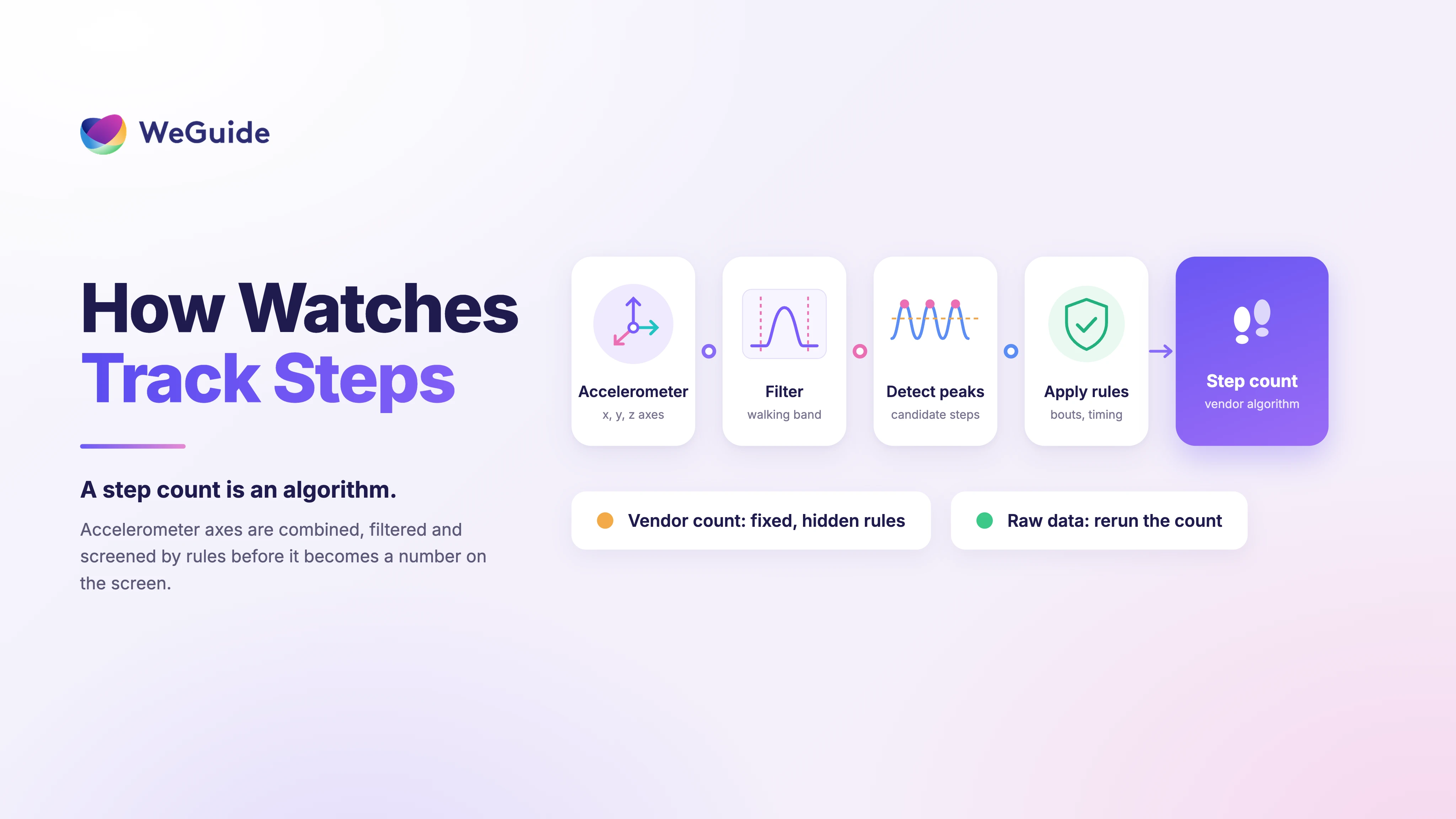


Watches track steps with an accelerometer, a motion sensor that records wrist movement in three directions many times a second. An algorithm filters that signal to the rhythm of walking, counts each peak as a step, and discards movement that doesn't fit a walking pattern.
The number on the screen is therefore the output of an algorithm the manufacturer doesn't publish, not a direct measurement. For a daily goal that hardly matters. Once step count becomes a study outcome, it matters a great deal, because two devices can give different numbers for the same walk. A software update can also change the number on the same device.
This guide covers how step counters work, how Apple, Garmin, Fitbit, and Android devices count steps, why devices disagree, and how accurate they are. It ends with what the FDA expects when steps support an endpoint, and when a study is better served by collecting raw accelerometer data and counting the steps itself.
Key Takeaways
- A step count is an algorithm output. Wearables combine accelerometer axes, filter the signal, and count peaks, then apply rules the manufacturer doesn't publish. Some step counters, such as Omron's, ignore any walking bout shorter than four seconds.
- Slow walking is one of the largest systematic errors. Most devices capture only 50% to 75% of steps at around 0.45 m/s, and in frail inpatients walking at a median 0.46 m/s a thigh sensor missed a median 40% of steps.
- Wear location moves the number more than brand does. A 2026 network meta analysis of 59 studies found wrist and ankle research devices recorded 15% to 30% more daily steps than hip devices, about 1,000 to 2,200 steps a day. That is comparable to or larger than several published minimal important differences.
- Lab accuracy does not carry into daily life. In a large systematic review, 45% of lab step comparisons were within 3% of true steps, but only 42% of free living comparisons were within 10%.
- Raw accelerometer data is the only way to rerun the count. It lets a study apply one open, published algorithm to every participant and every firmware version, at the cost of storage, battery, and processing effort.
How Do Step Counters Work?
A step counter turns body movement into acceleration data and then decides which parts of that data are steps. The hardware has changed a lot since the first pedometers. The logic has changed much less.
How does a pedometer work?
A pedometer counts steps by detecting the vertical bounce of the hips with each footfall. Early electronic pedometers used a spring suspended lever arm that swung with each bounce and closed a circuit. In the classic Yamax design, any vertical acceleration above 0.35 g counted as a step, according to a review of step counting by Bassett and colleagues in Sports Medicine (2017). Modern pedometers and wearables replace the lever with an accelerometer, but the counting logic is much the same.
The same review notes that the 10,000 steps target comes from a 1965 Japanese pedometer, the manpo kei or "10,000 steps meter", not from a clinical guideline.
The five stage step counting pipeline
Vendors don't publish their exact code, but open research algorithms show the stages clearly. The open source stepcount algorithm from the University of Oxford, described by Small and colleagues in 2024, is a good example:
- Sense. The accelerometer samples acceleration on three axes many times a second. Walking produces a repeating wave with positive and negative peaks.
- Combine. The three axes are combined into one vector magnitude, and 1 g is subtracted to remove gravity, so the result doesn't depend on how the device is oriented.
- Filter. A low pass filter keeps the frequency band of walking. Stepcount uses a 5 Hz cutoff.
- Detect. The algorithm counts peaks or zero crossings in the filtered signal. Each candidate has to meet a minimum height and width.
- Reject. Timing rules remove implausible steps. A minimum gap between peaks stops one footfall being counted twice, which pedometer makers began building in during the late 1980s, and some devices ignore short bursts altogether.
The last stage is where devices differ most, and where the rules are usually proprietary. Omron pedometers ignore any walking bout shorter than four seconds, even though the most common walking bout in daily life is only four steps long (Bassett 2017). Fitbit's help pages note a related display behaviour: steps may not update right away, and "catch up" after about 10 to 15 continuous steps (Google Health Help). Newer research algorithms add a stage in front of the others: a machine learning classifier first decides which windows of data contain walking, and peaks are counted only inside those windows.
Where the gyroscope fits
Steps are an accelerometer measure. Apple's 2024 white paper on Apple Watch sensing says the accelerometer is what informs motion based features such as steps (Apple). We found no vendor documentation stating that a gyroscope is what makes a watch's step count accurate, so treat that claim with caution when you see it.
How Do Watches and Phones Track Steps?
Each platform documents a slightly different version of the same pipeline. The differences matter for a study, because they decide which steps get counted and where the data ends up.
How iPhone tracks steps
On an iPhone, a low power motion coprocessor reads the accelerometer continuously and runs the step algorithm, even while the phone is asleep. Apps can read the result through Apple's CMPedometer interface, which returns steps, distance, cadence, and floors climbed. CMPedometer only returns the past seven days of data, so a pipeline that reads it directly has to sync more often than that. Steps saved to Apple Health are kept longer.
The bigger limitation is behavioural. An iPhone only counts while it is being carried. In a 7 day free living study, iPhones recorded 12% fewer steps than a waist pedometer, and the gap was largest in people who seldom carried their phone (Amagasa 2019). When it is carried, the phone does well: in a pocket, shoulder bag, or backpack, phone step counts were within 3% of observed steps at normal walking speeds (Höchsmann 2018).
How Android phones track steps
Android phones offer two built in step sensors. The step counter reports total steps since the last reboot, with up to 10 seconds of delay but better accuracy. The step detector fires an event for each step within about 2 seconds (Android Developers). Like an iPhone, an Android phone only counts while it is carried.
Our Samsung Galaxy Watch research guide covers the most common Android watch in studies.
How Apple Watch tracks steps
Apple Watch tracks steps with its accelerometer and counts continuously on a low power coprocessor. Apple says its Activity app relies on arm motion and the accelerometer to track movement, and asks users to let the watch arm swing naturally, for example by holding a dog's lead in the other hand (Apple Support). In a lab treadmill study, Apple Watch counts matched video counted steps almost exactly (Veerabhadrappa 2018). We found no step accuracy figure published by Apple.
Calibration teaches the watch stride length for distance and pace. It doesn't change how steps are detected (Apple Support). The watch also counts wheelchair pushes, which matters for studies that include wheelchair users.
Two Apple Health behaviours catch study teams out. Steps from iPhone and Apple Watch are fused rather than added together, and the Health app decides which source wins using a priority list. New apps and devices are added to the top of that list automatically (Apple Support), so a participant who installs another fitness app can change which source supplies their steps without anyone noticing. Our Apple Watch research guide covers the platform in more depth.
How Garmin watches track steps
Garmin's owner's manuals are unusually candid, telling users to wear the watch on the non dominant wrist and to carry it in a pocket when pushing a pram or lawn mower. They also warn that "the watch may interpret some repetitive motions, such as washing dishes, folding laundry, or clapping your hands, as steps" (Garmin vívoactive 6 manual). Garmin also states that its wearables are not medical devices (Garmin).
For researchers, the useful part is the Garmin Health SDK. Besides step totals, it lists configurable logging of accelerometer data, accelerometer zero crossing sums, actigraphy, beat to beat intervals, and gyroscope data, with support that varies by device model. That is the route WeGuide uses for raw sensor data on Garmin devices, and we come back to it below.
How Fitbit tracks steps
Fitbit counts steps with a three axis accelerometer and an algorithm designed to look for the motion patterns most typical of walking and running. Its help pages say the dominant wrist setting lowers step counting sensitivity to reduce overcounting. They also note that bumpy car journeys can add steps, and that pushing a pram may give a slightly lower total (Google Health Help).
There is also a pipeline issue. Fitbit's daily totals include steps recorded while the device was off the wrist, while its intraday data includes on wrist steps only (Fitbit Web API). The same documentation says the legacy Fitbit Web API is due to be switched off on 30 October 2026, with developers told to move to the Google Health API.
Any study that pulls Fitbit steps through the old API needs a migration plan now. Our Fitbit Air guide covers the newer device.
Why Step Counts Disagree
Put two devices on one participant for a week and they will rarely give the same total. The reasons are well studied, and most of them are systematic rather than random, which is exactly what makes them dangerous in a trial.
| Cause | Effect on the count | Evidence |
|---|---|---|
| Slow walking | Undercount | Good counters are within 3% at about 1.3 m/s, start undercounting near 0.9 m/s, and most capture only 50% to 75% of steps at about 0.45 m/s (Bassett 2017) |
| Frail, slow gait | Undercount | Frail inpatients walking at a median 0.46 m/s: thigh sensor missed a median 40% of steps, and an ankle sensor was within 1% (McCullagh 2017) |
| Cane or walker | Undercount | Every monitor except an ankle worn StepWatch underestimated by more than 11.5% (Floegel 2017) |
| Wrist kept still | Undercount | Wrist devices miss steps when pushing a pram or holding treadmill rails (Bassett 2017) |
| Arm movement without walking | Overcount | A wrist Fitbit counted steps while participants ate (Alinia 2017) |
| Phone not carried | Undercount | iPhones 12% below a waist pedometer in free living (Amagasa 2019) |
| Wear location | Systematic shift | Wrist and ankle research devices 15% to 30% higher than hip devices, consumer wrist devices 3% to 15% higher (Paluch 2026) |
| Processing settings | Large shift, same device | Switching an ActiGraph filter setting added about 7,500 steps a day in people with chronic obstructive pulmonary disease (COPD) (Antão 2024) |
| Software updates | Either direction | Validity "is not maintained when firmware and software updates can, and do, change device performance" (Collins 2019) |
Slow gait is the error that matters most clinically
The participants most likely to be in a trial are the participants step counters handle worst. Older adults, people with neurological conditions, people recovering from surgery, and people using walking aids all walk slowly or irregularly, and slow walking is where nearly every device undercounts.
The FDA's guidance on digital health technologies (DHTs) uses step counting as a recurring example, and warns that "the algorithm a DHT uses to capture steps in healthy participants may not be applicable for participants with Parkinson's disease with a shuffling gait" (FDA, 2023).
Accuracy depends on the population as well as the device. In mild to moderate Parkinson's disease, one study found both a Fitbit and a Garmin within 3% at self selected pace, and the Garmin was more consistent across cadences (Lamont 2018). Our mobility and gait biomarker hub lists related measures, including gait speed.
Wear location is a protocol decision
Where the device sits changes the count more than which brand it is. A 2026 network meta analysis of 59 free living studies found that wrist and ankle research accelerometers recorded 15% to 30% more daily steps than hip devices, about 1,000 to 2,200 extra steps a day. Consumer wrist devices ran 3% to 15% higher, or about 200 to 1,000 steps a day (Paluch 2026).
Even the same device changes with location and settings. In free living, ActiGraph's waist and wrist placements recorded about 6,700 and 9,300 steps a day under the default filter, and about 13,000 and 15,500 with the low frequency extension switched on (Bassett 2017). Our ActiGraph reference explains how that filter works, and our overview of consumer wearables in clinical research covers how consumer devices differ from research grade monitors.
Software updates change the number
Consumer wearables update their firmware and algorithms on the vendor's schedule, not the study's. In March 2026, after a Pixel Watch update, some users reported step counts doubling or tripling. Google confirmed the overcount, and its fix applied "to new activity only", so data already recorded stayed as it was, as reported by Android Central from the Fitbit status dashboard. A study running through that update would have a step change it could not undo, and could explain only if it had logged the update.
Collect step and sensor data from Garmin devices
WeGuide's native Garmin integration brings step counts and, on supported models, raw accelerometer and gyroscope data at 25 Hz into the same study app as your eConsent and ePRO.
How Accurate Are Step Counters?
Step counters are accurate enough for healthy adults walking at a normal pace, and much less reliable at slow speeds, in daily life, and in clinical populations. Researchers usually judge them against two thresholds: within 3% of true steps in controlled tests, and within 10% in free living.
A large systematic review by Fuller and colleagues covered 158 publications, nine brands, and 1,672 validity comparisons across steps, heart rate, and energy expenditure. In the lab, 45% of step comparisons were within 3%, and the median error was an undercount of 2%. In free living, only 42% of the comparisons with usable data were within 10%, and the median error was an overcount of 6%. Apple and Samsung devices had the tightest ranges, and most studies had fewer than 50 participants.
Other reviews point the same way:
- Fitbit. A review of 67 studies found 46% of controlled comparisons within 3%. Fitbit tended to undercount in the lab and to overcount in free living, where five studies found roughly 700 to 1,800 extra steps a day (Feehan 2018).
- Garmin. A review of Garmin trackers found step validity generally good to excellent across 16 studies, and good to excellent reliability in the few studies that tested it (Evenson 2020).
- Real days on video. When 12 people were filmed through a full free living day, an ankle StepWatch recorded 95% to 103% of true steps. Other methods, including wrist devices, recorded anywhere from about 70% to 220%, depending on device, placement, and filter (Toth 2018).
- Chronic disease. In 130 people with a chronic disease doing everyday activities, eight of nine consumer trackers undercounted steps (Ummels 2018).
Lab accuracy tells you how a device performs on a treadmill. It tells you little about a week of real life in your study population, and the Fuller review warns that devices are upgraded and redesigned faster than reviews can keep up. Our guide to wearable data quality in clinical trials covers the wider validation picture.
What This Means When Steps Are a Study Measure
Daily steps are a credible outcome. Our step count profile summarises the evidence linking daily steps to health outcomes and the condition specific uses. The harder question for a study team is whether its own step numbers can carry the weight it wants to put on them.
The FDA treats the algorithm as part of the measurement
The FDA's 2023 guidance on digital health technologies for remote data acquisition uses steps throughout. It separates verification, which confirms that the device measures acceleration accurately, from validation, which confirms that it assesses step count properly in the proposed participant population. Several of its expectations apply directly:
- Validate in your population. Validation activities include comparing device step counts with observed steps, and checking how placement, such as wrist versus hip, affects the result.
- Check consistency across models. If the protocol allows more than one brand or model, the sponsor needs evidence that they measure consistently.
- Use one method in every arm. "The same method for collection of data should be used in all study arms."
- Prespecify the endpoint. A measure such as average daily steps across the treatment period belongs in the statistical analysis plan.
- Log every update. Sponsors "should keep a record of the timing and nature of any updates for each DHT", because significant changes after updates "may invalidate the results."
The guidance also flags that bring your own device may not suit studies that need algorithms tuned for a specific movement disorder. Our comparison of BYOD and provisioned devices works through that choice, and our guide to digital health technologies in clinical trials covers the rest of the guidance.
No daily step count has an FDA or EMA qualification yet. The best known wearable precedent, stride velocity 95th centile in Duchenne muscular dystrophy, was qualified by the European Medicines Agency as a primary endpoint in July 2023 (Servais 2024). It measures how fast someone walks at their best, not how many steps they take. Our guide to digital endpoints in clinical trials covers the qualification route.
Meaningful change is about the size of device error
Published minimal important differences for daily steps are small:
| Condition | Minimal important difference (steps a day) | Source |
|---|---|---|
| COPD | 600 to 1,100 | Demeyer 2016 |
| Parkinson's disease | 581 to 1,592, depending on the anchor | Bianchini 2025 |
| Asthma | 1,413 (pooled) | de Lima 2025 |
| Idiopathic pulmonary fibrosis | 570 to 1,358 | Shingai 2023 |
A consumer wrist device can sit 200 to 1,000 steps a day above a hip device. That is the same size as the change many studies are trying to detect. This point is easy to miss: device model, wear location, and processing have to stay fixed across arms and visits, or the device becomes the intervention.
Define a valid day before you start
Consumer devices log zero steps whether a participant took the device off or sat still, so wear rules matter. A common rule is at least 10 hours of wear for a valid day, as in the Women's Health Study (Lee 2019). The All of Us analysis of participants' own Fitbits required at least 10 hours of wear and at least 100 steps (Master 2022).
Three valid days gave a reliable weekly estimate in adults (Tudor-Locke 2005), and four are often recommended (Migueles 2017). A COPD consensus review set a minimum of seven measurement days with at least four valid days of eight hours (Burtin 2021).
Step Count vs Raw Sensor Data: When a Study Needs Raw Accelerometry
A vendor step count is a finished product. Raw accelerometer data is the material it was made from. Collecting the raw data lets a study make its own step count, with a method it can describe, publish, and rerun.
What raw data lets a study do
- Rerun the count. Only wear location and sampling rate have to be fixed before data collection. Every other processing choice "can be made a posteriori", and new methods can be applied as sensitivity analyses later (Migueles 2017).
- Use one open algorithm for everyone. The same code runs on every participant, device, and firmware version, which removes the proprietary rule set from the analysis.
- Avoid vendor algorithm changes. A firmware change alters the vendor's count from that day on. Raw data processed with a fixed algorithm version is not affected by changes to the vendor's step algorithm.
- Derive more than steps. The same recording yields cadence, walking bouts, intensity, sedentary time, and sleep features, many of which need minute level or raw data.
Open step algorithms now publish their error, which consumer vendors generally do not:
| Algorithm | What it is | Published performance |
|---|---|---|
| Oxford stepcount | Machine learning walking classifier plus peak detection, trained on video annotated free living data | 12.5% mean absolute percentage error against free living video, close to zero bias (Small 2024) |
| Verisense step algorithm (usable through GGIR) | Open peak detection algorithm | In structured walks against a waist ActiGraph, revised parameters cut cadence error to about 10% to 12% (Rowlands 2022). Against free living video, 63.5% mean absolute percentage error (Small 2024) |
| Simple acceleration threshold | Reference baseline | 231% mean absolute percentage error in the same free living comparison (Small 2024) |
What raw data costs
A Garmin white paper on its actigraphy work notes that a vívosmart 5 holds about one day of continuous raw acceleration, and that retrieving it over Bluetooth takes about two hours (Garmin Health). That means more frequent syncing, more battery use, and more participant contact. Apple Watch can record raw accelerometer data at 50 Hz, but only in 12 hour blocks that the app must collect within three days (Apple Developer).
Processing takes expertise as well. Raw data needs calibration, non wear detection, and an algorithm choice. Reporting is poor even in published research: in one review, 60% to 80% of accelerometer studies didn't report the filter they used (Migueles 2017).
On sampling rate, published evidence suggests step detection works from roughly 10 to 20 Hz (Zhang 2012, Quisbert-Trujillo 2026), and common research practice is 30 to 100 Hz. Migueles and colleagues recommend the highest rate the device allows.
Vendor step count or raw data?
| Question | Vendor step count is enough | Collect raw accelerometer data |
|---|---|---|
| Role of steps | Exploratory, engagement, or context measure | Primary or key secondary endpoint |
| Population | Healthy adults at normal pace | Slow, shuffling, or assisted gait |
| Devices | One provisioned model, firmware logged | Mixed models, or a long study across updates |
| Analysis | Daily totals | Cadence, bouts, intensity, or a custom algorithm |
| Team | No signal processing capacity | Access to someone who can run open algorithms |
How WeGuide handles step and sensor data
On WeGuide, step data can come from Apple Health, Health Connect on Android, Fitbit Air, or Garmin devices. Raw sensor data is available only through Garmin. With Garmin devices, WeGuide uses the Garmin Health SDK and, on supported models, collects raw accelerometer and gyroscope data at 25 Hz in addition to step counts (Garmin integration). That rate is above the roughly 10 to 20 Hz that step detection needs, so a study can rerun the count with an open algorithm.
Supported Garmin models vary, so confirm the device list with us during study setup. The data arrives in the same participant app that runs eConsent, electronic patient reported outcomes (ePRO), and reminders, so step data and the rest of the study sit in one place.
A Step Count Checklist for Your Protocol
Before a study relies on steps, write these decisions into the protocol and analysis plan:
- Name the device model and wear location, and keep both fixed across arms and visits.
- Record firmware and app versions for every device, and log the date of every update.
- Pick one data source per participant. Don't mix phone and watch counts, and don't let Apple Health source priority decide for you.
- Define a valid day and the number of valid days before data collection starts.
- Plan for non wear. Decide how zero step hours will be treated, and use heart rate or another signal as a wear check where possible.
- Validate in your population, especially if participants walk slowly or use walking aids.
- Decide whether you need raw data using the table above, before the first device ships.
Step Count and Step Tracking FAQs
Does moving or swinging your arms count as steps?
On a wrist device, often yes. Garmin warns that washing dishes, folding laundry, or clapping can register as steps, and a wrist Fitbit counted steps while people ate (Alinia 2017). The algorithm sees a rhythmic arm signal at walking frequency and may not be able to tell it apart from walking.
How does my phone know how many steps I take?
On an iPhone, a low power motion coprocessor reads the accelerometer continuously and runs a step algorithm, even when the phone is asleep. Android phones have built in step counter and step detector sensors. Either way the phone only counts while you carry it, which is why iPhones recorded 12% fewer steps than a waist pedometer in a free living study (Amagasa 2019).
Is Fitbit or iPhone more accurate for steps?
Neither is a research reference standard. On a treadmill, iPhone and Galaxy apps were within about 7% of observed steps, waist clipped Fitbit trackers within about 1%, and wrist wearables, including the Fitbit Flex, from about 2% to 23% low (Case 2015). In daily life, iPhones undercount when left behind and Fitbit tends to overcount (Feehan 2018).
Why does my watch show different steps than my phone?
They sit in different places on the body and run different algorithms. Consumer wrist devices record 3% to 15% more daily steps than hip worn devices (Paluch 2026). Apple Health doesn't add the two together. It fuses them and uses a priority list to decide which source wins.
Do steps count if you walk in place?
It depends on the device, because we found no published study that has validated consumer wearables for walking in place. Wrist devices respond to rhythmic arm movement, and Garmin warns that repetitive arm motions can register as steps. Treat any walking in place counts as unvalidated.
How many hours make a valid day in step count research?
Most studies require at least 10 hours of wear for a valid day (Lee 2019, Master 2022), and at least three to four valid days for a reliable weekly average (Tudor-Locke 2005, Migueles 2017). Some disease specific consensus uses different rules, so check the literature for your condition.
Do I need raw accelerometer data to use steps as an endpoint?
Not always. A single provisioned device model with logged firmware can support a step outcome in a population it has been validated in. Raw data becomes the safer choice when the population walks slowly, when several device models are in use, or when the study needs to rerun the count with a published algorithm.
How Watches Track Steps: What It Means for Your Study
Watches track steps by running accelerometer data through a rule set the manufacturer keeps to itself. That rule set decides what counts as a step, it differs between devices, and it can change overnight with a software update. For a study, it decides whether a change in steps reflects the intervention or the device.
Make the device a fixed, documented part of the protocol: one model, one wear location, logged versions, a prespecified valid day, and validation in the population you are studying. When steps carry real weight, or the population walks slowly, collect raw accelerometer data and count the steps with an open algorithm you can describe and rerun. Our guide to wearables in clinical trials covers the wider design questions, and our companion piece explains how fall detection works using the same sensors.
Plan step data collection around your protocol
We'll walk through device choice, wear rules, and Garmin sensor data alongside eConsent and ePRO in one participant app.
Book a demoNo pressure, just a conversation.

