


The LASA Physical Activity Questionnaire (LAPAQ)
Designed for older adults, the LAPAQ measures physical activity through walking, cycling, and gardening. This interview-based tool helps researchers track daily movement patterns over time.

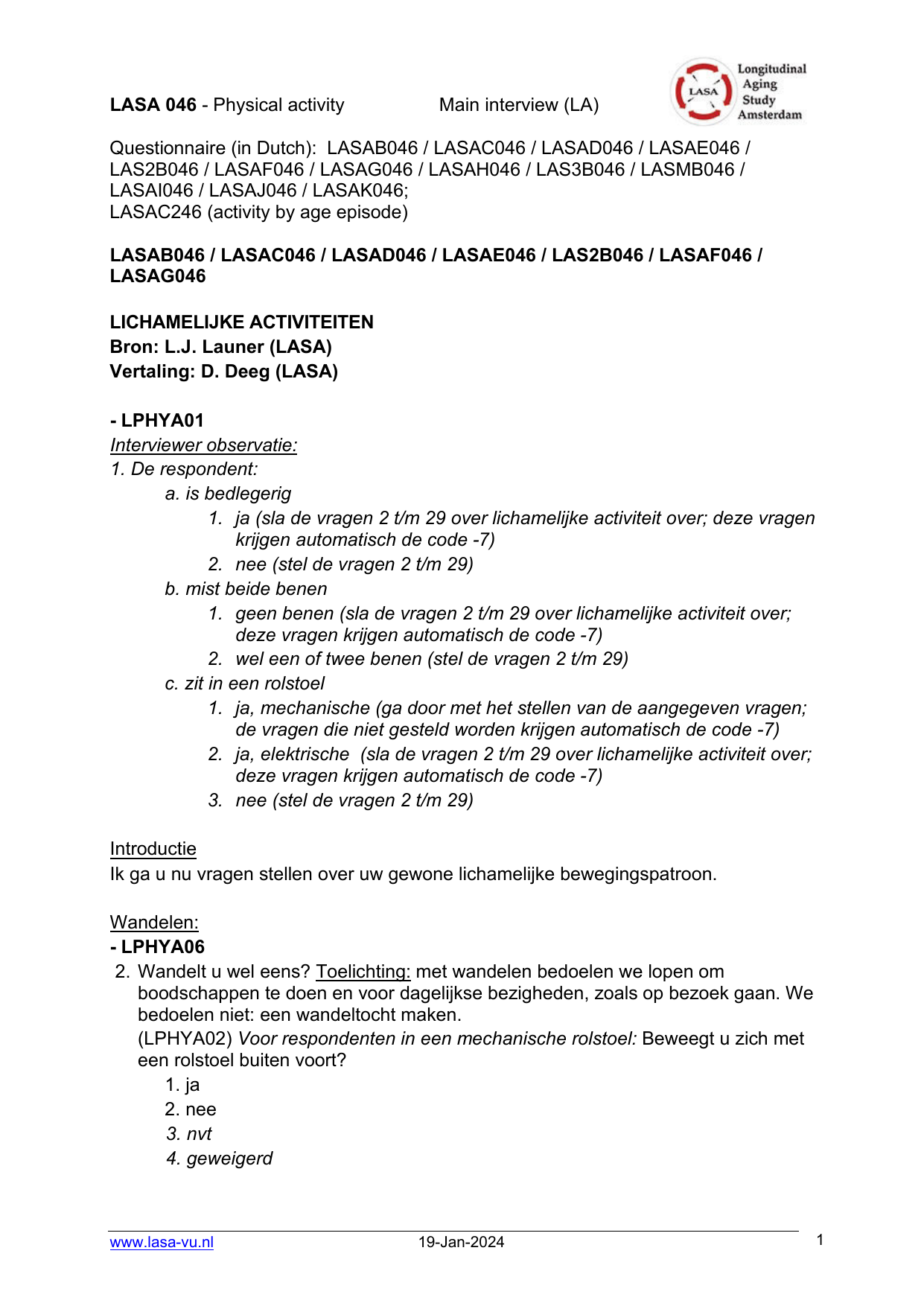
LASA Physical Activity Questionnaire (LAPAQ)
The LASA Physical Activity Questionnaire (LAPAQ) assesses physical activity in older adults. Covering the past two weeks, it tracks walking, cycling, and sports. This tool helps evaluate mobility and lifestyle habits in ageing populations, allowing clinicians to monitor health trends accurately.
Category
Disease
Source
What is LASA Physical Activity Questionnaire (LAPAQ)

The LASA Physical Activity Questionnaire (LAPAQ) is a trusted tool for tracking movement in older adults. It helps clinicians spot daily energy use. This instrument looks at how often and how long a person performs specific tasks. It covers the past two weeks to give a clear snapshot of regular habits without being too heavy. It covers common activities like walking outside, cycling, gardening, and household chores. Users report time spent on each, allowing the calculator to estimate total energy expenditure and assign metabolic equivalent scores for better health insights. Usually given by an interviewer, this survey is great for geriatric studies because it accounts for lifestyle differences. It is simple to score and interpret, making it a top choice for checking functional decline. It helps professionals plan better care strategies for ageing patients.
The LAPAQ can be scored using two main approaches: calculating total time and estimating energy use. 1. Total Time: You multiply the frequency and duration of activities like walking, cycling, and gardening during the last two weeks. Summing these gives a total activity score in minutes per day. 2. Energy Expenditure: This method assigns a metabolic equivalent or MET value to each specific activity intensity. By multiplying time spent by the MET value, you get a score reflecting daily kilocalories burned.
Advantages
.svg)
Streamlines research data gathering process.
.svg)
Strengthens evidence through systematic measurement approaches.
.svg)
Tracks patient condition changes systematically.
.svg)
Monitors clinical data throughout extended study periods.
.png)

Related Instruments

Digital counterpart
Digital biomarkers that measure the same thing with sensors rather than a questionnaire.
Collect LAPAQ data with WeGuide, the all in one patient engagement platform
.jpg)

Support Your patient in no time - all under your own brand
Our platform combines the knowledge of 100+ digital health solutions built, letting you easily build your patient engagement app for research or clinical use. Collect PROMs, support patients on waiting lists, or gather vital signs data. This is how:
Learn More.png)
Program Builder
.png)
.png)
Whitelabelling
.svg)
.svg)
.png)
Turn on components, dependent on your usecase
.svg)
.png)
Support The Full Journey
.png)
.png)
%20(1).png)
.png)
It’s your turn
Every WeGuide project, saves researchers and clinicians - 9 months and $450,000 - creating impactful digital health solutions.
