


The Cornell Scale for Depression in Dementia (CSDD)
The CSDD helps clinicians screen for depression in people with dementia by interviewing both patients and caregivers. This approach captures symptoms often missed due to memory loss.

Cornell Scale for Depression in Dementia (CSDD)
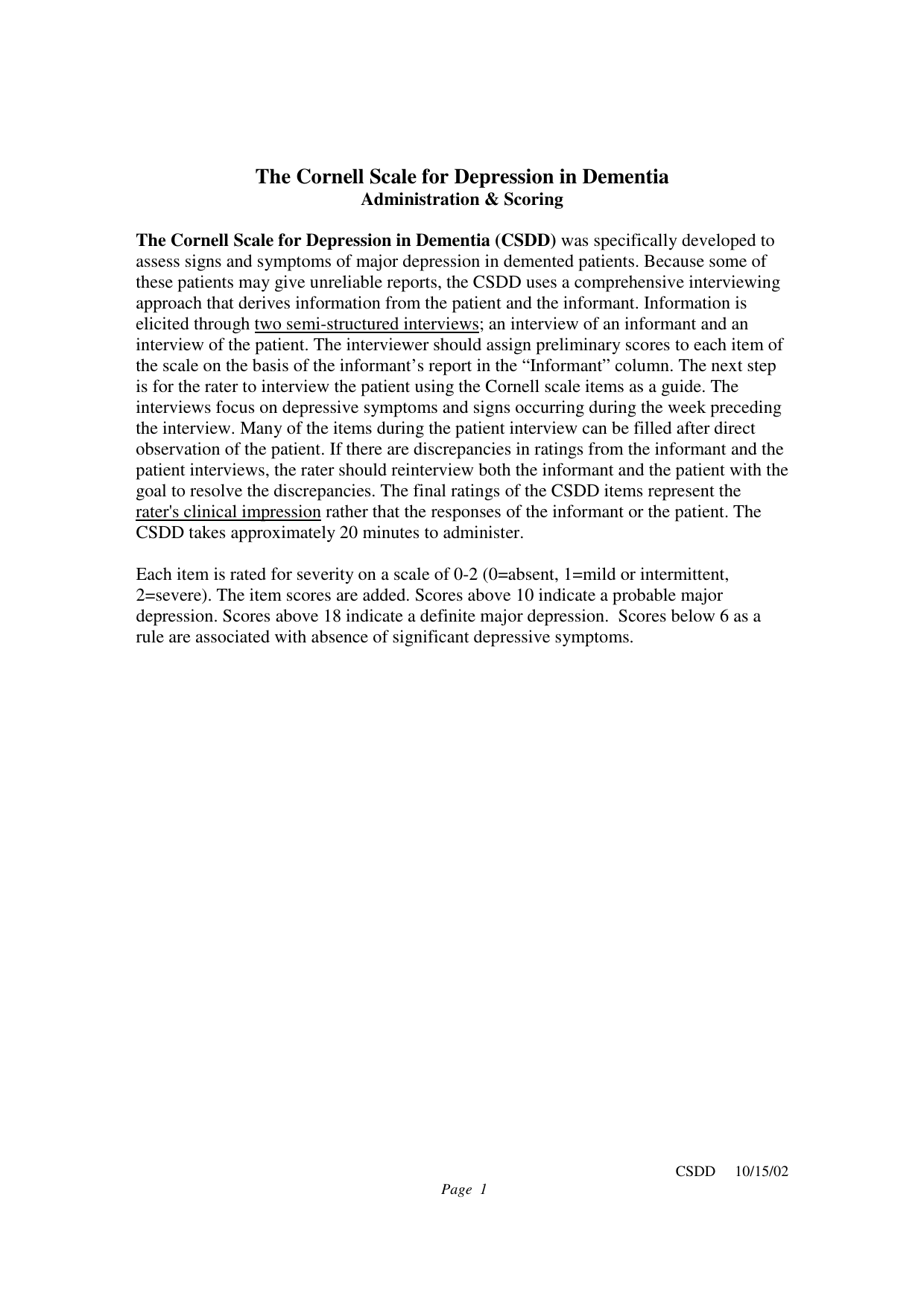
The Cornell Scale for Depression in Dementia (CSDD) screens for depression in people with cognitive impairment. By combining caregiver interviews with direct observation, it bypasses the need for self-reporting. This method ensures accurate assessment even when communication is difficult, making it a key clinical tool.
Category
Disease
Source
What is Cornell Scale for Depression in Dementia (CSDD)

The Cornell Scale for Depression in Dementia (CSDD) is a trusted tool for spotting depression signs in people living with cognitive challenges. Unlike standard self-reports, it relies on interviews with both the patient and a carer. This helps clinicians get a clear picture even if the patient struggles to communicate well. The scale covers nineteen items across five specific areas like mood, physical signs, cyclic functions, and behaviour changes. Each item gets scored from zero to two based on severity, which helps separate true mood issues from regular dementia symptoms. Administering the CSDD usually takes about twenty minutes, making it handy for busy nursing homes or clinics. Doctors use the total score to guide treatment plans and track progress. This practical approach ensures older adults get the mental health support they really need for a better quality of life.
The Cornell Scale for Depression in Dementia can be scored using one main approach: a cumulative total score. Clinicians rate 19 items covering signs like mood and physical changes. You assign a 0 for absent, 1 for mild, or 2 for severe symptoms based on interviews with the patient and carer. Simply add these up for a final result between 0 and 38. Generally, a score above 10 suggests probable major depression, while anything over 18 indicates definite major depression. It is a reliable way to spot mood issues in dementia care.
Advantages

Enables precise identification of patient health status.
.svg)
Provides consistent measurements for clinical research.
.svg)
Tracks patient condition changes systematically.
.svg)
Meets international clinical assessment requirements.
.png)

Related Instruments

Digital counterpart
Digital biomarkers that measure the same thing with sensors rather than a questionnaire.
Streamline Cornell Scale for Depression in Dementia assessments with WeGuide
.jpg)

Support Your patient in no time - all under your own brand
Our platform combines the knowledge of 100+ digital health solutions built, letting you easily build your patient engagement app for research or clinical use. Collect PROMs, support patients on waiting lists, or gather vital signs data. This is how:
Learn More.png)
Program Builder
.png)
.png)
Whitelabelling
.svg)
.svg)
.png)
Turn on components, dependent on your usecase
.svg)
.png)
Support The Full Journey
.png)
.png)
%20(1).png)
.png)
It’s your turn
Every WeGuide project, saves researchers and clinicians - 9 months and $450,000 - creating impactful digital health solutions.
