


Cognitive Failures Questionnaire (CFQ): Assessing Lapses
This self-report tool measures how often people make everyday errors, such as forgetting names. It helps researchers and clinicians assess cognitive slips in daily life.


Cognitive Failures Questionnaire (CFQ)
The Cognitive Failures Questionnaire (CFQ) is a self-report scale that measures the frequency of everyday lapses in memory, perception, and motor function. It's used to assess absent-mindedness and cognitive slips, helping clinicians understand how attention deficits affect a patient's daily life.
Category
Disease
Source
What is Cognitive Failures Questionnaire (CFQ)

The Cognitive Failures Questionnaire (CFQ) is a trusted tool for tracking everyday mental slips. It helps experts measure frequent lapses in focus. This twenty five item scale looks at failures in perception, memory, and motor function. It asks people to rate their own experiences with common mistakes like forgetting names. Respondents answer questions using a simple frequency scale ranging from never to very often. The items cover a mix of forgetfulness, such as dropping objects or failing to notice road signs, giving a clear picture of general cognitive function. It's easy to administer and score, making it great for clinical screening plus research into stress or workplace safety. By highlighting error proneness, the CFQ assists professionals in planning interventions that improve daily functioning and safety for a much better quality of life.
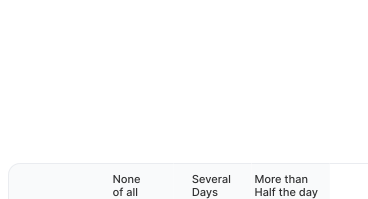
The Cognitive Failures Questionnaire can be scored using one main approach: calculating a total frequency sum. This tool lists 25 common mistakes, like forgetting names or bumping into people. Patients rate how often these happen on a scale from 0 for never to 4 for very often. You simply add up the ratings for a final score between 0 and 100. Higher numbers mean the patient is dealing with more cognitive blunders in daily life. While some experts might look at subscales for memory or focus, the total sum remains the most reliable way to monitor general cognitive function in a busy clinical practice.
Advantages
.svg)
Serves diverse clinical needs effectively.
.svg)
Streamlines research data gathering process.
.svg)
Strengthens evidence through systematic measurement approaches.
.svg)
Tracks patient condition changes systematically.
.png)

Related Instruments

Digital counterpart
Digital biomarkers that measure the same thing with sensors rather than a questionnaire.
Streamline Cognitive Failures Questionnaire data collection with WeGuide
.jpg)

Support Your patient in no time - all under your own brand
Our platform combines the knowledge of 100+ digital health solutions built, letting you easily build your patient engagement app for research or clinical use. Collect PROMs, support patients on waiting lists, or gather vital signs data. This is how:
Learn More.png)
Program Builder
.png)
.png)
Whitelabelling
.svg)
.svg)
.png)
Turn on components, dependent on your usecase
.svg)
.png)
Support The Full Journey
.png)
.png)
%20(1).png)
.png)
It’s your turn
Every WeGuide project, saves researchers and clinicians - 9 months and $450,000 - creating impactful digital health solutions.
