


Global Deterioration Scale (GDS-Reisberg): Staging Dementia
The Global Deterioration Scale outlines seven stages of cognitive decline to track dementia. It helps clinicians and caregivers monitor changes in memory and function over time.

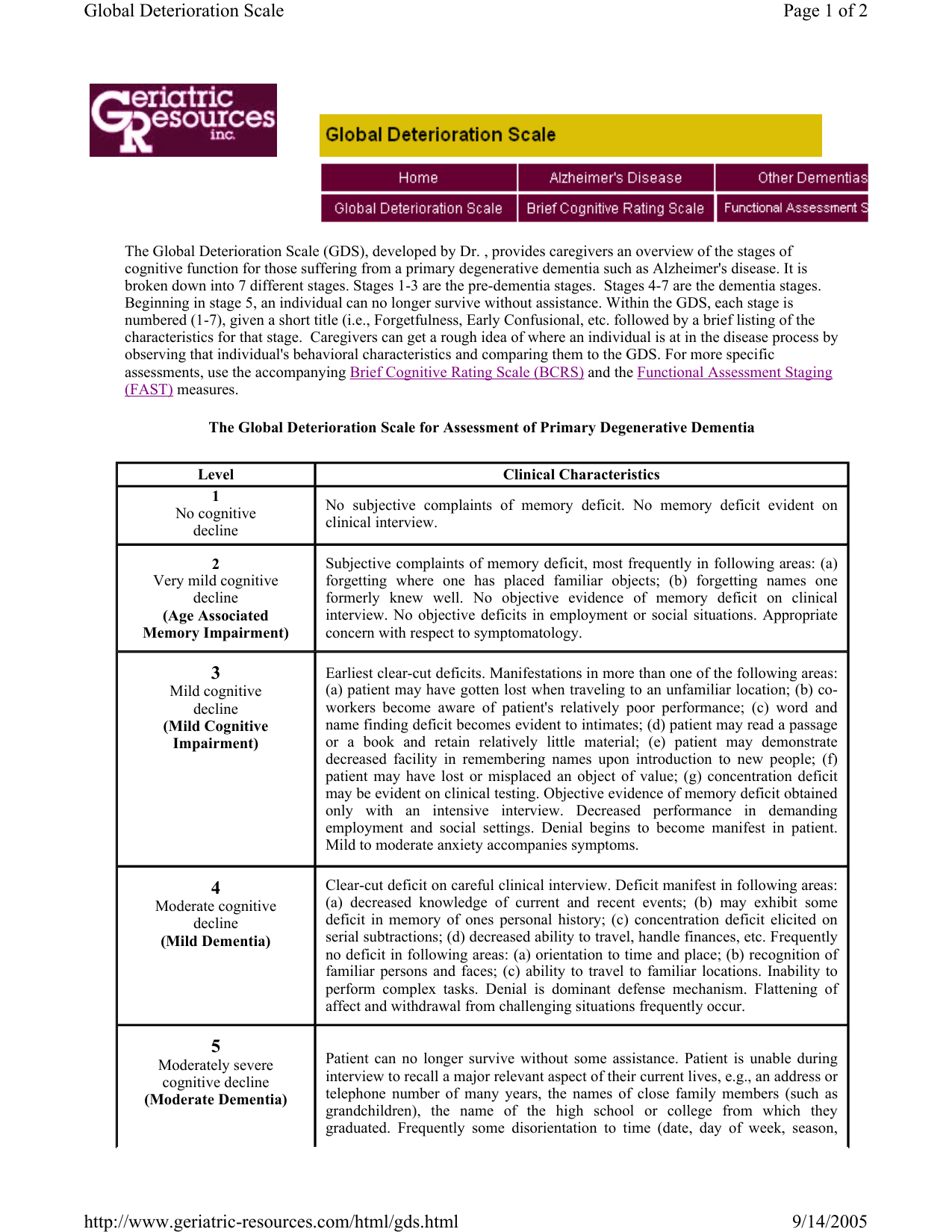
Global Deterioration Scale (GDS-Reisberg)
Used to assess primary degenerative dementia, the Global Deterioration Scale (GDS-Reisberg) defines seven stages of cognitive decline. It ranges from no impairment to severe loss, helping clinicians track disease progression. This scale is essential for creating effective care plans for Alzheimer's patients.
Category
Disease
Source
What is Global Deterioration Scale (GDS-Reisberg)

The Global Deterioration Scale (GDS-Reisberg) is a trusted tool for staging primary degenerative dementia. It helps clinicians track cognitive decline accurately. This scale breaks down the progression of Alzheimer's disease into seven distinct stages. It ranges from no impairment to very severe decline, offering a clear roadmap. Clinicians look at memory loss, orientation, and daily functioning. Stages 1 through 3 show pre-dementia signs, while stages 4 to 7 indicate clear dementia. It focuses on current abilities versus deficits, making it practical for care planning. Administering the GDS involves a semi-structured interview with the patient and a caregiver. It's widely used in aged care to monitor changes over time. The results help families understand the disease's path and assist doctors in managing medications or support services for better outcomes.
The Global Deterioration Scale can be scored using one main clinical staging approach: Clinicians rate patients on a scale from stage 1 to stage 7 based on cognitive function and daily skills. Stage 1 shows no decline, while stages 2 and 3 involve mild memory lapses. Stages 4 to 7 represent dementia, moving from moderate deficits to very severe decline where speech is lost. You choose the stage that best matches the patient's current abilities during an interview. It is a handy way to track how Alzheimer's progresses over time.
Advantages
.svg)
Promotes active participation in healthcare assessment.

Develops personalised strategies based on assessment data.
.svg)
Tracks patient condition changes systematically.
.png)

Related Instruments

Digital counterpart
Digital biomarkers that measure the same thing with sensors rather than a questionnaire.
Collect Global Deterioration Scale data with WeGuide, the all in one patient engagement platform
.jpg)

Support Your patient in no time - all under your own brand
Our platform combines the knowledge of 100+ digital health solutions built, letting you easily build your patient engagement app for research or clinical use. Collect PROMs, support patients on waiting lists, or gather vital signs data. This is how:
Learn More.png)
Program Builder
.png)
.png)
Whitelabelling
.svg)
.svg)
.png)
Turn on components, dependent on your usecase
.svg)
.png)
Support The Full Journey
.png)
.png)
%20(1).png)
.png)
It’s your turn
Every WeGuide project, saves researchers and clinicians - 9 months and $450,000 - creating impactful digital health solutions.
