

.svg)


The best patient engagement software in 2026 depends on which of three jobs you are hiring it for. Practice communication tools like Phreesia, OhMD, and Luma Health excel at intake, scheduling, and two way texting for clinics. Hospital outreach platforms like Artera and TeleVox run high volume reminders across large health systems. Research grade platforms like WeGuide keep patients active in studies, registries, and digital health programs with eConsent, ePRO surveys, education, and wearable data. Most "best of" lists rank all three side by side as if they were interchangeable. They are not, and picking a tool from the wrong segment is the most common reason engagement software becomes shelfware.
This guide compares 12 patient engagement software companies honestly, segment by segment. We build patient engagement software ourselves, so we have put our own platform in the segment where it genuinely belongs, research and digital health programs, and recommended competitors by name where they are the better fit. Every evaluation criterion we used is listed, so you can rerun the comparison against your own requirements.
Key Takeaways
- Patient engagement software splits into three segments. Practice communication (intake, texting, scheduling), hospital outreach (high volume reminders and campaigns), and research grade engagement (eConsent, ePRO, education, wearables). Pick your segment before you pick a vendor.
- The best platform per segment: Phreesia for intake and payments, Luma Health for access and scheduling, Artera for enterprise messaging, and WeGuide for research, registries, and digital health programs.
- Ask every vendor for published engagement numbers. WeGuide's benchmark is 94% adherence across 6,000+ participants in five countries. Screenshots are not evidence.
- Compliance needs differ by segment. A HIPAA badge is enough for a clinic texting tool. Research programs need ISO 27001, GDPR, and 21 CFR Part 11 aligned workflows on top.
- Pricing models matter as much as price. Practice tools usually charge per provider per month. Research platforms are typically project based. Be wary of six figure minimums for a pilot.
What Counts as Patient Engagement Software?
Patient engagement software is a digital platform that keeps people actively involved in their care or study between visits: appointment and medication reminders, secure messaging, electronic consent, patient reported outcome surveys, education, and connected wearable data, delivered through a patient facing app or messaging channel. Unlike a patient portal, which passively stores records, these tools reach out, educate, and collect data. For a full definition, the core components, and how the category differs from portals, see our complete guide to patient engagement software.
The market conflates three product categories under one label, so this list is organised to keep them apart:
- Practice and clinic communication tools handle the front office: intake forms, self scheduling, two way texting, payments, reviews, and recall. Their buyer is a practice manager, and their outcome metric is fewer no shows and less phone time.
- Hospital and health system outreach platforms push reminders, campaigns, and post discharge follow ups across hundreds of departments and languages, usually deep inside Epic, Oracle Health, or another enterprise EHR.
- Research and digital health engagement platforms keep participants active over months or years: eConsent, ePRO and PROM surveys, education modules, wearable data collection, and long term retention, under research grade compliance.
How We Evaluated These Patient Engagement Software Companies
We scored every platform on the same six criteria we recommend buyers use. They mirror the buying criteria on our patient engagement software hub, where each one is explained in depth.
- Segment fit. What the tool is actually built for, based on its own positioning and feature depth, not its marketing category.
- Engagement depth beyond reminders. Reminders are table stakes. We looked for education delivery, survey and ePRO collection, and longitudinal follow up.
- Integration depth. EHR and PAS connections for care settings; REDCap, EDC, and open APIs for research; wearable device data where relevant.
- Evidence of outcomes. Published adherence, retention, or no show numbers, not testimonials alone.
- Compliance posture. HIPAA support at minimum; ISO 27001, GDPR, TGA certification, and 21 CFR Part 11 aligned workflows for regulated research.
- Pricing model and total cost. Per provider subscriptions suit practices; project based pricing suits programs and studies. We flag models that punish small pilots.
Quick Comparison: 12 Patient Engagement Software Vendors
| Platform | Segment | Best for | Standout capability |
|---|---|---|---|
| WeGuide | Research and digital health | Studies, registries, care programs | White label apps with eConsent, ePRO, education, and wearables |
| Phreesia | Practice communication | Intake and payments at scale | Self service registration and copay collection |
| Luma Health | Practice and health system | Access and scheduling | Self scheduling, waitlists, and operational AI |
| OhMD | Practice communication | Two way patient texting | Texting first shared inbox for practices |
| Klara (ModMed) | Practice communication | Specialty practices | Messaging plus intake inside the ModMed ecosystem |
| Artera | Health system outreach | Enterprise messaging | Multi language SMS first communication at system scale |
| Weave | Small practice all in one | SMB practices | Phones, texting, reviews, and payments in one |
| Solutionreach | Practice communication | Recall heavy practices | Automated reminders, recall, and reputation tools |
| NexHealth | Practice communication | Online booking and API needs | Real time EHR and PMS synchronisation |
| TeleVox | Health system outreach | High volume hospital outreach | Omnichannel voice, SMS, and email campaigns |
| QliqSOFT | Virtual care communication | Chatbot led journeys | No code chatbots, secure texting, and virtual visits |
| Emitrr | Small practice communication | Budget conscious clinics | SMS automation with missed call text back |
The 12 Best Patient Engagement Software Platforms for 2026
1. WeGuide: best for research, registries, and digital health programs

WeGuide is an active patient engagement software platform built for organisations that need people engaged over months or years, not just reminded about Tuesday's appointment. Research institutions, sponsors, hospitals, and digital health teams use it to run clinical trials, patient registries, and routine care programs through one white label, patient facing app: eConsent, ePRO and PROM surveys, education modules, smart reminders, secure messaging, and wearable data collection, configured without code.
The evidence is the differentiator. In the BRACE trial, WeGuide sustained 94% participant adherence across 6,000+ people in five countries, launched in six weeks. GenV, one of the world's largest birth cohorts, engages more than 100,000 families through a WeGuide powered app, and the FSHD Global registry keeps a dispersed rare disease community contributing long term data. Research using Apple Watch data on WeGuide has been featured on the Apple Newsroom.
Standout features:
- White label patient apps under your own brand, with native multi language content
- No code program builder for eConsent, ePRO and PROM surveys, and patient education
- Wearable data collection across consumer and medical grade devices
- Integration Engine for EMR and PAS systems, REDCap, and EDC platforms
- TGA Class I certified medical device software, ISO 27001 aligned, supporting HIPAA, GDPR, and 21 CFR Part 11 aligned workflows
Keep in mind: WeGuide is not a front desk tool. If your main problem is copay collection, online booking, or review generation, a practice platform below will serve you better.
Best for: clinical trials, patient registries, cohort studies, telehealth and remote monitoring, and hospital programs that need research grade engagement with published adherence numbers. Pricing is project based and scales with program complexity, with no six figure minimums.
2. Phreesia: best for patient intake and payments
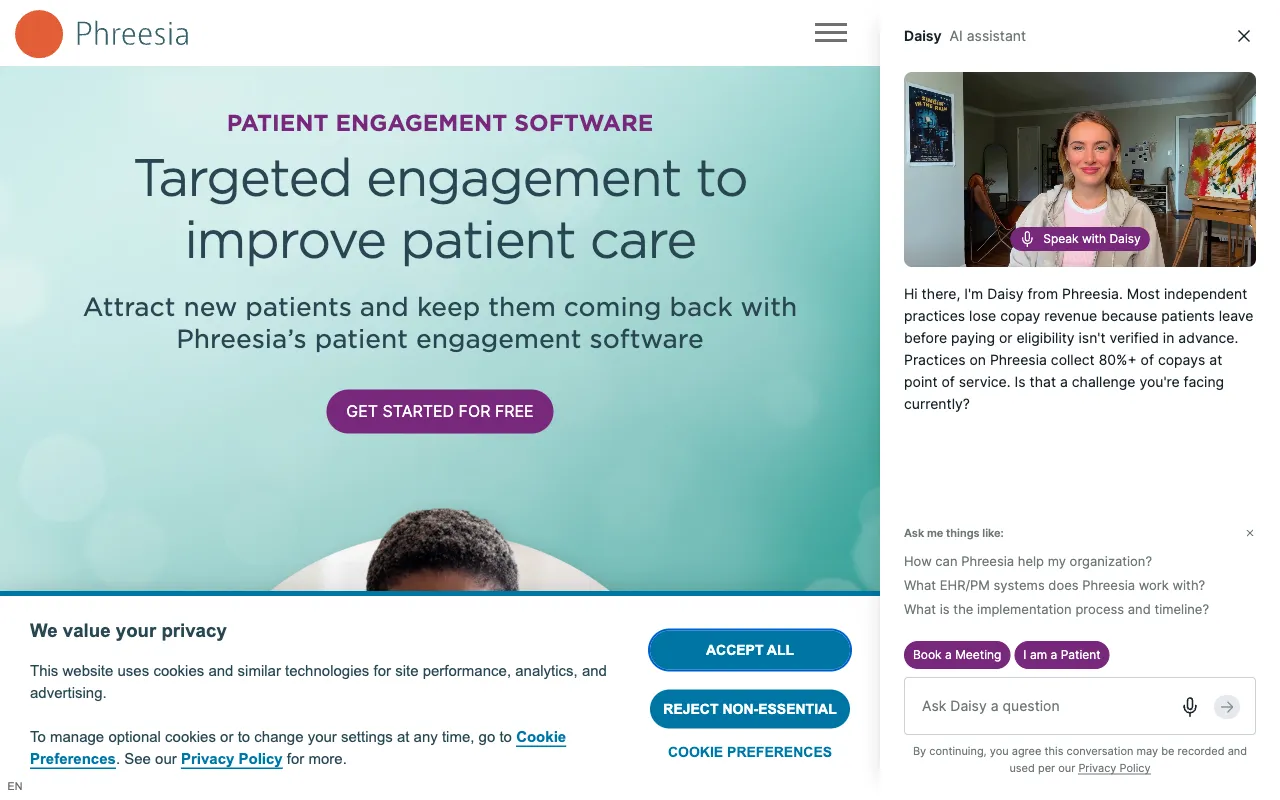
Phreesia is the reference platform for patient intake. Patients complete registration, consents, screenings, and payments before they reach the front desk, from their own phone or an in office tablet. Appointment reminders, waitlist offers, and health campaigns round out the engagement layer, and the platform's scale across US ambulatory care is unmatched in this list.
Standout features:
- Self service registration, consent, and clinical screening questionnaires
- Copay collection and payment plans built into intake
- Appointment reminders, recall, and targeted health outreach
- Analytics on intake completion, collections, and patient satisfaction
Keep in mind: Phreesia is built around the visit. Engagement between visits, education programs, and longitudinal data collection are not its core job, and pricing is quote based.
Best for: medical groups and health systems that want intake, payments, and pre visit workflows automated at scale.
3. Luma Health: best for patient access and scheduling

Luma Health positions itself as an operational AI and patient success platform: self scheduling, smart waitlists, referral conversion, reminders, and AI powered call handling that reduce the load on access centres. It sits deep in the EHR so schedule changes flow both ways in real time, and it is strongest where patient demand outstrips phone capacity.
Standout features:
- Patient self scheduling with real time EHR synchronisation
- Smart waitlist that automatically fills cancelled slots
- AI assistants for calls, faxes, and routine patient requests
- Multi channel reminders and recall campaigns
Keep in mind: Luma solves access and operations first. Surveys, education, and long term program engagement are lighter, and it is scoped to provider organisations rather than research.
Best for: health systems and large groups fixing scheduling bottlenecks, no show rates, and call centre overload.
4. OhMD: best for two way patient texting
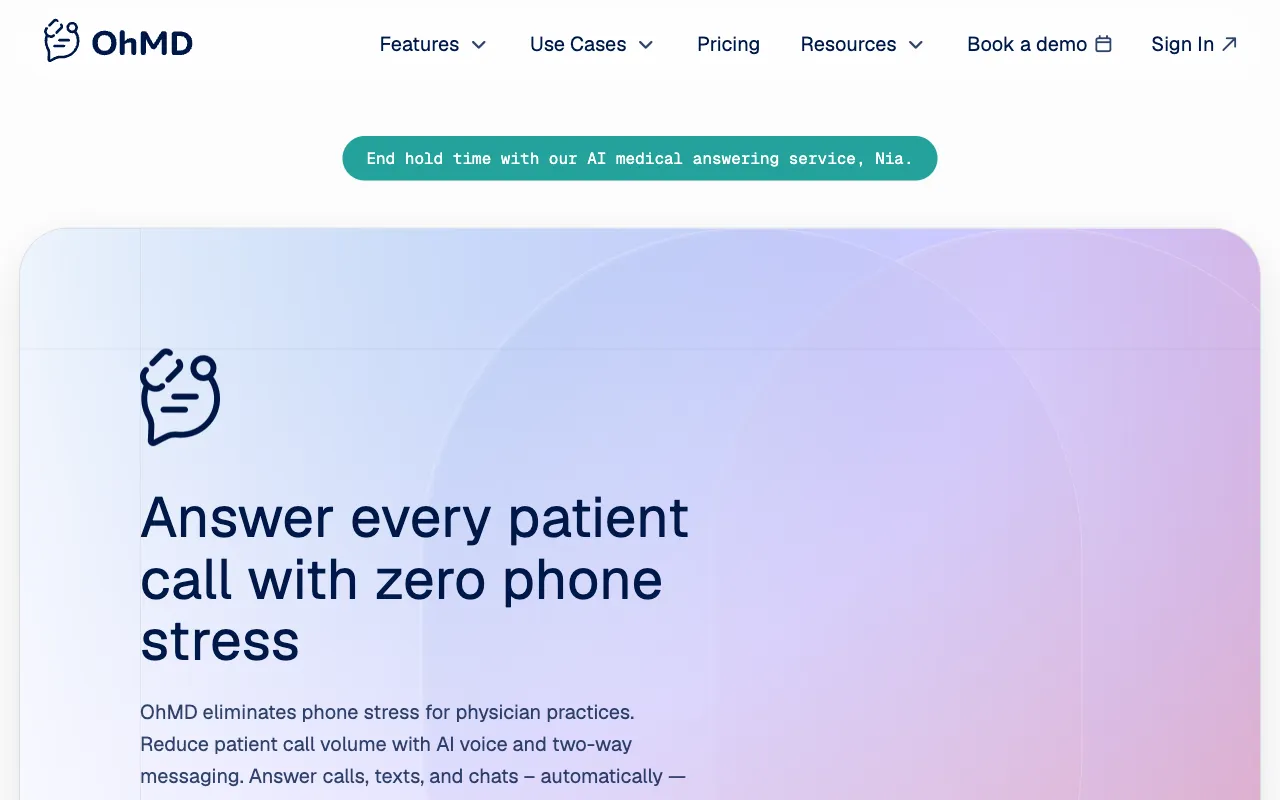
OhMD is a texting first patient communication platform for physician practices. Every conversation lands in a shared, HIPAA compliant inbox the whole team can work from, with broadcast messages, forms, and AI assisted responses layered on top. It is one of the fastest tools in this list to roll out, and practices routinely replace large chunks of phone tag with it.
Standout features:
- Two way SMS with a team inbox and templated replies
- Broadcast messaging and automated appointment reminders
- Forms and intake over text, no patient login required
- AI answering support for routine inbound questions
Keep in mind: OhMD is a communication layer, not a full engagement platform. Education programs, surveys beyond simple forms, and analytics depth are limited.
Best for: independent practices and small groups that want patients texting the office instead of calling it.
5. Klara (ModMed): best for specialty practices in the ModMed ecosystem

Klara built its name on patient messaging that keeps front desk, clinical team, and patient in one threaded conversation, with intake, reminders, and telehealth attached. Since its acquisition by ModMed, it has become the engagement arm of the ModMed specialty EHR suite, and the tightest experience now comes when the two are deployed together.
Standout features:
- Threaded patient messaging shared across the care team
- Digital intake, reminders, and lightweight telehealth
- Voicemail transcription and call deflection to text
- Deep integration with ModMed's specialty EHR workflows
Keep in mind: the roadmap increasingly assumes ModMed. Practices on other EHRs should validate integration depth before committing.
Best for: dermatology, orthopaedics, ophthalmology, and other specialty practices, especially existing ModMed customers.
6. Artera: best for enterprise health system messaging

Artera, formerly WELL Health, is the enterprise choice for patient communication. Large health systems use it to unify appointment reminders, broadcast outreach, and conversational messaging across every department, in dozens of languages, with AI agents increasingly handling routine conversations end to end. Governance features let hundreds of clinics share one platform without messaging chaos.
Standout features:
- SMS first conversational messaging at health system scale
- Multi language outreach with per department governance
- AI agents for scheduling, FAQs, and routine workflows
- Enterprise EHR integrations and analytics
Keep in mind: Artera is scoped and priced for enterprises. Small practices will find it heavy, and research style data collection is out of scope.
Best for: multi hospital systems standardising patient communication on one governed platform.
7. Weave: best all in one for small practices
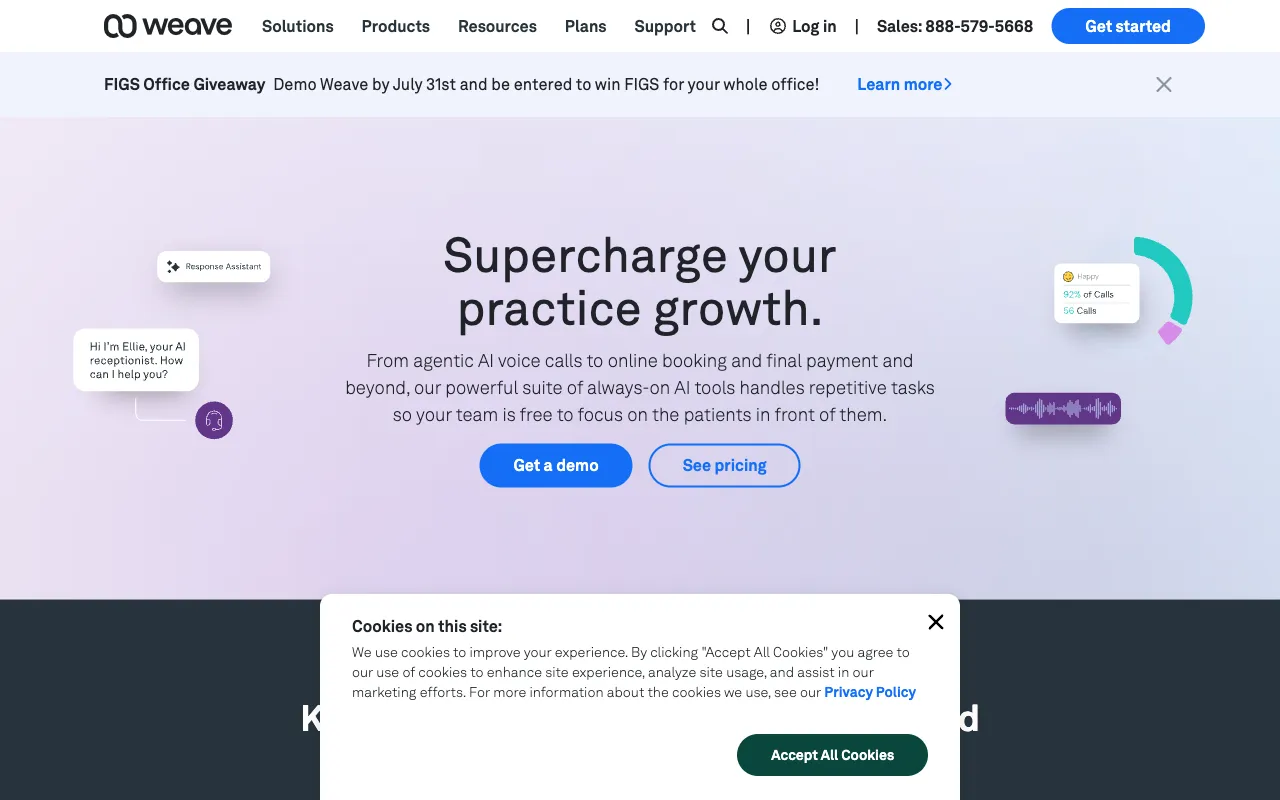
Weave bundles the entire front office communication stack for small practices: VoIP phones, two way texting, scheduling, reminders, payments, and review collection in a single subscription. It is especially entrenched in dental, optometry, and veterinary practices, where replacing a phone system and adding engagement tools in one purchase is attractive.
Standout features:
- Integrated phone system with caller insights from the practice management system
- Two way texting, reminders, and missed call text back
- Text to pay and payment plans
- Automated review requests and reputation management
Keep in mind: Weave's breadth is horizontal. Clinical depth, education content, and structured data collection are not the focus, and it targets small teams rather than systems.
Best for: small practices that want phones, messaging, payments, and reviews consolidated into one tool.
8. Solutionreach: best for recall heavy practices

Solutionreach is one of the longest standing patient engagement vendors, built around a simple loop: remind, recall, and re book. Automated reminders across text, email, and voice, recall campaigns for overdue patients, newsletters, surveys, and review management have made it a staple in dental and vision practices for two decades, with medical practices well represented too.
Standout features:
- Multi channel appointment reminders and confirmations
- Automated recall for overdue and lapsed patients
- Patient newsletters, satisfaction surveys, and review tools
- Two way texting with a shared inbox
Keep in mind: the model centres on appointment volume. Programs, education journeys, and outcomes data sit outside its lane.
Best for: dental, optometry, and primary care practices where recall discipline drives revenue.
9. NexHealth: best for online booking and EHR synchronisation
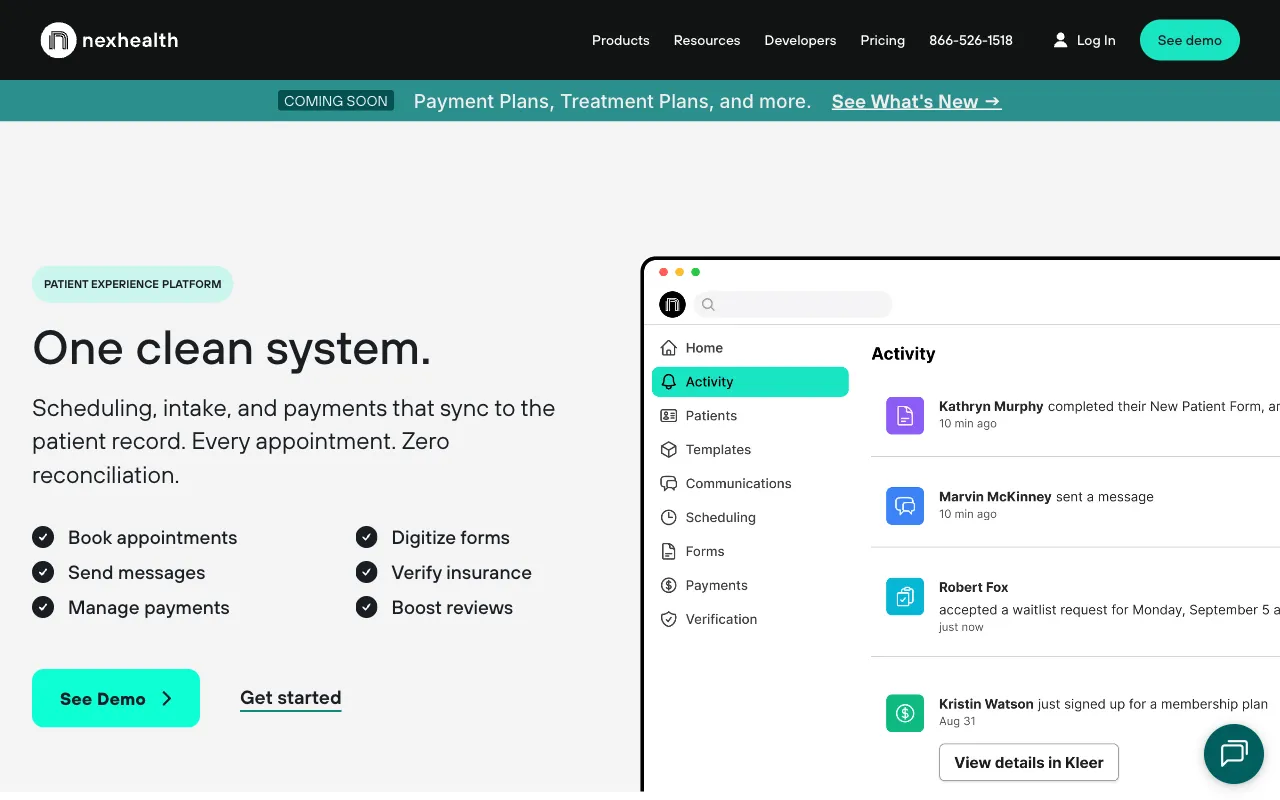
NexHealth automates the front office around real time online booking: patients book into live EHR and practice management calendars, then reminders, digital forms, payments, and reviews follow automatically. Its Synchronizer technology, which reads and writes to systems that lack modern APIs, also makes NexHealth a favourite integration layer for digital health builders.
Standout features:
- Real time online scheduling synced to the EHR or PMS
- Automated reminders, digital forms, and text to pay
- Review generation and waitlist management
- Developer API for third party integrations
Keep in mind: NexHealth is strongest in dental and ambulatory settings. Engagement beyond the booking to visit loop is thinner.
Best for: growth focused practices that live and die by online booking, and product teams needing EHR connectivity.
10. TeleVox: best for high volume hospital outreach

TeleVox has run patient outreach for hospitals and health systems for decades, and it still owns the high volume, omnichannel use case: appointment reminders, procedure prep, post discharge follow up, and preventive care campaigns delivered across automated voice, SMS, email, and web chat. For organisations where a large share of patients still answer the phone rather than a text, its voice heritage is a genuine advantage.
Standout features:
- Omnichannel campaigns across voice, SMS, email, and chat
- EHR integrated reminders and recall at system scale
- Post discharge and preventive care outreach workflows
- Conversational AI for routine inbound calls
Keep in mind: TeleVox is outreach infrastructure. Patient facing apps, education programs, and survey depth are not the product.
Best for: hospitals and health systems running millions of outreach touches a year across mixed channels.
11. QliqSOFT: best for chatbot led virtual care journeys

QliqSOFT combines secure clinical texting with Quincy, a no code chatbot platform that walks patients through education, intake, post discharge check ins, and virtual visits without an app download. Care teams get HIPAA compliant messaging among themselves as well, which makes QliqSOFT a bridge between staff communication and patient engagement.
Standout features:
- No code chatbot builder for education and follow up journeys
- Secure texting for care teams and patients
- Virtual visits and digital forms without app installs
- Campaign style outreach for defined patient cohorts
Keep in mind: chatbot journeys are the strength; longitudinal programs, wearables, and research workflows are not in scope.
Best for: hospitals and virtual care teams that want guided, chatbot led patient journeys quickly.
12. Emitrr: best budget option for small clinics

Emitrr is a horizontal SMB communication tool with a strong healthcare footprint. Clinics use it for two way texting, appointment reminders, missed call text back, review requests, and simple automations at a price point well below the healthcare specific platforms in this list. For a small clinic that mainly needs reliable texting and reminders, it covers the essentials.
Standout features:
- Two way texting and bulk SMS campaigns
- Appointment reminders and missed call text back
- Review generation and simple workflow automation
- Integrations with common practice management tools
Keep in mind: Emitrr is not healthcare native. Clinical workflows, compliance depth, and engagement beyond messaging are limited, so validate HIPAA arrangements carefully.
Best for: budget conscious small clinics that need dependable texting and reminders without enterprise overhead.
See how research grade patient engagement works
94% adherence across 6,000+ participants in five countries. Explore how WeGuide combines eConsent, ePRO surveys, education, and wearable data in one white label platform.
Best Patient Engagement Software by Use Case
- Clinical trials and decentralised studies: WeGuide. Purpose built participant engagement with eConsent, ePRO, and wearables. For a trials only comparison, see the best patient engagement software for clinical trials. For the design side, see our guide to decentralised studies.
- Patient registries and cohort studies: WeGuide. Long term retention is the product's core job, proven across GenV's 100,000+ families and the FSHD Global registry.
- Hospital digital health programs: WeGuide for program depth, Artera or TeleVox for pure outreach volume.
- Intake, payments, and front desk automation: Phreesia first, NexHealth where online booking leads.
- Reducing no shows in a busy system: Luma Health for access and scheduling, Artera for enterprise messaging.
- A small practice's first engagement tool: OhMD for texting, Weave for an all in one stack, Emitrr on a tight budget.
- Recall driven specialties: Solutionreach, with Weave as the all in one alternative.
- Chatbot guided education and follow up: QliqSOFT's Quincy, with WeGuide where education needs to live inside a broader program.
How to Choose Between Patient Engagement Software Vendors
Run every shortlist through the same six checks we scored this list with. First, name your segment honestly: front office, outreach, or program engagement. Second, demand engagement depth beyond reminders if patients need to do anything between visits, complete surveys, read education, or contribute device data. Third, map integrations to your actual stack: EHR and PAS for care, REDCap and EDC for research, open APIs for anything custom. Fourth, ask each vendor for published engagement numbers from real deployments; treat a refusal as an answer. Fifth, match compliance to your risk: HIPAA support is the floor, and regulated research adds GDPR, ISO 27001, and 21 CFR Part 11 aligned workflows. Sixth, interrogate the pricing model: per provider subscriptions can quietly outgrow project based pricing as you scale, and six figure minimums make pilots impossible.
Two more practical filters separate digital patient engagement tools that get used from those that stall. Ask who configures changes after go live: if every tweak is a vendor ticket, adoption dies with your team's patience, which is why no code configuration ranks so highly in our criteria. And ask what patients see: a branded, multi language experience patients recognise consistently outperforms a generic third party interface on enrolment and retention.
Five Red Flags When Evaluating Patient Engagement Platforms
The demos in this category are uniformly impressive, so the fastest way to separate patient engagement platforms is to look for the warning signs vendors cannot polish away.
- No published engagement numbers. If a vendor cannot show adherence, retention, or completion rates from a named deployment, assume the average deployment does not produce numbers worth showing. Case study logos are not data.
- Every change is a professional services ticket. Ask to watch someone build a reminder sequence or edit a survey live in the demo. If the answer involves a statement of work, your program will move at the vendor's pace, not yours.
- The patient experience is generic. Patients respond to their hospital, their study, their language. A tool that cannot white label the app, or that treats additional languages as a paid add on, will underperform on enrolment in every diverse population.
- Compliance answers stop at HIPAA. For US only clinic messaging that may be fine. The moment your program touches research, international sites, or medical device territory, ask specifically about GDPR, ISO 27001 certification, and 21 CFR Part 11 aligned workflows, and get the answers in writing.
- Pricing punishes starting small. Six figure annual minimums for a pilot force you to commit before you have evidence the tool works in your population. Prefer vendors whose pricing scales down as well as up, so the evidence can come first.
None of these flags is fatal in isolation, but two or more together predict the outcome buyers fear most: an expensive platform that patients never open.
Frequently Asked Questions
What is the best patient engagement software in 2026?
There is no single winner, because the category spans three different jobs. Phreesia leads patient intake and payments, Luma Health leads access and scheduling, Artera leads enterprise health system messaging, and WeGuide leads research grade engagement for clinical trials, registries, and digital health programs. Match the tool to the job, then compare within that segment.
What is the difference between patient engagement software and a patient portal?
A patient portal is a passive record store: patients log in to look up results. Patient engagement software is active: it sends reminders, delivers education, collects surveys and wearable data, and follows up automatically between visits. Most organisations run both. Our patient engagement software guide covers the comparison in detail.
How much does patient engagement software cost?
Practice communication tools typically charge per provider or per location per month, from budget SMB tools like Emitrr up to enterprise platforms priced by quote. Research grade platforms like WeGuide use project based pricing that scales with study or program complexity, with every module included. Whatever the model, confirm implementation fees, support tiers, and whether pilots carry minimum commitments.
What is the best patient engagement software for clinical trials?
Purpose built research platforms beat retrofitted practice tools for trials, because consent, ePRO, and retention workflows are regulated and longitudinal. WeGuide sustained 94% adherence across 6,000+ participants in the five country BRACE trial. Our separate guide to clinical trial patient engagement software compares the research segment in depth. If Huma is on your research shortlist, our Huma alternatives comparison covers that segment too.
Are patient engagement tools HIPAA compliant?
Every healthcare specific vendor on this list supports HIPAA compliant workflows, but the details matter: confirm a signed BAA, encryption in transit and at rest, role based access, and audit trails. Horizontal SMB tools need extra scrutiny. Research programs should additionally look for ISO 27001, GDPR readiness, and 21 CFR Part 11 aligned workflows.
How do patient engagement tools improve outcomes?
They lower the effort of staying involved: reminders cut missed appointments and doses, education improves comprehension, surveys surface problems between visits, and wearables fill in objective data. The effect is measurable when engagement is sustained, which is why we recommend judging vendors on published adherence and retention numbers rather than feature lists. Learn more in our guide to patient engagement in clinical trials.
See research grade patient engagement in action
Compare WeGuide against any platform on this list with your own program's requirements. A 30 minute demo shows how eConsent, ePRO surveys, education, and wearable data run in one white label app.
Book a demoNo pressure, just a conversation.

