


The Michigan Neuropathy Screening Instrument (MNSI)
The Michigan Neuropathy Screening Instrument helps clinicians detect nerve damage in diabetic patients. It pairs a survey with a foot exam to identify risks early.


Michigan Neuropathy Screening Instrument (MNSI)
The Michigan Neuropathy Screening Instrument (MNSI) is a two-part tool used to screen for diabetic neuropathy. Combining a questionnaire with a physical foot exam, it helps clinicians spot nerve damage early. It’s a key test for preventing serious complications like foot ulcers in diabetic patients.
Category
Disease
Source
What is Michigan Neuropathy Screening Instrument (MNSI)

The Michigan Neuropathy Screening Instrument (MNSI) is a trusted tool for checking diabetic peripheral neuropathy and spotting nerve damage early on. This assessment splits into two distinct sections. The first part is a self-administered questionnaire, while the second involves a detailed physical foot exam. Patients answer fifteen simple Yes or No questions about leg sensations plus pain. Afterward, a healthcare pro checks foot appearance, ulceration risk, ankle reflexes, and vibration perception to build a complete clinical picture for the patient file. It is quick to use in busy clinics and does not hurt at all. Doctors use it often for diabetes care to stop foot ulcers before they start. It is really useful for tracking changes over time and making sure treatment plans work well for long-term patient health outcomes in daily clinical practice.
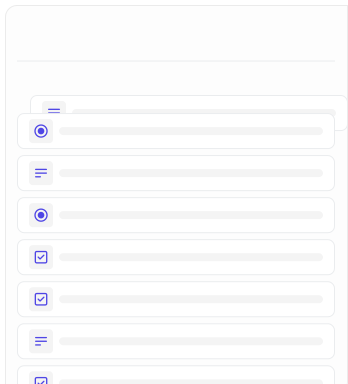
The Michigan Neuropathy Screening Instrument can be scored using two main approaches: a survey and a physical exam.1. Questionnaire: Patients answer 15 yes or no questions about leg and foot sensation. We tally abnormal responses to get a total out of 13, as two questions generally do not count. A score of 7 or higher indicates trouble.2. Physical Assessment: A clinician inspects the feet for deformities, dry skin, and ulcers. They also test ankle reflexes and vibration perception. Each foot earns points for deficits, summing to a max score of 10. A score greater than 2 typically flags diabetic neuropathy.
Advantages

Enables precise identification of patient health status.
.svg)
Streamlines research data gathering process.
.png)

Related Instruments

Digital counterpart
Digital biomarkers that measure the same thing with sensors rather than a questionnaire.
Streamline Michigan Neuropathy Screening Instrument assessments with WeGuide
.jpg)

Support Your patient in no time - all under your own brand
Our platform combines the knowledge of 100+ digital health solutions built, letting you easily build your patient engagement app for research or clinical use. Collect PROMs, support patients on waiting lists, or gather vital signs data. This is how:
Learn More.png)
Program Builder
.png)
.png)
Whitelabelling
.svg)
.svg)
.png)
Turn on components, dependent on your usecase
.svg)
.png)
Support The Full Journey
.png)
.png)
%20(1).png)
.png)
It’s your turn
Every WeGuide project, saves researchers and clinicians - 9 months and $450,000 - creating impactful digital health solutions.
