



Harris Hip Score (HHS): Measuring Hip Function
The Harris Hip Score evaluates pain and function following hip surgery. Doctors use this tool to monitor recovery in patients with joint replacements. It provides clear data on treatment outcomes.

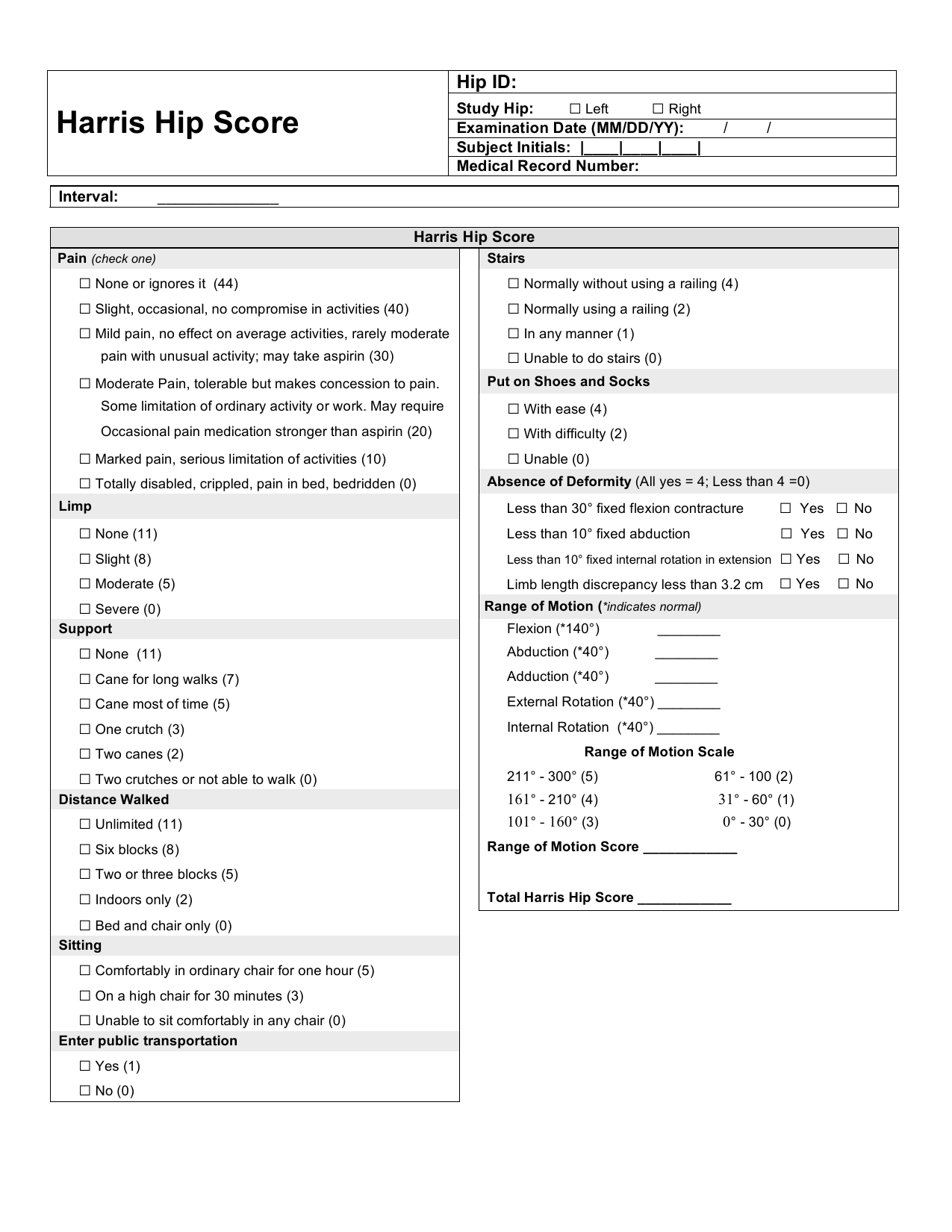
Harris Hip Score (HHS)
The Harris Hip Score (HHS) is a key tool for evaluating hip function and pain, especially after arthroplasty. It covers pain, daily function, deformity, and range of motion to produce a score out of 100. This helps clinicians track recovery progress and surgical outcomes accurately.
Category
Disease
Source
What is Harris Hip Score (HHS)

The Harris Hip Score (HHS) is a widely used tool for checking specific hip function and pain levels. It helps clinicians track recovery outcomes after surgery. This assessment looks at four main areas including pain severity, daily function, absence of deformity, and range of motion to build a clear clinical picture. The total score goes up to a maximum of 100 points. Pain takes up the biggest chunk at 44 points while function covers gait and daily activities like putting on shoes. A total below 70 is considered poor while anything over 90 is excellent. Doctors usually fill this out during a check-up to monitor progress after a hip replacement or fracture. It only takes a few minutes but gives reliable data on joint stability. This feedback helps medical teams decide if a current treatment plan is working well or if changes are needed for better mobility.

The Harris Hip Score can be scored using one main approach: summing points from four specific categories. You will tally up points from four sections: pain, function, range of motion, and absence of deformity. Pain holds the most weight at 44 points, while function covers daily activities like walking and climbing stairs for 47 points. Physical checks for motion and deformity add the final 9 points. The total score ranges from 0 to 100. A result over 90 is excellent, while anything under 70 is considered a poor outcome. It is a solid way to track recovery after hip surgery.

Advantages
.svg)
Measures treatment effectiveness through standardised tools.
.svg)
Meets international clinical assessment requirements.
.svg)
Tracks patient condition changes systematically.
.svg)
Strengthens evidence through systematic measurement approaches.
.png)

Related Instruments

Digital counterpart
Digital biomarkers that measure the same thing with sensors rather than a questionnaire.
Collect Harris Hip Score data with WeGuide, the all in one patient engagement platform
.jpg)

Support Your patient in no time - all under your own brand
Our platform combines the knowledge of 100+ digital health solutions built, letting you easily build your patient engagement app for research or clinical use. Collect PROMs, support patients on waiting lists, or gather vital signs data. This is how:
Learn More.png)
Program Builder
.png)
.png)
Whitelabelling
.svg)
.svg)
.png)
Turn on components, dependent on your usecase
.svg)
.png)
Support The Full Journey
.png)
.png)
%20(1).png)
.png)
It’s your turn
Every WeGuide project, saves researchers and clinicians - 9 months and $450,000 - creating impactful digital health solutions.
