

.svg)
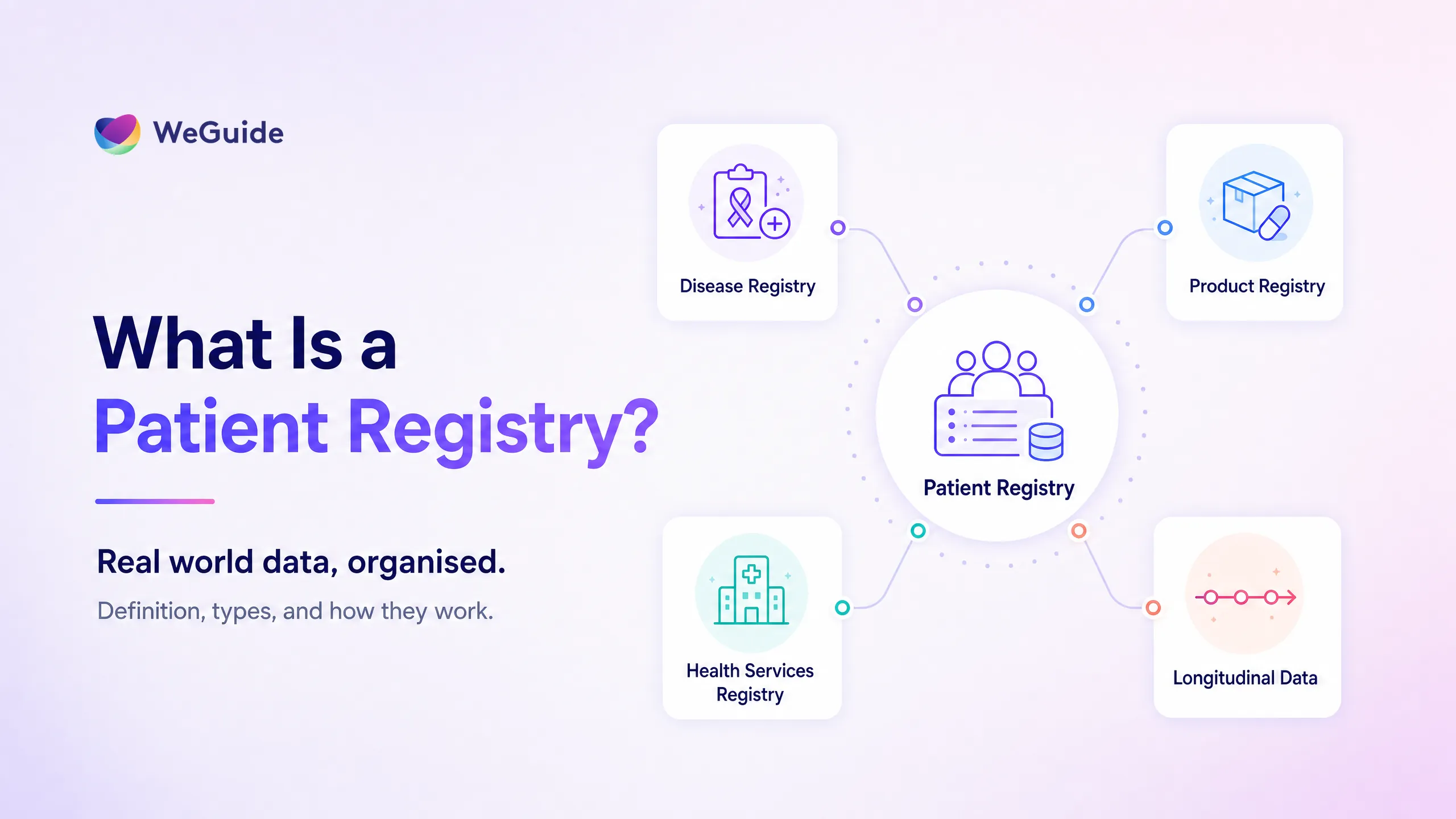


A patient registry is an organised system that collects standardised health information from a defined group of people who share a disease, a condition, a treatment, or a health service, so researchers and clinicians can follow what happens to them over time. Rather than a single snapshot, a registry runs continuously, tracking the same patients across months and years to build a real world picture of how a condition behaves and how care performs.
For sponsors, patient advocacy groups, and research teams, that continuous view answers questions a single clinical trial cannot. This guide explains what a patient registry is, why registries matter, the main types you will meet, how they differ from clinical trials, how one works in practice, and what to look for in a patient registry platform. WeGuide builds and runs registries, including the FSHD rare disease registry with the FSHD Global Foundation and the GenV cohort of more than 100,000 families, so the focus here is practical rather than theoretical.
Key Takeaways
- A patient registry tracks a defined group over time. It collects standardised data from people who share a disease, a product exposure, or a health service, building a continuous record rather than a single snapshot.
- Registries answer real world questions trials cannot. They follow patients in ordinary care, which supports natural history research, safety monitoring, and real world evidence.
- There are three main types. Disease registries, product registries, and health services registries differ by how they define the population they follow.
- A registry is only as good as its data. Clear consent, standardised data capture, and strong governance decide whether registry data holds up for research and regulators.
- Software choice shapes the outcome. The right patient registry platform handles consent, longitudinal data capture, participant engagement, and privacy in one place.
What Is a Patient Registry?
A patient registry is an organised system that uses observational methods to collect uniform data on a group of patients who share a defined characteristic, such as a disease, a condition, or a treatment, and follows them over time to study health outcomes. The data serves one or more predefined scientific, clinical, or policy purposes.
That definition sits at the heart of the field and is set out in the NCBI reference Defining Patient Registries and Research Networks. Two words in it do the heavy lifting. Observational means a registry watches and records what happens in ordinary care, without assigning anyone a treatment. Defined means the registry sets clear rules about who belongs in it before a single person is enrolled.
The practical effect is one structured source of truth for a patient population. Instead of scattered notes across different hospitals and clinics, a registry holds the same fields, captured the same way, for every participant. That consistency is what lets a research team count cases, measure outcomes, and spot patterns that individual records would hide.
Why Patient Registries Matter
Registries matter because they capture what happens to real patients, in real settings, over the time periods that actually matter to a disease. A clinical trial might follow a few hundred people for a year under tight conditions. A registry can follow thousands for a decade as they live ordinary lives. That difference opens up questions that trials are not built to answer.
The purpose of a patient registry depends on who runs it, but most serve one or more of these aims:
- Natural history. Describe how a disease starts, progresses, and varies, which is often the first step for a rare condition with little published data.
- Safety and outcomes. Watch how a drug, device, or procedure performs after approval, including rare effects that a trial was too small to detect.
- Quality of care. Compare outcomes across sites and feed the results back to improve practice.
- Research readiness. Identify and reach eligible participants quickly when a trial or study opens.
- Policy and access. Give payers and regulators evidence on how a treatment works in practice.
The AHRQ handbook Registries for Evaluating Patient Outcomes: A User's Guide remains the reference text for designing registries around these purposes, and most regulators point back to it.
For rare conditions the case is even stronger. When a disease affects only a few thousand people worldwide, no single hospital sees enough patients to learn from. A rare disease registry pools those scattered cases into one dataset, which is why patient foundations so often start one. WeGuide built exactly this kind of registry with the FSHD Global Foundation, giving a dispersed community a shared place to contribute data.
Types of Patient Registries
Registries are usually grouped by how they define the patients they follow. The three most common types of patient registries are disease registries, product registries, and health services registries. The data they hold overlaps, but the entry rule, the sponsor, and the typical use differ.
| Type | What it tracks | Example | Who runs it |
|---|---|---|---|
| Disease registry | All patients with a specific disease or condition, regardless of treatment | A cystic fibrosis or FSHD registry following every diagnosed patient | Patient foundations, academic centres, clinical networks |
| Product registry | Patients exposed to a particular drug, device, or biologic | A registry following everyone who received a specific implant or medicine | Manufacturers and sponsors, often for regulators |
| Health services registry | Patients linked by a procedure, service, or care setting | A joint replacement or intensive care registry | Hospitals, health systems, professional bodies |
A disease registry, sometimes called a condition registry, is the type most people picture. It follows everyone with a given diagnosis to map how the condition behaves and how patients fare. Our guide to disease registries goes deeper on how they are designed and used.
A product registry, also called an exposure registry, follows patients because of something they received rather than a diagnosis they share. These are common after a medicine or device reaches the market, when a regulator wants ongoing safety data on how it performs in everyday use.
A health services registry groups patients by a procedure or care episode, such as a joint replacement or an admission to intensive care. These tend to focus on quality and outcomes across providers, and they often feed national audits.
Plenty of registries blend these definitions, and some are sorted instead by purpose, such as quality registries or post market safety registries. The label matters less than getting the population rule clear before enrolment begins.
Patient Registry vs Clinical Trial
The quickest way to understand a registry is to set it against a clinical trial. A clinical trial is interventional and controlled. It assigns participants to a treatment or a comparison, follows a strict protocol, and runs for a fixed period to test a specific hypothesis. A patient registry is observational. It records what happens in routine care, does not assign treatment, and usually has no fixed end date.
That makes the two complementary rather than rival. A trial answers whether a treatment works under controlled conditions. A registry shows what happens once that treatment meets the messy reality of everyday practice, across a wider and more varied group of patients. Registries can also feed trials, by identifying eligible participants and supplying external comparison data.
We break the differences down in full, including when to choose each, in our guide to patient registry vs clinical trial.
Build a registry your participants will stay with
WeGuide brings eConsent, digital forms, longitudinal data capture, and a branded participant app into one platform, so registry data lands clean and people keep contributing.
How a Patient Registry Works
Every registry runs on the same chain: define the population, consent participants, capture data, and govern it well. Get that chain right and the data is trustworthy. Skip a step and gaps appear that no analysis can fix later. Patient foundations often start with limited resources, and the NIH NCATS Toolkit is a useful free resource for planning a registry or natural history study.
It all begins with a clear protocol that sets the population, the data fields, and the purpose. From there the work falls into three parts.
Consent and enrolment
Participants must agree to join and to have their data used, which means informed consent that holds up to ethics review. Registries increasingly use electronic consent so people can join from home and so the consent record stays current as the registry evolves. Our guide to eConsent for patient registries covers how digital consent works for studies that run over many years.
Data capture
Data comes in through digital forms completed by clinicians, by participants themselves as patient reported outcomes, and through links to hospital systems or wearables. The goal is the same field, captured the same way, every time. Patient registry data is only useful when it is standardised, complete, and current, which is why reminders and a simple participant experience matter as much as the form design.
Governance and privacy
A registry holds sensitive health data for years, so governance is not optional. That means clear rules on who can access data, how it is kept secure, how privacy law is met, and how data quality is checked over time. Good governance is also what lets a registry share data for research without breaking participant trust.
For a walkthrough of setting one up from scratch, see our guide to how to build a patient registry.
Patient Registries and Real World Evidence
Registries are one of the richest sources of real world evidence (RWE), the clinical evidence drawn from data collected outside controlled trials. Because a registry follows defined patients over time with structured fields, it produces exactly the kind of longitudinal real world data that regulators and payers increasingly accept.
That evidence supports decisions a trial cannot reach alone: how a treatment performs across a broad population, how safe it is over years, and how a disease progresses without intervention. Regulators including the FDA and EMA have built frameworks for using this kind of data, and well run registries sit at the centre of many of them.
The link is not automatic. Raw registry data becomes real world evidence only when it is collected to a standard a regulator will trust. We explain how registries feed that pipeline in our guide to patient registries and real world evidence.
Choosing Patient Registry Software
The software behind a registry decides how much of this is straightforward and how much is a constant struggle. A registry is a long term commitment, so the platform has to handle consent, longitudinal data capture, participant engagement, and privacy without a stack of disconnected tools.
A few things matter most when choosing:
- Consent built in, so enrolment and renewed consent are handled in the same system as the data.
- Flexible digital forms, so you can capture clinician entered and patient reported data and change fields as the registry grows.
- Participant engagement, because a registry depends on people coming back year after year, which a branded app, reminders, and multilingual support all help with.
- Standards and security, including audit trails, access control, and compliance with health privacy law. WeGuide is TGA Class I certified medical device software and supports GCP aligned data capture, though sponsors remain responsible for their own regulatory strategy.
- Integration, so the registry connects to hospital systems, wearables, and analysis tools rather than trapping data in one place.
Our patient registry software buyer's guide works through these criteria in detail. This is the model WeGuide is built on, proven on registries from the FSHD rare disease community to the GenV cohort, where keeping a large group engaged over time is the whole task.
Frequently Asked Questions
What is the purpose of a patient registry?
The purpose of a patient registry is to collect consistent data on a defined patient group over time so researchers can study a disease, monitor the safety of a treatment, measure quality of care, or find eligible participants for studies. One registry often serves several of these aims at once.
What is the difference between a patient registry and a clinical trial?
A clinical trial assigns participants to a treatment and tests it under a strict protocol for a set period. A patient registry is observational. It records what happens in routine care, does not assign treatment, and usually runs without a fixed end date, giving a real world view across a broader group.
What are the main types of patient registries?
The three main types are disease registries, which follow everyone with a condition, product registries, which follow patients exposed to a drug or device, and health services registries, which group patients by a procedure or care setting. Many registries combine these, and some are sorted by purpose instead.
What medical conditions have a patient registry?
Thousands of conditions have registries, from common ones like diabetes, cancer, and heart disease to rare diseases such as cystic fibrosis or FSHD. Rare disease communities rely on registries most, because pooling scattered cases is often the only way to build enough data to study the condition properly.
What is patient registry data?
Patient registry data is the standardised information a registry holds on each participant, including diagnosis, treatments, outcomes, and patient reported measures, captured the same way over time. Its value comes from consistency and completeness, which is why standardised forms, clear definitions, and ongoing data checks matter so much.
How do you set up a patient registry?
Setting up a registry starts with a clear protocol that defines the population, the data fields, and the purpose. From there you arrange ethics approval and consent, choose a platform for consent and data capture, and put governance in place. Free planning resources like the NCATS Toolkit can help.
Conclusion
A patient registry turns scattered records into a continuous, structured account of a patient group, and that is why sponsors, foundations, and research teams keep building them. The value sits in the chain behind it: define the population clearly, consent participants well, capture standardised data, and govern it for the years a registry runs.
Get that right and a registry becomes far more than a list. It supports natural history research, safety monitoring, quality improvement, and the real world evidence that regulators now expect. The decisions follow a clear order. Settle the purpose and population first, choose the registry type that fits, then build the consent, data capture, and engagement that keep people contributing. WeGuide is the platform that brings those pieces together, proven on registries from rare disease communities to large longitudinal cohorts.
Plan your patient registry with confidence
Walk through how WeGuide handles consent, longitudinal data capture, and participant engagement for registries of any size.
Book a demoNo pressure, just a conversation.

