

.svg)
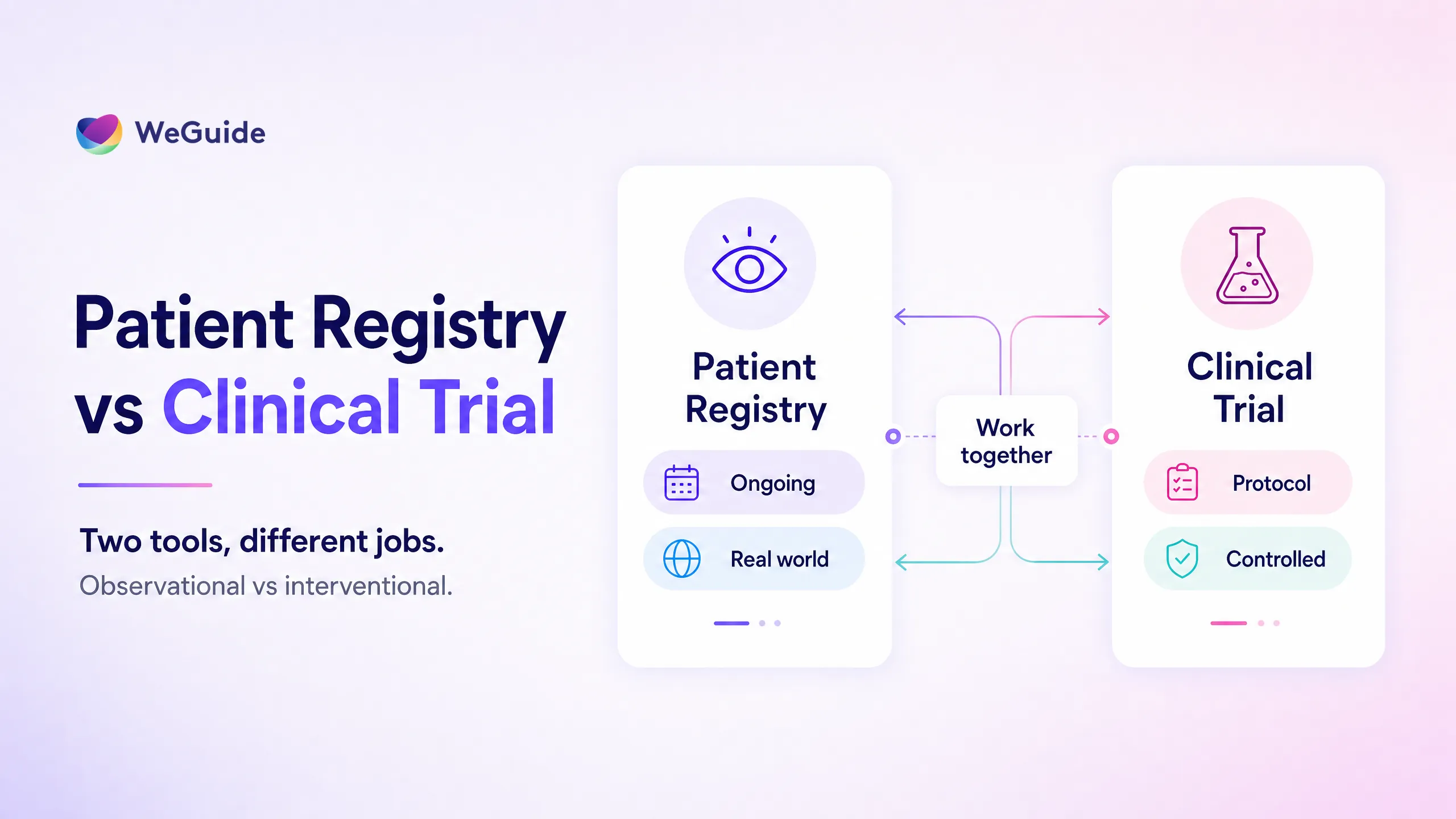


A patient registry and a clinical trial both collect health data, but they answer different questions. A patient registry is an observational study that follows a defined group of people over time to record how a disease behaves and how patients fare under routine care. A clinical trial is an interventional study that tests whether a specific treatment is safe and works, under a fixed protocol. That is the heart of patient registry vs clinical trial. A registry observes what happens, while a trial steps in and changes something.
This guide explains the difference between a registry and a clinical trial across design, data, duration, and regulatory role, then shows when a registry study is the right tool and how the two work together. WeGuide builds the participant facing layer for both, so if you are weighing up a patient registry platform against a trial setup, the decision itself is what matters here. If you are new to the topic, start with our explainer on what is a patient registry.
Key Takeaways
- A registry observes, a trial intervenes. A patient registry records care and outcomes as they happen, while a clinical trial assigns a treatment and measures the result.
- The data sources differ. Registries draw on real world data from routine care, patients, and devices. Trials collect protocol driven data from scheduled study visits.
- Time horizons are not the same. Registries are usually open ended and run for years. Trials are fixed and stop at a defined endpoint.
- They answer different questions. A registry asks how a disease or population behaves over time. A trial asks whether one intervention is safe and works.
- They feed each other. Registries help identify and recruit eligible participants for trials, and they generate real world evidence once a treatment is in use.
Patient Registry vs Clinical Trial: The Short Answer
If you only remember one thing, make it this. A clinical trial is built to test cause and effect. It introduces an intervention, controls the conditions, and measures what changes, which is why it sits at the centre of drug and device approval. A patient registry is built to capture reality. It records how people with a condition are actually managed and how they do, without changing their care.
That difference shapes everything else, from the data you collect to how long the study runs and what regulators expect. Neither is better in the abstract. A trial gives you a clean answer to a narrow question. A registry gives you a broad, long view of a disease or population. Most research programmes need both at different stages.
Getting the distinction right early saves money and rework. If you call a study a registry but design it like a trial, you take on cost you do not need. If you treat a trial like a registry, you risk a result that cannot support a submission. The sections below help you place your study on the right side of that line.
What a Patient Registry and Clinical Trial Are For
A clinical trial exists to answer a precise question, usually whether a treatment is safe and works in a defined group under controlled conditions. Participants are enrolled against strict eligibility criteria, often assigned to a treatment or comparison group, and followed to a set endpoint. The design is there to remove as much bias as possible so the result can support a regulatory submission.
A patient registry exists to understand a disease, condition, or population over time. It enrols people who share a characteristic, such as a diagnosis or a procedure, and records their care and outcomes as they happen in the real world. The US Agency for Healthcare Research and Quality describes a registry as an organised system that uses observational methods to collect uniform data for one or more predetermined purposes, set out in its handbook Registries for Evaluating Patient Outcomes.
Here is how the two compare across the dimensions that matter most.
| Dimension | Patient registry | Clinical trial |
|---|---|---|
| Study design | Observational, follows people as they are managed | Interventional, assigns a treatment or comparison |
| Intervention | None, care continues as normal | Yes, tests a drug, device, or procedure |
| Data source | Real world data from clinics, patients, and devices | Protocol driven data from scheduled study visits |
| Duration | Open ended, often runs for years | Fixed, runs to a defined endpoint |
| Primary purpose | Understand a disease or population over time | Prove whether an intervention is safe and works |
| Regulatory role | Supports post market surveillance and real world evidence | Supports approval of a new treatment |
The table is a starting point rather than a hard line. Some registries are highly structured, and some trials, such as pragmatic trials, borrow registry style real world data collection.
Observational vs Interventional Studies
The clearest way to frame registry vs trial is the split between observational and interventional research. In an observational vs interventional study comparison, the deciding question is simple. Does the study change what happens to the participant, or does it only watch and record?
A clinical trial is interventional. The research team decides who gets the treatment, the dose, and the schedule, and that decision is part of the study. Because the team controls the variable being tested, a well run trial can show that the treatment, and not something else, caused the outcome. This is why randomised controlled trials are the standard for proving that a new therapy works.
A patient registry is observational. Clinicians and patients make their usual care decisions, and the registry records what they choose and what follows. Nothing about the registry changes the treatment. That makes the data messier than a trial, because people are not matched into neat groups, but it also makes it a truer picture of everyday practice. The US National Library of Medicine sets out these definitions in Defining Patient Registries and Research Networks.
Both designs can run remotely. WeGuide supports decentralised clinical trials and registries from the same participant app, so the observational or interventional choice does not force you into a particular data collection model.
Run a registry that is ready for real world evidence
WeGuide builds branded, multilingual registries with eConsent and longitudinal data capture, so you can follow a population for years and feed clean data into trials and RWE.
When to Choose a Registry Study
Choose a registry study when your question is about a population over time rather than a single intervention. Registries suit rare diseases, where cases are scattered and you need to gather enough people to learn anything. They suit long term safety and outcomes, where you want to see what happens over years, not weeks. They also suit natural history work, mapping how a condition progresses before a treatment even exists.
A registry is often the practical first step in a rare disease. WeGuide built a rare disease registry with the FSHD Global Foundation, which gives a dispersed patient community one place to contribute data over time. Large scale population work fits the same pattern. The GenV programme follows a broad cohort of newborn families, capturing data that would be impossible to collect through a single trial.
Choose a clinical trial instead when you need to prove that a specific treatment causes a specific outcome, because only an interventional design can do that with confidence. In practice many teams run a registry first to understand the disease and find participants, then run trials, then return to a registry to track real world use. If a registry is your next step, our guide on how to build a patient registry walks through the design and data decisions.
How Registries and Clinical Trials Work Together
Registries and clinical trials are not rivals. The strongest research programmes use each to make the other better. The two main bridges are recruitment and real world evidence.
On recruitment, a registry is a ready made pool of characterised, consenting participants. When a trial opens, the team can search the registry for people who meet the eligibility criteria and invite them, which is faster and cheaper than starting recruitment from scratch. For rare conditions, a registry is sometimes the only realistic way to find enough eligible participants for a trial at all.
On evidence, registries pick up where trials stop. A trial proves a treatment works under controlled conditions in a selected group. A registry then tracks how that treatment performs in everyday practice across a wider population, which generates the real world evidence regulators increasingly expect for post market surveillance. The same participant facing technology can serve both. WeGuide ran the BRACE trial with the Murdoch Children's Research Institute on a WeGuide app, supporting more than 6,000 participants across five countries with over 90% participant adherence in a six week deployment, and that same longitudinal capture is what a registry needs to follow a population for years.
The lesson is to plan the relationship early. If you design a registry with trial recruitment and real world evidence in mind, you collect the right data, with the right consent, from the start.
Frequently Asked Questions
What is the main difference between a patient registry and a clinical trial?
A patient registry is observational and records care and outcomes as they happen, without changing treatment. A clinical trial is interventional and tests whether a specific treatment is safe and works under a fixed protocol. In short, a registry observes a population while a trial intervenes and measures the result.
Is a patient registry observational or interventional?
A patient registry is observational. It follows people who share a diagnosis or characteristic and records their routine care and outcomes over time, without assigning treatments or controlling conditions. This is the key distinction in any observational vs interventional study comparison, and it is what separates a registry from a clinical trial.
What is a registry study?
A registry study is observational research that collects uniform data on a defined group of patients, usually those with a particular disease, condition, or procedure, for a set purpose. It follows participants over time in routine care to understand outcomes, safety, and how a condition progresses, rather than testing an intervention.
Can a patient registry support a clinical trial?
Yes. A registry can identify and recruit eligible participants for a trial, supply natural history data that informs trial design, and act as a source of comparison data. After a trial, a registry tracks how the treatment performs in everyday practice, which generates real world evidence for regulators and post market surveillance.
Is a registry cheaper than a clinical trial?
Usually, yes, per participant. A registry uses routine care data and does not run a controlled intervention, so it avoids much of the cost of trial visits, monitoring, and treatment delivery. That said, a good registry runs for years, so the long term commitment is real even when the per participant cost is lower.
Do patient registries need regulatory approval?
Registries need ethics approval, informed consent, and data protection controls, just like other research involving people. They are not approved in the way a trial protocol is, because they do not test a treatment, but registry data is increasingly used in regulatory decisions, so quality and consent need to meet a high standard from the start.
Conclusion
The patient registry vs clinical trial question comes down to one distinction. A registry observes a population over time to understand a disease, while a trial intervenes under a controlled protocol to prove whether a treatment is safe and works. The difference between a registry and a clinical trial then flows through design, data source, duration, and regulatory role.
For most research programmes the answer is not one or the other. A registry study helps you understand a condition, find participants, and follow real world outcomes, while trials give you the clean evidence that a treatment works. Decide which question you are answering, then design the study, the consent, and the data capture to match. WeGuide is the participant facing layer for both, bringing eConsent, multilingual forms, and longitudinal data capture together so a registry and a trial can share clean, connected data.
Build a registry that works with your trials
See how WeGuide supports patient registries and clinical trials in one branded participant app, from eConsent to longitudinal, analysis ready data.
Book a demoNo pressure, just a conversation.

