

.svg)
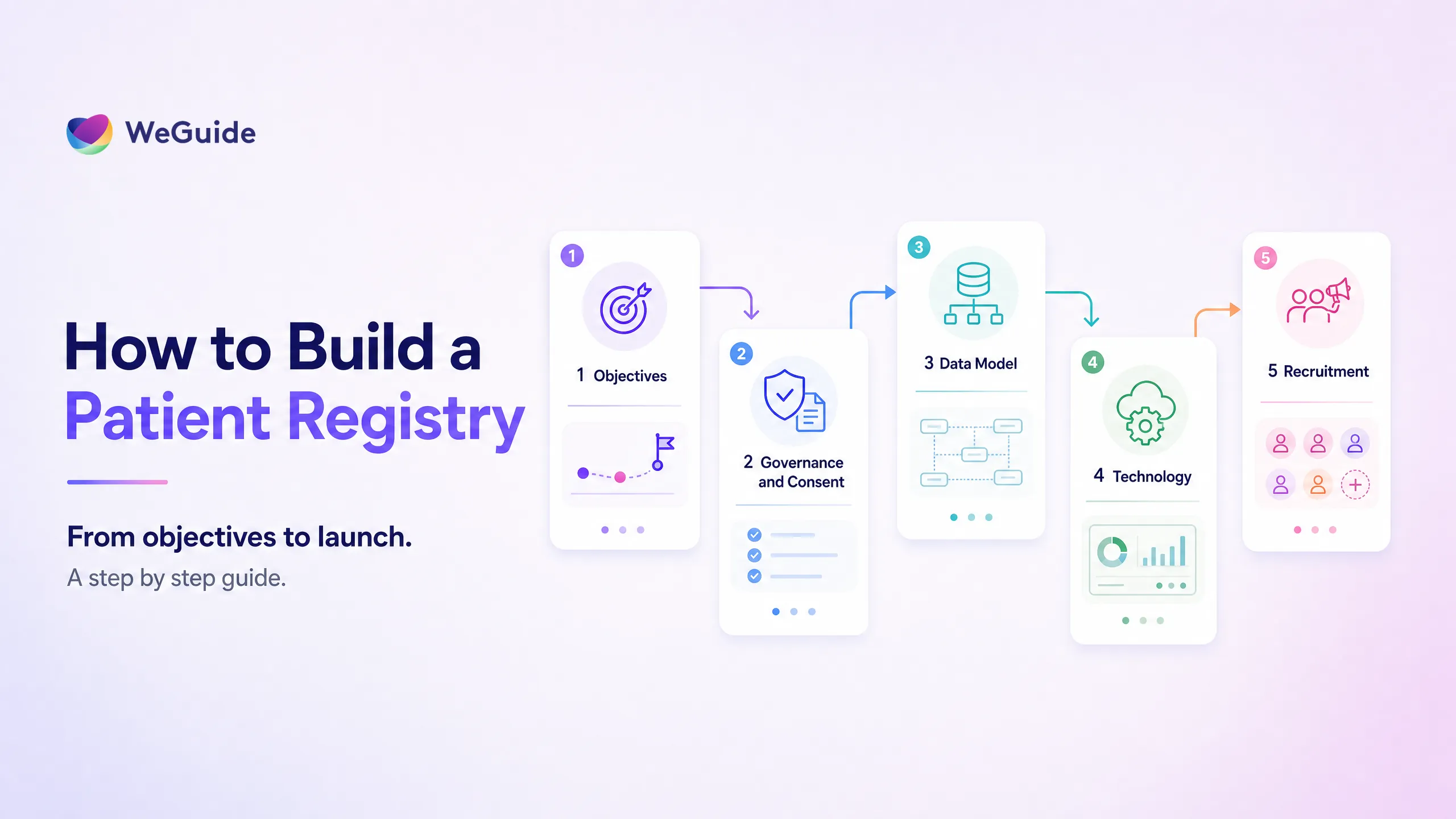


Building a patient registry means setting up an organised system that collects health information about a defined group of people over time, usually those who share a condition, a treatment, or an exposure. To build a patient registry you work through six steps: define your objectives and scope, set up governance and consent, design the core dataset, choose the technology, plan recruitment and retention, then manage data quality and long term sustainability. Knowing how to set up a patient registry is less about software and more about clear purpose and sound governance.
This guide walks through each step in order, with the decisions and the common mistakes at every stage. It is written for sponsors, patient advocacy groups, and research teams who want a registry that answers real questions and lasts beyond its first year. WeGuide builds the patient registry platform that many of these registries run on, so the notes below reflect how they come together in practice. For the definition and the different registry types, start with our pillar guide to what is a patient registry.
Key Takeaways
- Purpose comes before technology. A registry succeeds or fails on a clear objective and a defined population, not on the platform you pick.
- Governance and consent are the foundation. Ethics approval, a consent model, and clear data rules protect participants and keep the registry usable.
- Collect the minimum dataset that answers your questions. Over collecting data is the most common reason sites fall behind and quality slips.
- Recruitment is only half the job. A registry lives on retention, so the participant experience and follow up matter as much as enrolment.
- Plan for the long term from day one. Funding, analysis, and governance need a plan that reaches well past launch.
How Do You Build a Patient Registry?
A patient registry is built in six steps that move from purpose to long term operation. You define what the registry is for, put governance and consent in place, design the data you will collect, choose the technology to capture it, recruit and retain participants, then manage data quality and funding so the registry lasts.
The order matters. Many registries that later struggle built the technology first and did the hard thinking afterwards. The table below summarises the six steps, the key decisions at each one, and the pitfalls to avoid. The sections that follow work through each step in detail.
| Step | Key decisions | Common pitfalls |
|---|---|---|
| 1. Objectives and scope | Primary purpose, research questions, population definition, registry vs natural history study | Vague aims that collect everything and answer nothing |
| 2. Governance, ethics, consent | Oversight model, ethics approval, consent model, data sharing rules | Treating consent as a one off form rather than ongoing permission |
| 3. Core dataset and data model | Minimum data set, common data elements, coding standards, versioning | Over collecting variables that sites cannot sustain |
| 4. Technology and data capture | Build vs buy, eConsent, forms, integrations, hosting | Choosing a tool before the dataset and workflow are clear |
| 5. Recruitment and retention | Site and patient recruitment, participant app, follow up cadence | Strong enrolment followed by a silent drop off |
| 6. Data quality and sustainability | Validation rules, monitoring, analysis plan, funding | No plan for funding or governance beyond year one |
Step 1: Define Patient Registry Objectives and Scope
A registry starts with a single question: what is it for? The clearest registries can state their primary purpose in one sentence, such as describing how a disease progresses, monitoring the safety of a treatment after approval, measuring quality of care, or building a pool of participants for future studies. Write that purpose down first, because every later decision flows from it.
From the purpose come your research questions. These define the population, the variables, and the follow up you need. Be specific about who is eligible. A clear case definition, with inclusion and exclusion criteria, keeps the cohort meaningful and stops the registry from drifting into an unfocused database.
Scope is the next decision. A narrow registry that answers a few questions well is almost always more useful than a sprawling one that collects everything and analyses little. Decide how long you intend to follow participants, how often you will collect data, and what counts as success.
This is also where the natural history study framing matters. A natural history study tracks how a condition behaves over time without an intervention, and a registry is often the structure that holds that data. For rare diseases especially, a registry designed as a natural history study can describe progression, surface candidate outcome measures, and prepare the ground for trials that may follow. The US National Center for Advancing Translational Sciences pairs registries with natural history studies for exactly this reason, and its NCATS Toolkit sets out practical guidance for rare disease groups planning one.
It helps to be clear on what a registry is and is not at this stage. A registry observes a population over time, while a clinical trial tests an intervention under a protocol. Our explainer on patient registry vs clinical trial covers the difference, which shapes your ethics, consent, and analysis from the start.
Step 2: Governance, Ethics, and Consent
Governance is what turns a data collection effort into a trustworthy registry. Before any participant enrols, decide who owns the registry, who makes decisions about it, and who can access the data. Many registries set up a steering committee, and rare disease registries often include patient representatives so the people the registry serves have a voice in how it runs.
Ethics approval comes next. Most registries need review by an ethics committee or institutional review board, even when they only collect observational data. The committee will want to see your purpose, your consent process, your data protections, and your plan for sharing results. Build time for this into your schedule, because approval can take longer than teams expect.
Consent is the part that defines the participant relationship. Registries usually rely on broad consent, where participants agree to ongoing data collection and to future research uses that cannot all be named in advance. That makes the consent wording, and the ability to update it, more important than in a one off study. Treat consent as a living permission, not a single form signed once.
Electronic consent makes this practical at scale. With eConsent, participants can read or watch plain language materials, ask questions, and give consent remotely, with a clear audit trail and version control as the registry evolves. This matters most for long running registries where people consent once and stay enrolled for years. Our guide to eConsent for patient registries covers the consent models and re consent situations specific to registries.
Set your data governance rules early too. Decide how data is stored, who can request it, how it is shared, and how participant privacy is protected. WeGuide is TGA Class I certified medical device software and supports secure, documented data capture, though the registry owner remains responsible for ethics approval and data governance.
Step 3: Design the Core Dataset and Data Model
With purpose and governance set, design the data. The goal is a minimum dataset, the smallest set of variables that answers your research questions reliably. Every extra field adds work for sites and participants and a new place for data quality to slip, so discipline here pays off for years.
Start from your research questions and work backwards to the variables you genuinely need. Group them into demographics, clinical characteristics, treatments, and outcomes, and decide which are collected once and which are collected at each follow up. Be honest about what sites can realistically supply at every visit.
Wherever you can, use common data elements and recognised coding standards rather than inventing your own. Standard definitions for diagnoses, medications, and outcomes make your data comparable with other registries and easier to use in future research. The AHRQ handbook Registries for Evaluating Patient Outcomes: A User's Guide is the reference most teams turn to for dataset design and data element selection, and it is freely available.
Think about the data model, not just the field list. Map how records relate to one another, how repeated measures over time are stored, and how you will handle changes to the dataset as the registry matures. A registry that runs for a decade will need to add or revise fields, so plan for versioning from the outset.
Patient reported outcomes deserve a place in many registries, because they capture how people actually feel and function between visits. Validated instruments collected directly from participants add a dimension that clinical records alone miss, and they often become the measures that future trials build on.
Turn your registry design into a working system
WeGuide gives sponsors, advocacy groups, and research teams one platform for eConsent, configurable forms, and a branded participant app, so your registry runs cleanly from day one.
Step 4: Choose the Technology and Data Capture
Only once the dataset and workflow are clear should you choose the technology. Picking a platform first is the most common sequencing mistake, because the tool then shapes the registry instead of the other way around.
The first decision is build versus buy. Building a registry from scratch gives full control but demands engineering, security, and maintenance that most research teams underestimate. A purpose built platform gets you to launch faster and carries much of the compliance and hosting burden, which is why most registries today run on configurable software rather than custom code.
Whatever you choose, the technology needs to do a few things well. It has to capture structured data through clear forms, collect consent electronically, support data entry by both sites and participants, and store everything securely with a full audit trail. With a digital form builder, research teams can build and update registry forms without code, which matters when the dataset changes over the life of the registry.
Integration is the next consideration. A registry rarely sits alone. It may need to receive data from electronic health records, link to wearables for continuous measures, or export to analysis tools and other registries. Decide which connections you need early, because adding them later is harder.
For registries that follow people over years, the participant facing side is as important as the back end. A branded app that participants recognise and trust keeps them engaged and supports multilingual access for diverse populations, which widens who can take part and keeps the cohort representative.
Step 5: Recruitment and Retention
A registry only delivers value if people join and stay. Recruitment has two layers: bringing in sites or clinics that contribute participants, and engaging the participants themselves. For rare diseases, patient advocacy groups are often the most effective recruiters, because they hold the trust and the reach that clinical sites alone cannot match.
Make joining simple. Remote, electronic consent lets people enrol from home rather than waiting for a clinic visit, which widens reach and speeds enrolment. Clear, plain language materials that explain why the registry exists and how the data helps make people far more likely to take part.
Retention is where many registries quietly fail. Strong enrolment can mask a slow drop off as participants stop responding to follow ups. The fix is a participant experience that respects people's time and keeps them connected, through reminders, updates on how their data is being used, and a follow up cadence that is steady without becoming a burden.
WeGuide has supported registry and longitudinal cohort work in practice. The FSHD rare disease registry with the FSHD Global Foundation shows how a focused rare disease community can sustain a registry over time, and GenV, a large birth cohort, shows the same principles at population scale, where a participant friendly app helps families stay involved for the long term. The lesson from both is consistent: a registry that treats participants as partners holds on to them.
Step 6: Patient Registry Data Quality, Analysis, and Sustainability
Data quality is built in, not bolted on. The most reliable registries set validation rules at the point of entry, so ranges, required fields, and logic checks catch errors before they reach the database. Periodic monitoring and data cleaning then keep the dataset trustworthy as it grows.
Define your quality measures up front. Completeness, the share of expected data actually captured, and consistency across sites are the usual ones. A registry with high enrolment but patchy follow up data cannot answer the questions it was built for, so track these measures from the start rather than discovering gaps at analysis time.
Plan the analysis before you collect the data, not after. Knowing how you will analyse the registry shapes the dataset, the follow up schedule, and the quality thresholds you set. Many registries also publish a summary of findings for participants, which both honours the consent agreement and helps retention.
Sustainability is the step teams most often skip, and the one that decides whether a registry survives. A registry is a long term commitment, so it needs a funding model, a governance structure, and an operational plan that reach well beyond launch. Think about who pays for hosting and support in year three, who maintains the dataset, and how the registry adapts as research priorities shift.
Done well, a registry becomes infrastructure. It can feed natural history studies, support post market safety work, identify participants for trials, and generate real world evidence for years. That return only comes to registries designed for the long haul from the very first step.
Frequently Asked Questions
How long does it take to build a patient registry?
Most patient registries take six to twelve months from planning to first enrolment, though simple registries can launch faster and complex multi site ones take longer. The longest stages are usually ethics approval and dataset design. Using a configurable platform rather than custom software shortens the build time considerably.
What is the difference between a patient registry and a natural history study?
A natural history study describes how a condition develops over time without any intervention. A patient registry is the organised system that collects and holds that data. In rare diseases the two often overlap, because a registry is frequently the practical way to run a long term natural history study.
Do you need ethics approval to set up a patient registry?
Yes, in almost all cases. Even though a registry only observes participants rather than testing a treatment, it collects identifiable health data, so an ethics committee or institutional review board usually has to approve the purpose, the consent process, and the data protections before enrolment begins.
What data should a patient registry collect?
Collect the minimum dataset that answers your research questions, no more. That usually means demographics, clinical characteristics, treatments, and outcomes, with patient reported outcomes where they add value. Using common data elements and recognised coding standards makes your data comparable with other registries and useful for future research.
How much does it cost to build a patient registry?
Cost depends on the size, the data complexity, and whether you build or buy. The main expenses are technology, staff time, ethics and governance, and long term hosting and support. A configurable platform usually costs less than custom development and makes ongoing costs easier to predict across the registry's life.
Can a small patient group build a registry?
Yes. Many successful registries are run by small rare disease communities and advocacy groups. The keys are a clear purpose, sound governance, and a platform that does not need an engineering team to operate. Patient organisations often recruit and retain participants better than large institutions can.
Conclusion
Learning how to build a patient registry comes down to sequence and discipline. Define the purpose and population first, put governance and consent on a sound footing, design the smallest dataset that answers your questions, then choose technology that fits the workflow rather than the other way around. Recruitment, retention, and a real plan for data quality and funding turn that design into a registry that lasts.
The registries that deliver value years later are the ones that did this thinking before they built a single form. WeGuide is the participant facing platform that brings eConsent, configurable forms, and a branded app together, so a registry can capture clean, consistent data from the first participant to the long term follow up. Whatever your condition or cohort, start with the purpose and let every other decision follow from it.
Build a patient registry that lasts
See how WeGuide brings eConsent, configurable forms, and a branded participant app together so your registry captures clean, consistent data for years.
Book a demoNo pressure, just a conversation.

