

.svg)
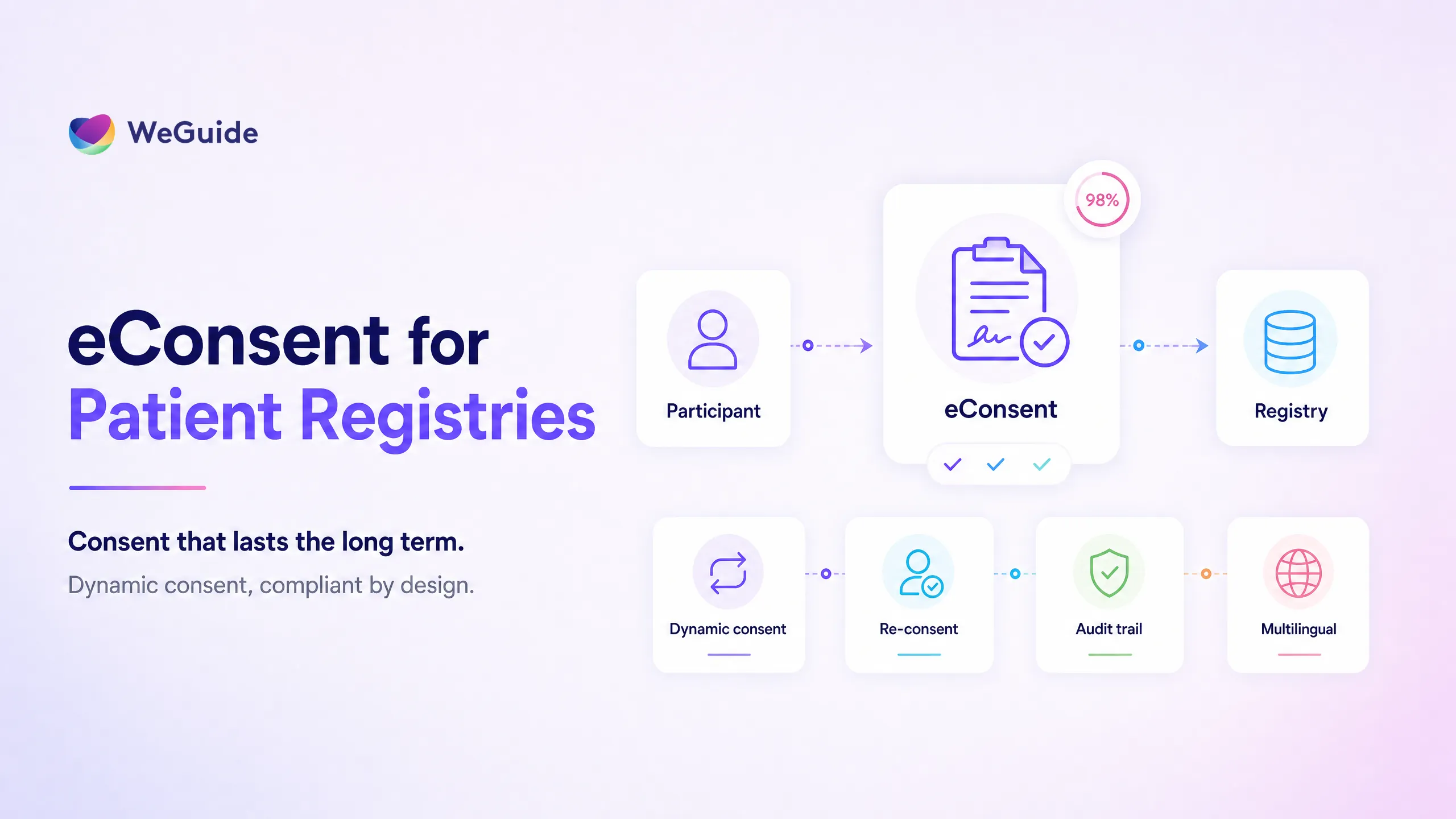


eConsent for patient registries is electronic informed consent built for studies that follow the same people for years, not weeks. Instead of a paper form signed once at enrolment, participants read, understand, and sign on their own phone or computer, and the registry keeps a clear record of what each person agreed to and when. For a registry that may run a decade or longer, that living record is what keeps consent valid as the study, the data uses, and the participants themselves change.
A patient registry collects health information from people who share a condition, exposure, or treatment, and uses it to answer questions over time. If you are new to the model, start with our guide to what is a patient registry. Consent is the part registries most often get wrong, because a one off paper signature cannot keep up with reconsent, withdrawals, and minors who grow into adults during the study. This guide walks through why registries need eConsent, the consent challenges unique to long term cohorts, how dynamic and broad consent work, the features that matter, and the compliance and ethics that hold it all together.
Key Takeaways
- eConsent suits registries because consent is ongoing, not a one off. Participants sign digitally and the registry keeps a versioned, time stamped record of what each person agreed to as the study evolves.
- Long term cohorts create consent that paper cannot track. Reconsent for new data uses, partial withdrawals, and minors reaching adulthood all need a system that updates each person's status without losing the audit trail.
- Dynamic and broad consent give participants real choice. Broad consent allows future research within agreed limits, while dynamic consent lets people change their preferences at any time from their own device.
- A few features decide whether registry eConsent works. Version control, granular preferences, multilingual forms, comprehension support, and a complete audit trail matter more than a digital signature alone.
- Compliance spans several frameworks at once. Registries often answer to GDPR, HIPAA, ICH GCP, and local ethics or IRB review, so the consent record has to satisfy all of them.
Why Patient Registries Need eConsent
Patient registries need eConsent because consent in a registry is not a single event. It is a relationship that has to stay current for as long as the registry runs, which can be many years. Electronic consent gives a registry a way to capture, version, and update each participant's agreement without losing the record of what came before.
A paper consent form does one job well. It records that a person agreed to take part on a given day. The problem is that registries keep collecting data, adding research questions, and sharing information with new partners long after that day has passed. When the study changes, paper offers no clean way to go back to thousands of people, explain what is new, and record their fresh decision. eConsent does, because the form, the signature, and the participant's preferences all live in one connected record.
This matters most for the registries that run the longest. WeGuide's eConsent powers patient and disease registries that follow people over time, including the FSHD rare disease registry with the FSHD Global Foundation and GenV, a large birth cohort that follows families from newborn onward. In studies like these, the value of the registry grows the longer people stay enrolled, so the consent process has to make staying easy and leaving simple. If you are planning a new cohort, our guide on how to build a patient registry covers where consent fits in the wider build.
Consent Challenges in Long Term Registries
Long term registries face consent problems that short studies rarely meet. The same people stay enrolled for years, life circumstances change, and the registry itself evolves. Three challenges come up again and again, and each one is hard to handle on paper.
Reconsent when the study changes
A registry that started with one research aim often grows to support many. Each new data use, partner, or linkage may fall outside the original consent, which means going back to participants to explain the change and record a new decision. With paper, that is a mailout, a wait, and a filing problem. Electronic consent lets a registry send an updated form to the people affected, capture their response, and keep both the old and new versions linked to each person.
Withdrawals and partial withdrawals
People have the right to leave a registry at any time, and many want to limit rather than end their involvement. Someone might agree to keep contributing existing data but decline future recontact, or withdraw from a biobank while staying in the survey arm. These partial choices are easy to describe and hard to track by hand. A digital system records exactly what a person has withdrawn from and when, so the registry honours the choice without deleting the evidence that it was made.
Minors who reach adulthood
Paediatric and birth cohort registries enrol children under a parent or guardian's consent. When those participants turn eighteen, that consent no longer covers them, and the registry needs their own agreement to continue. Tracking birthdays across thousands of participants and asking each one to consent in their own right at the right moment is a real operational task. eConsent can flag when a participant is approaching adulthood and prompt the move from parental consent to the participant's own.
Consent that keeps up with a long running registry
WeGuide eConsent captures digital signatures, versions every form, and lets participants update their preferences from their own device, so your registry record stays current for years.
Dynamic and Broad Consent
Two consent models help registries handle change, and most strong registries use a mix of both. Broad consent sets the outer limits of what participants agree to up front. Dynamic consent gives them a live way to adjust their choices inside those limits over time.
Broad consent asks participants to agree to a defined range of future research, rather than one specific study. For a registry this is practical, because the exact studies a dataset will support are not known at enrolment. Broad consent is not a blank cheque. Ethics committees expect clear limits on the kinds of research allowed, the types of partners involved, and the governance that decides what proceeds. Done well, a broad consent registry model lets valuable data support new questions without a fresh consent round for every project.
Dynamic consent works alongside it. Instead of a fixed agreement, participants have an ongoing connection, usually through a secure portal or app, where they can see how their data is used and change their preferences whenever they like. They can opt in to a new sub study, decline recontact for a period, or update who may access their information. For long running cohorts, dynamic consent turns consent from a one off signature into a relationship participants can manage themselves.
The two models answer different needs. Broad consent gives a registry the legal and ethical room to grow. Dynamic consent gives participants real control day to day. Registry consent management is strongest when both are in place, because the registry can pursue new research while participants keep a clear say. Much of this thinking carries over from eConsent in clinical trials, though registries lean harder on the dynamic side because the time horizon is so much longer.
eConsent Features That Matter for Registries
Not every eConsent tool suits a registry. A platform built for a single trial may handle one consent version and a fixed end date, while a registry needs to manage many versions and preferences over an open ended timeline. The features below are the ones that decide whether registry eConsent holds up.
| Feature | Why it matters for registries | What to look for |
|---|---|---|
| Version control | Consent forms change over years as the registry adds data uses | Each participant linked to the exact form version they signed |
| Granular preferences | People want to allow some uses and decline others | Toggle level choices for data sharing, recontact, and biobanking |
| Dynamic consent portal | Preferences and circumstances change over a long study | A participant can review and update consent any time from their device |
| Multilingual forms | Registries often span regions and communities | Validated translations, not machine output, with the same logic in every language |
| Comprehension support | Valid consent depends on understanding, not just a signature | Plain language, short videos, and optional knowledge checks |
| Audit trail | Ethics committees and regulators ask who consented to what and when | Time stamped, exportable record of every signature and change |
| Withdrawal handling | Participants can leave or limit involvement at any point | Clear options that update data use without breaking the record |
Beyond the table, fit with the rest of the registry matters. Consent records should connect to the participant's profile, their surveys, and any linked data, so a withdrawal or preference change flows through to what the registry actually collects. WeGuide brings consent, participant communication, and data collection into one branded app, which is why teams running long term cohorts use it as their patient registry platform rather than stitching separate tools together.
Compliance and Ethics
Registries sit under more rules than a single study, because they often run across regions, share data with many partners, and last for years. Consent is where most of those rules meet, so the eConsent record has to satisfy several frameworks at once.
Under GDPR, consent for health data must be specific, informed, and freely given, and people have the right to withdraw and to access their data. This is part of why dynamic consent fits European registries so well, because it gives participants the standing control the regulation expects. In the United States, HIPAA governs how identifiable health information is used and shared, and registry authorisations need to be clear about disclosures. The EMA's guidance on patient registries sets out how registry data is expected to support regulatory decisions, which raises the bar for how consent and data quality are documented.
Where a registry feeds interventional research or regulated submissions, ICH GCP principles and electronic records expectations apply. The US FDA's guidance on the use of electronic informed consent explains what regulators expect from digital consent, from clear presentation to secure signatures and records. WeGuide is TGA Class I certified medical device software and supports the documented, secure consent capture these frameworks call for, though the registry sponsor remains responsible for the consent design, governance, and regulatory strategy.
Ethics review sits over all of it. An IRB or ethics committee approves the consent materials, the broad consent limits, and how participants can change or withdraw their agreement. The clearer your consent record, the easier that review becomes, because the committee can see exactly what each participant was asked and what they decided. Good registry consent is not only a compliance task. It is how a registry keeps the trust that makes people willing to stay enrolled for years.
Frequently Asked Questions
What is eConsent for patient registries?
eConsent for patient registries is electronic informed consent designed for studies that follow the same participants over many years. Participants read and sign on their own device, and the registry keeps a versioned, time stamped record of what each person agreed to, updating it as the study and its data uses change.
What is the difference between broad consent and dynamic consent?
Broad consent asks participants to agree to a defined range of future research at enrolment, within limits an ethics committee approves. Dynamic consent gives them an ongoing way to view and change those preferences over time. Most registries use both, pairing broad permission with participant level control.
Can registry participants withdraw consent after signing?
Yes. Participants can withdraw at any time, and many choose partial withdrawal, such as keeping existing data in the registry while declining future recontact or biobanking. eConsent records exactly what a person has withdrawn from and when, so the registry honours the decision without losing the audit trail.
How does eConsent handle minors who reach adulthood in a registry?
Paediatric and birth cohort registries enrol children under parental consent. When a participant turns eighteen, that consent no longer covers them. eConsent can flag participants approaching adulthood and prompt them to provide their own consent, so the registry can keep following them with a valid, current agreement.
Is eConsent for registries compliant with GDPR and HIPAA?
eConsent supports compliance with GDPR and HIPAA, but compliance depends on how the registry is set up. GDPR requires specific, informed consent and the right to withdraw, while HIPAA governs how health information is disclosed. A clear, versioned consent record helps a registry meet both, alongside ethics approval.
Do registries need to reconsent participants?
Often, yes. When a registry adds new data uses, partners, or linkages beyond the original agreement, participants usually need to be asked again. eConsent makes this practical by sending updated forms to the people affected, capturing their response, and linking each new version to the participant's record.
Conclusion
eConsent for patient registries is less about replacing a paper signature and more about keeping consent alive for the whole life of the study. Registries change, partners join, participants grow up, and people change their minds, and the consent record has to keep pace with all of it. Broad consent gives a registry room to grow, dynamic consent gives participants control, and the right features and audit trail hold the two together.
Decide your consent model early, design it with your ethics committee, and choose a system that can version forms, track preferences, and handle withdrawals across a long timeline. Get that right and consent stops being a compliance hurdle and becomes part of why participants trust your registry enough to stay. WeGuide brings eConsent, participant engagement, and data collection into one branded app built for registries that run for years.
Build a registry participants trust
See how WeGuide eConsent supports dynamic consent, broad consent, and long term registry follow up in one branded participant app.
Book a demoNo pressure, just a conversation.

