

.svg)
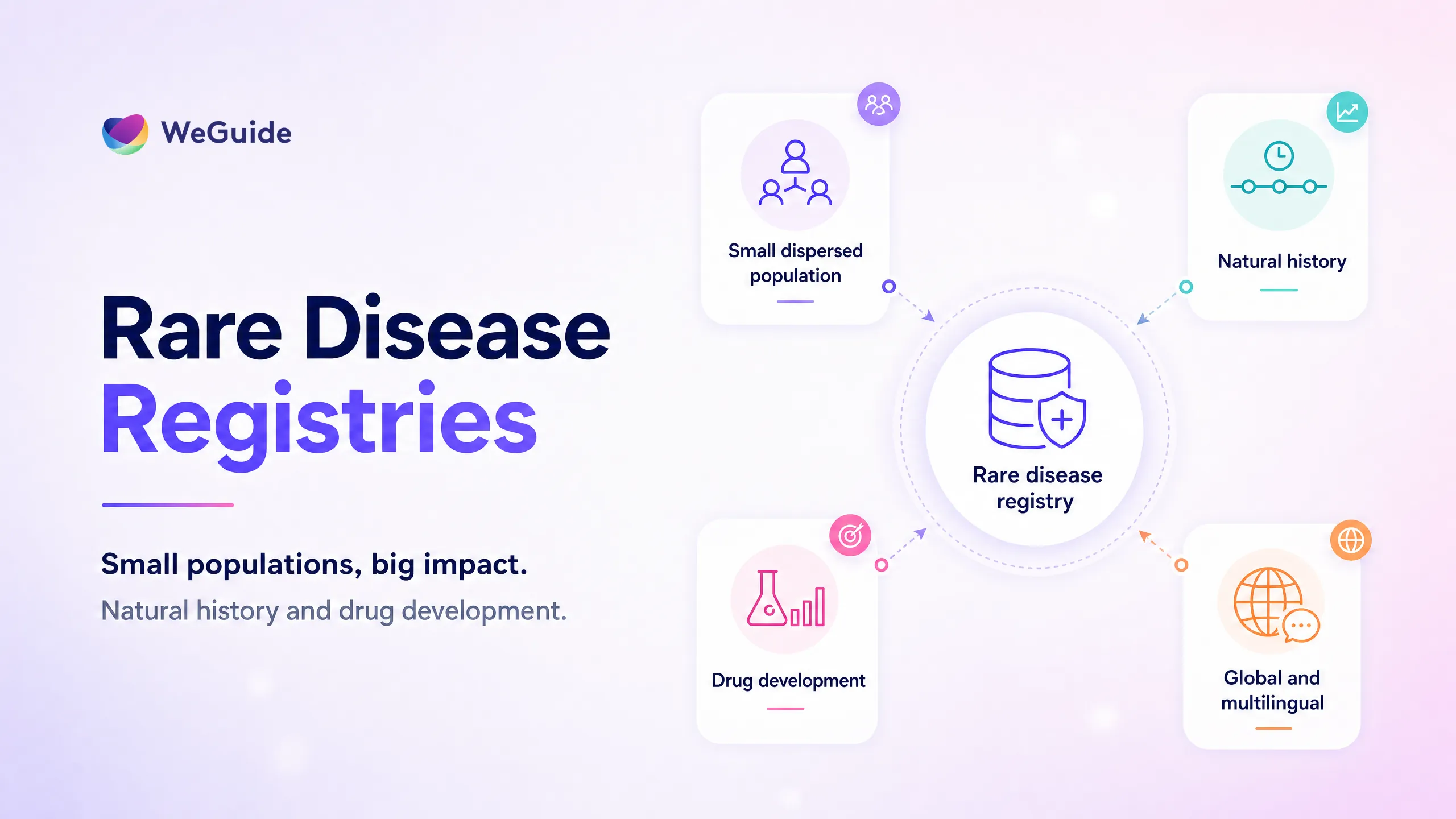


A rare disease registry is an organised collection of health data about people living with a specific rare condition, captured consistently over time to support research, better care, and drug development. Because each rare disease affects only a small, widely scattered group of people, a registry is often the only practical way to bring that information together in one place. A rare disease patient registry can hold diagnosis details, symptoms, genetic data, treatments, and a record of how a condition changes across years.
For rare disease pharma, advocacy groups, and research teams, a registry answers questions that are otherwise almost impossible to study. It builds the natural history picture a treatment needs, it shows regulators who the patients are, and it creates a ready community for future trials. This guide explains what a rare disease registry is, why it matters, the real challenges of running one, and how to run one well. WeGuide builds this kind of registry as a patient registry platform, so the focus here is practical, not theoretical.
If you are new to the wider topic, our guide to what is a patient registry covers the basics that apply to every condition. This article focuses on what makes rare disease different, and why those differences shape almost every decision.
Key Takeaways
- A rare disease registry collects data on one condition over time. It brings together a small, scattered patient population so researchers, clinicians, and sponsors can study a disease that is otherwise hard to see.
- Registries underpin rare disease drug development. They build the natural history record, help define endpoints, and create a community that regulators and sponsors can draw on for trials.
- The hard parts are recruitment, geography, and staying funded. Tiny dispersed populations and long timelines make a rare disease registry harder to fill and harder to sustain than a common disease one.
- Patient centred design is what makes it work. Remote enrolment, multilingual access, and a registry built with the patient community keep participation high across borders.
- WeGuide has built a rare disease registry in practice. We built the FSHD patient registry with the FSHD Global Foundation, a real example of a global, patient centred rare disease registry.
What Is a Rare Disease Registry?
A rare disease registry is a structured database that follows people with a particular rare condition over time, recording standardised information about their health, history, and experience. Unlike a one off study, a registry keeps collecting, so the picture grows richer with every year and every participant who joins.
A registry is one type of disease registry, the broad term for any organised collection of data about people who share a diagnosis or exposure. Our overview of disease registries explains the wider category.
What sets the rare disease version apart is scale. A common disease registry might enrol tens of thousands of people from a single country. A rare disease registry often works with a few hundred people spread across many countries, which changes almost every design decision you make.
The data usually includes diagnosis and genetic information, symptoms and how they progress, treatments and their effects, and the outcomes that matter most to patients and families. Most rare disease registries also serve as a natural history study, tracking how an untreated or treated condition unfolds over years. The US National Library of Medicine reference on defining patient registries and research networks sets out how registries are structured and governed, and those principles apply directly to rare disease work.
Why Rare Disease Registries Matter
Rare disease registries matter because they solve a problem that is unique to rare conditions. There are simply not enough patients in any one place to study the disease the usual way. By pooling data across regions and countries, a registry reaches the numbers researchers need to find patterns, define outcomes, and plan trials.
Small, dispersed populations. With only a handful of patients per country, no single clinic sees enough cases to draw firm conclusions. A registry is the mechanism that gathers a meaningful group together, turning scattered individuals into a population researchers can actually study.
Natural history. Many rare diseases have never been described in detail, so no one knows the typical course, the rate of decline, or the moments when treatment could help most. A rare disease natural history study, often run inside a registry, builds that baseline. Without it, a sponsor cannot tell whether a new therapy is changing the course of a disease.
Drug development. Rare disease drug development depends on registry data at almost every step. Registries help identify and recruit eligible participants, supply the natural history that serves as a comparison for small trials, and provide outcome data after a therapy reaches the market. For conditions where a placebo controlled trial is hard to justify, registry based natural history can act as an external comparison.
Regulatory and access. Regulators increasingly look for real world data to support rare disease approvals and to monitor safety after launch. A well run registry gives sponsors and advocacy groups credible evidence to bring to agencies, payers, and clinicians. It also strengthens the case for funding and for recognition of a condition that may be invisible in routine health data.
Build a registry your patient community will actually use
WeGuide runs rare disease registries as one branded, multilingual app, with eConsent, digital forms, and longitudinal capture, so the data lands consistent across every country.
The Challenges of Running a Rare Disease Registry
The reasons a rare disease registry matters are the same reasons it is hard to run. Small numbers, global spread, and long timelines push against everything that makes data collection easy. Knowing the challenges upfront is the first step to designing around them rather than being caught out by them later.
| Challenge | Why it is harder for rare disease | How to address it |
|---|---|---|
| Recruitment | Only a few patients exist per country, and many are undiagnosed or unknown to researchers | Partner with patient advocacy groups, let patients self enrol from home, and make joining simple |
| Geography | Participants are scattered across many countries and time zones, far from any single site | Run the registry remotely through an app people use from anywhere, with no travel required |
| Data quality | Small samples mean every record counts, and inconsistent data can distort the whole picture | Use standardised digital forms, validation at entry, and consistent outcome measures across sites |
| Language and access | A global population speaks many languages and has varied access to devices | Offer the registry in multiple languages and on the devices participants already own |
| Engagement over time | Natural history needs years of follow up, and participants tire or move on | Keep participation light, give families useful feedback, and build the registry with the community |
| Sustainability | Funding and ownership can lapse once a grant ends or a champion moves on | Plan governance and funding early, and use a platform the group can keep running for the long term |
No single fix solves all of these at once. The common thread is that a rare disease registry has to meet patients where they are, because there are too few of them to lose any along the way.
How to Run a Rare Disease Registry Well
Running a rare disease registry well comes down to one idea. Design everything around the patient and family, because their participation is the whole asset. A few principles separate registries that grow from those that stall after the first wave of enrolment.
Start with the patient community
The strongest rare disease registries are built with patients and advocacy groups, not just for them. Communities know which outcomes matter, what wording makes sense, and how to reach people no clinic can find. A patient led registry, set up or championed by an advocacy organisation, often enrols faster because the trust already exists before you ask anyone to share their data.
Make it global and remote
Because patients are spread thin, the registry has to reach across borders from day one. A remote, app based model lets someone enrol, give consent, and contribute data from home, wherever they live. This removes travel, opens the registry to every country, and stops a tiny population from being split apart by geography.
Build for many languages
A global rare disease population speaks many languages. Offering consent, forms, and education in a participant's own language widens who can take part and improves the quality of what they report. Multilingual access is not a nice extra for rare disease. It is often the difference between reaching a viable number of participants and falling short.
Keep the data consistent and consent clear
Small samples leave no room for messy data. Standardised digital forms, clear definitions, and validation at the point of entry keep records comparable across countries. Electronic consent, or eConsent, lets participants understand and agree to take part remotely. It also keeps a clear record of what they agreed to, with the option to update it later.
Plan for the long term
Natural history plays out over years, so a rare disease registry is a long term commitment, not a project with a fixed end date. Decide early who owns the data, how it is governed, how families can access their own information, and how the registry stays funded. The NCATS Rare Diseases Registry Program toolkit offers practical guidance on planning, governance, and standards for groups setting one up.
A Real Example: The FSHD Rare Disease Registry
WeGuide has built a rare disease registry in practice. Working with the FSHD Global Foundation, we built a patient registry for facioscapulohumeral muscular dystrophy, or FSHD, a rare inherited muscle condition. You can read the full story in the FSHD rare disease registry case study.
The registry shows what the principles above look like in real life. It was built as a patient centred app that families can use from home, which suits a condition whose patients are spread across many countries. It brings consent, data collection, and longitudinal follow up into one place, so the foundation can build the natural history record that FSHD research needs.
The point of the example is not a headline number. It is that a patient advocacy foundation, working with the right platform, can own and run a global rare disease registry for its own community and the researchers who depend on it. WeGuide has done the same kind of long term, patient centred data capture at scale on other programmes, including the GenV cohort following families over time.
The lesson is consistent. When the registry is easy for families to use, participation holds, and the data becomes something a sponsor or regulator can rely on.
Frequently Asked Questions
What is a rare disease registry?
A rare disease registry is an organised collection of data about people living with a specific rare condition, gathered consistently over time. It brings together a small, scattered patient population so researchers, clinicians, sponsors, and advocacy groups can study the disease, track its natural history, and plan future trials.
How is a rare disease registry different from a natural history study?
A natural history study tracks how a disease changes over time, while a registry is the structure that collects and holds the patient data. In rare disease, the two usually overlap, because most registries are designed to capture natural history. A registry can also support recruitment, safety monitoring, and care beyond natural history alone.
Why are rare disease registries important for drug development?
Rare disease drug development depends on registry data to find eligible participants, to understand a disease's natural course, and to provide a comparison for small trials. Because recruiting a placebo group can be hard for rare conditions, registry based natural history data can act as an external comparison and support regulatory and post market evidence.
What is a patient led registry?
A patient led registry is set up or driven by patients and advocacy groups rather than only by sponsors or clinicians. The community defines the priorities, helps recruit, and often owns the data. For rare disease, this model builds trust quickly and reaches patients no single clinic could find on its own.
How do you set up a rare disease registry?
Start with the patient community, agree the questions the registry must answer, and choose outcome measures and a data standard. Then pick a platform that supports remote, multilingual enrolment and eConsent, plan governance and funding for the long term, and partner with advocacy groups to recruit and keep participants engaged.
Who can run a rare disease registry?
Patient advocacy foundations, academic groups, hospitals, and pharma sponsors can all run a rare disease registry, often together. Many of the most active registries are owned by a patient organisation working with a technology partner. What matters most is clear governance, sustainable funding, and a platform the group can keep running over many years.
Conclusion
A rare disease registry is the foundation that makes research on small, scattered populations possible. It builds the natural history record, supports rare disease drug development, and gives regulators, sponsors, and advocacy groups credible real world data on conditions that are otherwise hard to see. The challenges are real, from recruitment and geography to data quality and staying funded, but each one can be designed around.
The pattern that works is consistent. Build the rare disease registry with the patient community, make it global, remote, and multilingual, keep the data clean and the consent clear, and plan for the long term. WeGuide builds rare disease patient registries as one branded app that families can use from anywhere, bringing eConsent, digital forms, and longitudinal capture together so the data holds up for the research that depends on it.
Run a rare disease registry your community will trust
See how WeGuide brings eConsent, multilingual forms, and longitudinal data capture into one branded app built for rare disease research.
Book a demoNo pressure, just a conversation.

