

.svg)
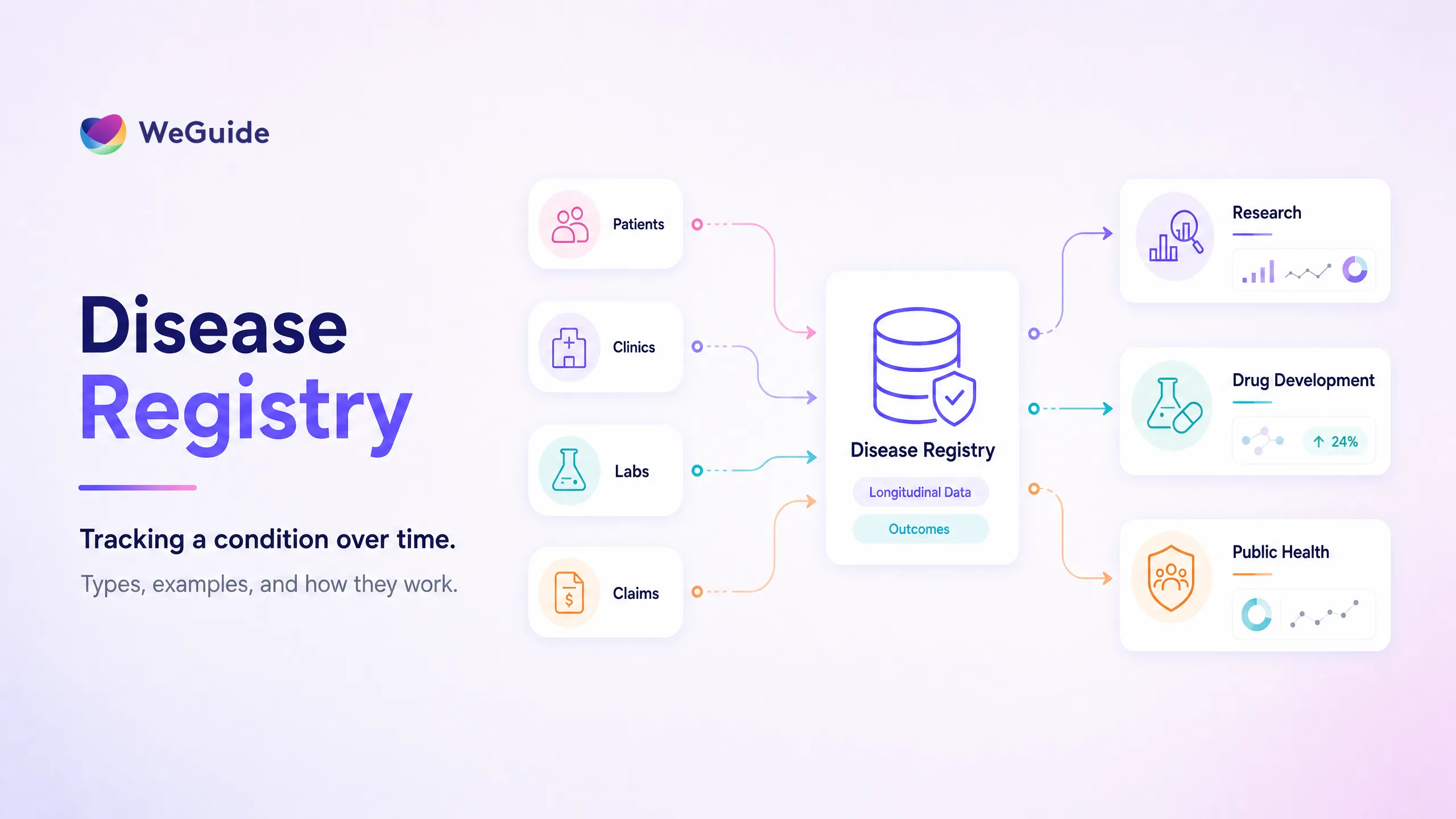


A disease registry is an organised collection of data about people who share a diagnosis, condition, or exposure, gathered over time to track how a disease behaves and how treatments perform. It brings clinical, demographic, and outcome data from many patients into one structured database that researchers, clinicians, and sponsors can study.
Registries sit behind much of what we know about chronic and rare conditions, yet the term gets used loosely and often blurs with "patient registry". This guide clears up the terminology, walks through the main types of disease registries with real examples, and explains how they work and where they fit in research and drug development. The focus is on research and sponsor led registries rather than public health surveillance, which is a related but separate use. If you are building one, a purpose built patient registry platform handles the consent, data capture, and follow up that a registry depends on.
Key Takeaways
- A disease registry tracks everyone with a given condition. It collects standardised data on diagnosis, treatment, and outcomes over time, so patterns across a whole patient population become visible.
- "Disease registry" and "patient registry" overlap. The terms are often used interchangeably, though a disease registry usually centres on one condition while a patient registry is the broader category.
- There are several types. Registries are grouped by what they track, from single conditions and rare diseases to product, exposure, and quality registries.
- Registries power research and drug development. They support natural history studies, post market safety monitoring, external control arms, and regulatory submissions built on real world evidence.
- Good data depends on good capture. Consent, structured forms, and consistent follow up decide whether a registry produces usable evidence or scattered records.
What Is a Disease Registry?
A disease registry is a structured database that records information about all patients with a specific disease, condition, or exposure within a defined population or healthcare setting. It captures who has the condition, how it progresses, what treatment they receive, and what outcomes follow, building a long term picture that single studies rarely provide.
The most cited definition comes from the US Agency for Healthcare Research and Quality, whose handbook on defining patient registries and research networks describes a registry as an organised system that uses observational methods to collect uniform data on a population defined by a particular disease, condition, or exposure. The key words are observational and uniform. A registry watches what happens in normal care rather than assigning treatment, and it collects the same fields for every patient so the records can be compared.
That design is what makes a registry useful. A single trial follows a selected group for a fixed window, while a disease registry follows a real population for as long as it runs. Over years it shows how a condition unfolds, which treatments people actually receive, and how outcomes vary across age, severity, and geography.
Disease Registry vs Patient Registry
In everyday use, disease registry and patient registry mean almost the same thing, and many sources treat them as synonyms. The difference is one of emphasis. A disease registry is organised around a condition, so everyone in it shares the same diagnosis, such as a cystic fibrosis registry or a cancer registry. A patient registry is the wider umbrella term for any registry built around a defined patient population, which may be grouped by a disease, a treatment, a device, or a shared exposure.
Put simply, every disease registry is a patient registry, but not every patient registry is organised by disease. For the full picture of the category, including product and quality registries, see our guide to what is a patient registry.
Two related terms are worth separating too. A clinical registry is a broad synonym used across healthcare, while disease surveillance, run by public health agencies such as the CDC, tracks the spread of conditions across a population for reporting rather than for the patient level research this guide covers.
Types of Disease Registries
Disease registries are grouped by what they track and why. Below are the main types of disease registries, each with a real disease registry example.
| Type | What it tracks | Example |
|---|---|---|
| Disease specific registry | Everyone with one named condition, from diagnosis through outcomes | A cystic fibrosis registry following lung function and treatment over time |
| Rare disease registry | Small, geographically spread populations with a rare condition | The FSHD registry run with the FSHD Global Foundation |
| Product registry | Patients taking a specific medicine or using a device, often for safety | A pregnancy exposure registry monitoring a drug's safety |
| Quality registry | Treatments and outcomes across providers, to benchmark care | A national joint replacement registry comparing implant results |
| Exposure registry | People exposed to a substance, agent, or environmental factor | A registry of workers exposed to an industrial chemical |
| Population registry | Incidence and prevalence across a defined geographic area | A population based cancer registry covering a state or country |
These categories overlap in practice. A rare disease registry is often disease specific, and it may also act as a product registry once a new therapy reaches the market. Rare conditions carry their own design challenges, from tiny patient numbers to dispersed families, so we cover them separately in our guide to rare disease registries.
The right type follows the question you want to answer. A sponsor watching a new medicine in real use needs a product registry, while a research group mapping how a condition progresses needs a disease specific or natural history registry.
Build a registry on a participant facing platform
WeGuide brings eConsent, digital forms, and a branded participant app together so your disease registry captures clean, longitudinal data from day one.
How Disease Registries Work
A disease registry is only as good as the process behind it. Most follow a similar lifecycle, whether they sit in a single hospital or span many countries.
- Define the population and data set. Set clear inclusion criteria and a core set of fields every record must hold, so the data stays uniform.
- Consent and enrol participants. Patients give informed consent for their data to be collected and used, often through eConsent in modern registries.
- Capture data through structured forms. Clinical and patient reported data is entered through standardised electronic forms, sometimes pulled from electronic health records.
- Follow participants over time. Registries are longitudinal, so they collect data at set intervals for years, which is what gives them their value.
- Manage quality and governance. Validation rules, audit trails, and clear data ownership keep the registry trustworthy and compliant.
- Analyse and report. Researchers query the data to answer questions about natural history, treatment patterns, and outcomes.
Behind all of this sits a disease registry database, the structured store where every record lives. Older registries ran on spreadsheets or paper, but modern disease registry platforms handle consent, multilingual forms, and long term follow up in one system, which matters when a registry runs for a decade or reaches families across several countries.
WeGuide has supported large, long running cohorts, including GenV, a study following more than 100,000 families, where the same participant app carries consent, questionnaires, and follow up over years. The lesson from that work is plain. When capture is simple for participants and consistent across sites, the data holds up well enough to answer real questions later.
Disease Registries in Research and Drug Development
Registries have moved from background record keeping to a working tool in research and drug development. Regulators increasingly accept registry data as a source of real world evidence, which is data drawn from routine care rather than a controlled trial. Used well, a disease registry answers questions a single study cannot, because it follows a real population over years instead of a selected sample for a fixed window.
The main uses in drug development include:
- Natural history studies. Registries show how a disease progresses without a new treatment, which informs trial design, endpoints, and what a meaningful change looks like. This matters most in rare disease, where the natural course is often poorly understood.
- External control arms. Registry data can stand in for a comparison group when a randomised control is not ethical or practical, a common need in rare and serious conditions.
- Post market safety. Product registries track safety and effectiveness once a medicine or device is in real use, across a far wider population than any trial.
- Recruitment. A registry identifies eligible patients quickly, which speeds enrolment into new trials.
- Regulatory and reimbursement. Registry evidence supports submissions and health technology assessments where long term, real world outcomes carry weight.
The NIH maintains a public list of registries that shows the range, from cancer and cardiovascular conditions to rare genetic disorders. For a deeper look at how this fits the wider shift toward routine care data, see our explainer on what is real world evidence. For sponsors, a well run disease registry can shorten timelines and strengthen a submission, because the evidence reflects how a treatment performs in practice.
Frequently Asked Questions
What is the purpose of a disease registry?
A disease registry exists to collect consistent data on everyone with a condition, so researchers can study how it progresses, how treatments perform, and what outcomes patients experience in real life. It supports natural history research, safety monitoring, and better care, answering questions that single clinical trials cannot.
What is an example of a disease registry?
A well known example is a cystic fibrosis registry, which follows patients' lung function, treatment, and outcomes for years. Other examples include cancer registries, joint replacement registries, and rare disease registries such as the FSHD registry. Each gathers standardised data on a defined patient population over time.
What is the difference between a disease registry and a patient registry?
The terms are often used interchangeably. A disease registry is built around one condition, so every participant shares a diagnosis. A patient registry is the broader category, covering any registry defined by a disease, treatment, device, or exposure. Every disease registry is a type of patient registry.
How do you create a disease registry?
Start by defining the population and a core set of data fields, then set up consent and enrolment, usually through eConsent. Capture data with standardised electronic forms, follow participants over time, and apply validation and governance rules. A dedicated registry platform handles these steps in one system.
Are disease registries the same as clinical trials?
No. A clinical trial tests an intervention under controlled conditions for a fixed period, while a disease registry observes patients in routine care over a long span without assigning treatment. Registries produce real world evidence and can support trials, but they do not replace the controlled testing a trial provides.
What data does a disease registry collect?
A disease registry collects demographic details, diagnosis and clinical history, treatments and procedures, laboratory or imaging results, and outcomes such as disease progression or quality of life. Many also gather patient reported data. The aim is a uniform record for every participant, so the data can be compared.
Conclusion
A disease registry turns scattered patient records into a structured resource that follows a condition across a whole population and over many years. Whether it is organised around a single disease, a rare condition, a product, or a quality measure, the aim is the same, to collect uniform data that answers questions no single study can. The terminology can be loose, but the core idea holds. A registry observes real patients in routine care and builds evidence over time.
For research teams and sponsors, that evidence is increasingly central to drug development, from natural history studies and external control arms to post market safety and regulatory submissions. The value depends on the basics done well, clear inclusion criteria, sound consent, structured data capture, and follow up that holds participants over the long run.
WeGuide builds the participant facing layer that disease registries rely on, bringing eConsent, multilingual digital forms, and a branded app together so data lands clean and stays consistent across years of follow up. From rare disease cohorts to studies following more than 100,000 families, the same foundation keeps a registry usable as it grows.
Build a disease registry that lasts
See how WeGuide supports consent, data capture, and long term follow up for disease and patient registries, from rare conditions to large national cohorts.
Book a demoNo pressure, just a conversation.

