

.svg)
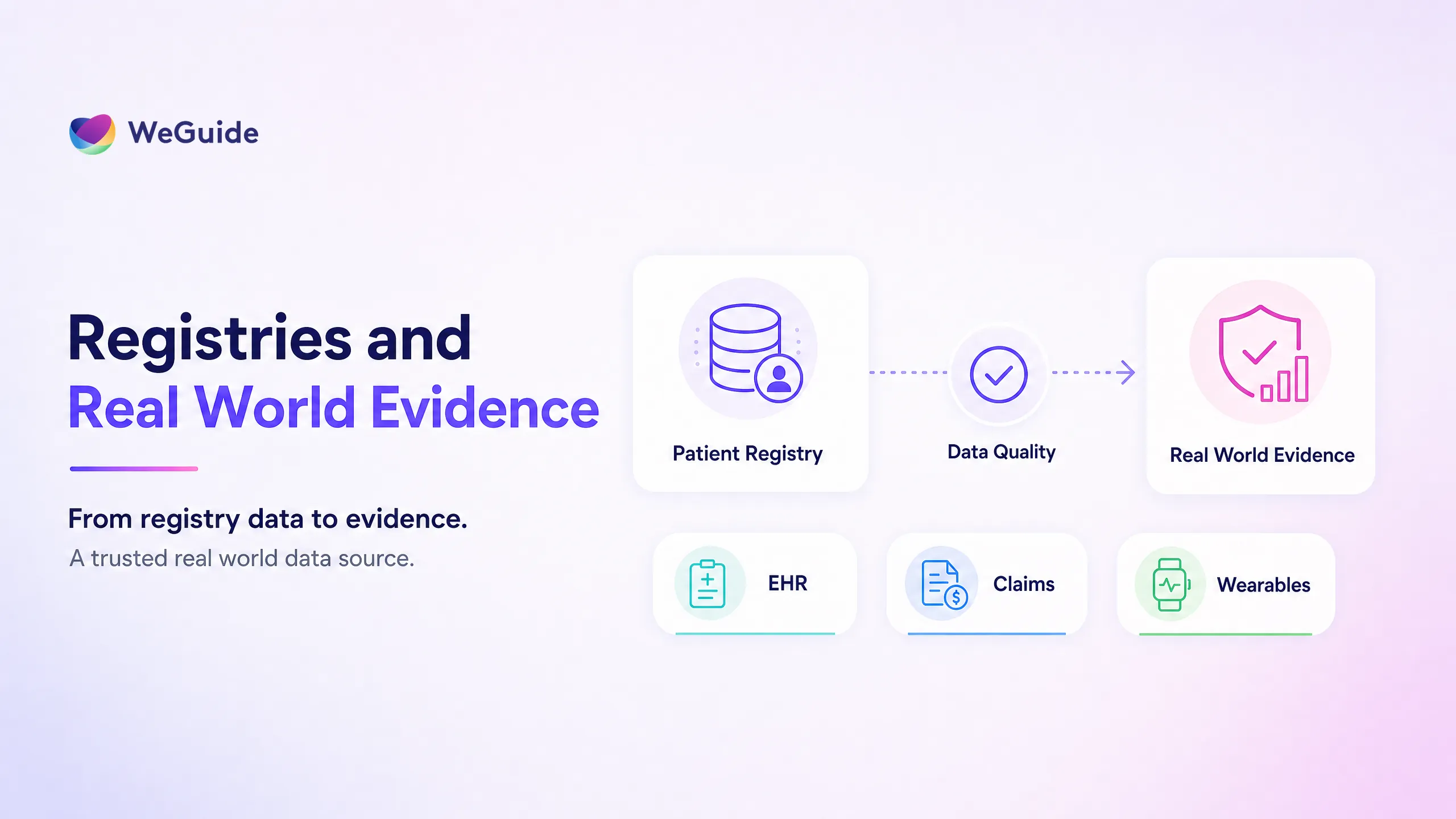



Patient registries are one of the most trusted real world evidence sources in healthcare. They collect the same health data from a defined group of people over months or years, then turn it into evidence about how a treatment or condition behaves in everyday practice. A patient registry is an organised system that follows a group defined by a disease, a treatment, or an exposure, and records standardised data at set points over time. Real world evidence, or RWE, is the clinical conclusion you draw from that real world data once it has been analysed.
This article sits between two topics. If you want the basics of either side, start with our pillar on what is a patient registry or our explainer on what is real world evidence.
Here the focus is narrower. How do registries work as a real world evidence source, where do regulators accept that evidence, and what makes registry data fit for the job? WeGuide builds the patient registry platform that captures this data directly from participants, so the examples are grounded in how registries actually run.
Key Takeaways
- A registry turns longitudinal data into evidence. It collects standardised data from a defined group over time, then that real world data becomes real world evidence once it is analysed against a clear question.
- Registries are a prospective real world data source. Unlike data collected for billing or routine care, registry data is gathered on purpose for research, with defined fields and planned follow up.
- Regulators already use registry evidence. The FDA and EMA accept registry RWE for safety monitoring, rare disease research, and post market surveillance, though it complements rather than replaces randomised trials.
- Data quality decides whether registry RWE holds up. Completeness, accuracy, consistent follow up, and clear governance separate evidence regulators trust from a dataset they discount.
- Registries complement other RWD sources. EHR records, insurance claims, and wearables each add scale or signal, and many studies link registries with them for depth and reach.
How Patient Registries Generate Real World Evidence
A patient registry generates real world evidence in three connected steps. First it defines a group, usually by a shared diagnosis, a treatment, or an exposure. Then it collects the same agreed data points from every participant at set times. Finally, a research team analyses that data against a specific question, and the answer is the evidence.
The registry is the engine. The evidence is what comes out the other end.
What sets a registry apart is that the data is planned in advance. A research team agrees a set of core data elements before anyone enrols, fixes a follow up schedule, and applies the same definitions to everyone. That structure is the difference between a pile of records and a real world data source you can actually analyse. A registry watches the same people in the same way over a long period, so it can show how a disease progresses or how a treatment performs once it leaves the controlled conditions of a trial.
The people who rely on this evidence sit across the research world. Sponsors and CROs use registries to study natural history and treatment patterns. RWE and HEOR teams use registry data to model outcomes, costs, and quality of life. Regulators and clinicians use it to understand safety and effectiveness in everyday populations that a trial may never have reached.
In each case the value comes from the same place. Consistent patient registry data, collected over time, about real people.
Registries as a Real World Data Source
It helps to keep two terms apart. Registry data is real world data, the raw information. Real world evidence is the conclusion you reach after analysing it.
A registry is therefore a real world data source first, and the evidence is the second stage. Our real world evidence platform is built around that flow, from capture through to the analysis that produces evidence.
Registries come in a few shapes, and each serves a different evidence need. Disease registries follow everyone with a given condition, which is useful for natural history and rare disease work. Product or device registries track everyone using a particular medicine or device, which suits effectiveness and safety questions.
Exposure registries follow people exposed to something specific, such as a drug during pregnancy. A post market surveillance registry is a product registry pointed at safety after approval, watching for rare or long term effects in real use.
What makes registry data different from other real world data is intent. Electronic health records and insurance claims are created for care and billing, then reused for research, so they carry gaps and quirks that were never meant for analysis. Registry data is collected on purpose, with consent, defined fields, and planned follow up. That does not make it automatically better, but it does make it cleaner for the question it was designed to answer, which is why registries for real world evidence carry real weight.
Turn registry data into real world evidence
WeGuide captures consented, standardised registry data from participants in one app, ready for the real world evidence and HEOR analysis your study depends on.
Regulatory Use of Registry Evidence
Regulators do accept registry evidence, but for defined jobs rather than as a blanket substitute for trials. The common uses are safety monitoring after approval, studying rare diseases where a large randomised trial is not feasible, supporting label expansions, and building external comparison groups. For these questions a well run registry can supply evidence that no single trial could, because it watches real patients for longer and in greater numbers.
In Europe, the European Medicines Agency runs a patient registries initiative that encourages sponsors to use existing disease registries for regulatory questions, and registries often underpin post authorisation safety studies. The aim is to make registry data more usable for decisions about a medicine once it is on the market, with agreed methods and quality expectations set out up front.
In the United States, registry evidence fits inside the FDA's real world evidence framework, shaped by the 21st Century Cures Act. The FDA treats registries as one credible real world data source among several, and a post market surveillance registry is a recognised way to track safety and performance after launch. Across both regions the message is consistent. Registry RWE supports regulatory decisions when the methods are sound and the data quality is documented, and it works alongside randomised trials rather than displacing them.
Making Registry Data Fit for RWE
Registry evidence is only as good as the data underneath it, so quality decides whether regulators and HEOR teams accept the conclusions. Four things matter most:
- Completeness, so there are few missing values
- Accuracy, so the recorded data matches reality
- Consistency, so everyone is measured the same way
- Retention, so participants stay in long enough for the follow up to mean something
A registry that loses half its participants cannot support strong claims about long term outcomes.
Governance carries equal weight. That means ethical approval and clear consent, defined ownership of the data, and agreed standards so the dataset can be understood and reused. Many registries align with shared data standards and common data models, and validated core outcome sets keep the fields comparable across studies. The long standing AHRQ user's guide, Registries for Evaluating Patient Outcomes, remains a practical reference for designing a registry that produces evidence rather than just a database.
The most reliable way to protect quality is to capture data well at the source. When participants give eConsent and complete validated digital forms on their own device, missing data drops and the dataset stays clean from day one. WeGuide is TGA Class I certified medical device software and supports GCP aligned, documented capture through eConsent, digital forms, ePRO, and wearable data in one participant app, though sponsors remain responsible for study design and regulatory strategy. If you are weighing tools for this, our patient registry software buyer's guide walks through what to look for.
Registries vs Other Real World Data Sources
A registry is rarely the only real world data source in a study. It sits among electronic health records, insurance claims, and wearable sensors, and each has a clear trade off between scale, cost, and cleanliness. The table below sums up where each fits when the goal is real world evidence.
| Data source | What it captures | Strength for RWE | Main limitation |
|---|---|---|---|
| Patient registries | Standardised, consented data on a defined group over time | Purpose built and clean for a specific question, with planned follow up | Smaller scale and higher set up cost than reused data |
| Electronic health records (EHR) | Clinical notes, diagnoses, tests, and prescriptions from routine care | Large populations and real clinical detail at low marginal cost | Gaps, free text, and variation, since data is collected for care not research |
| Insurance claims | Billing records for services, procedures, and dispensed medicines | Broad coverage and good for utilisation, cost, and adherence questions | Little clinical detail and shaped by reimbursement rules |
| Wearables and sensors | Continuous activity, heart rate, sleep, and other passive signals | Objective, frequent data between visits, useful for digital endpoints | Quality and wear time vary, and signals need validation |
The practical answer is usually to combine sources. A registry supplies the structured, consented backbone, while linked EHR, claims, or wearable data adds scale or continuous signal. Registries often pull these threads together, which is part of why patient registries and real world evidence are so closely tied. The registry gives the question a clean spine, and the other sources fill in reach.
Frequently Asked Questions
What is the difference between a patient registry and real world evidence?
A patient registry is the system that collects health data from a defined group over time. Real world evidence is the clinical conclusion you draw after analysing that registry data. The registry is the source, and the evidence is the output. One feeds the other in a continuous flow.
Are patient registries a real world data source?
Yes. A patient registry is a prospective real world data source, built to record standardised information outside a controlled trial. Unlike data collected for billing or routine care, registry data is gathered on purpose for research, with defined fields and planned follow up, which makes it well suited to real world evidence work.
Do regulators accept registry data as real world evidence?
Regulators including the FDA and EMA accept registry evidence for defined purposes such as safety monitoring, rare disease research, and label expansion. They expect clear methods, good data quality, and transparent governance. Registry RWE supports regulatory decisions but does not replace randomised trials for proving efficacy.
What is a post market surveillance registry?
A post market surveillance registry tracks the safety and performance of a medicine or device after approval. It follows real patients in everyday use to detect rare side effects, long term outcomes, and how the product performs across wider populations than the original trial was able to reach.
What makes registry data fit for real world evidence?
Registry data is fit for real world evidence when it is complete, accurate, consistent, and follows participants without heavy loss. Clear governance, ethical consent, and agreed data standards matter too. Capturing data directly from participants through validated digital forms reduces missing values and keeps the dataset reliable.
Are patient registries better than EHR or claims data for RWE?
Not better, just different. Registries are purpose built and standardised, so the data is cleaner for a specific question. EHR and claims data cover larger populations at lower cost but were not collected for research. Many real world evidence studies combine registries with these sources for both depth and scale.
Conclusion
Patient registries remain one of the most reliable ways to generate real world evidence, because they collect purpose built, longitudinal data from the people most relevant to a research question. The registry supplies the real world data, and disciplined analysis turns it into evidence that regulators, HEOR teams, and clinicians can act on. That is the whole point of treating registries as a real world data source rather than a static database.
The two things that decide success are quality and design. Plan the core data elements, the follow up, and the governance before anyone enrols, then capture the data cleanly at the source so completeness and consistency hold up. Combine the registry with EHR, claims, or wearable data where extra scale or signal helps. Get those right and patient registries and real world evidence reinforce each other, giving you conclusions that stand up to scrutiny.
WeGuide is the participant facing layer that captures consented, standardised registry data through one branded app, bringing eConsent, digital forms, ePRO, and wearable data together so the evidence holds up.
Build a registry that produces evidence
See how WeGuide captures consented, high quality registry data through one participant app, so your real world evidence stands up to regulatory and HEOR scrutiny.
Book a demoNo pressure, just a conversation.

