


Major Depression Inventory (MDI): Assessing Severity
The Major Depression Inventory is a self-report tool that measures depression severity. It helps doctors diagnose conditions and allows patients to track their mood changes over time.

Major Depression Inventory (MDI)
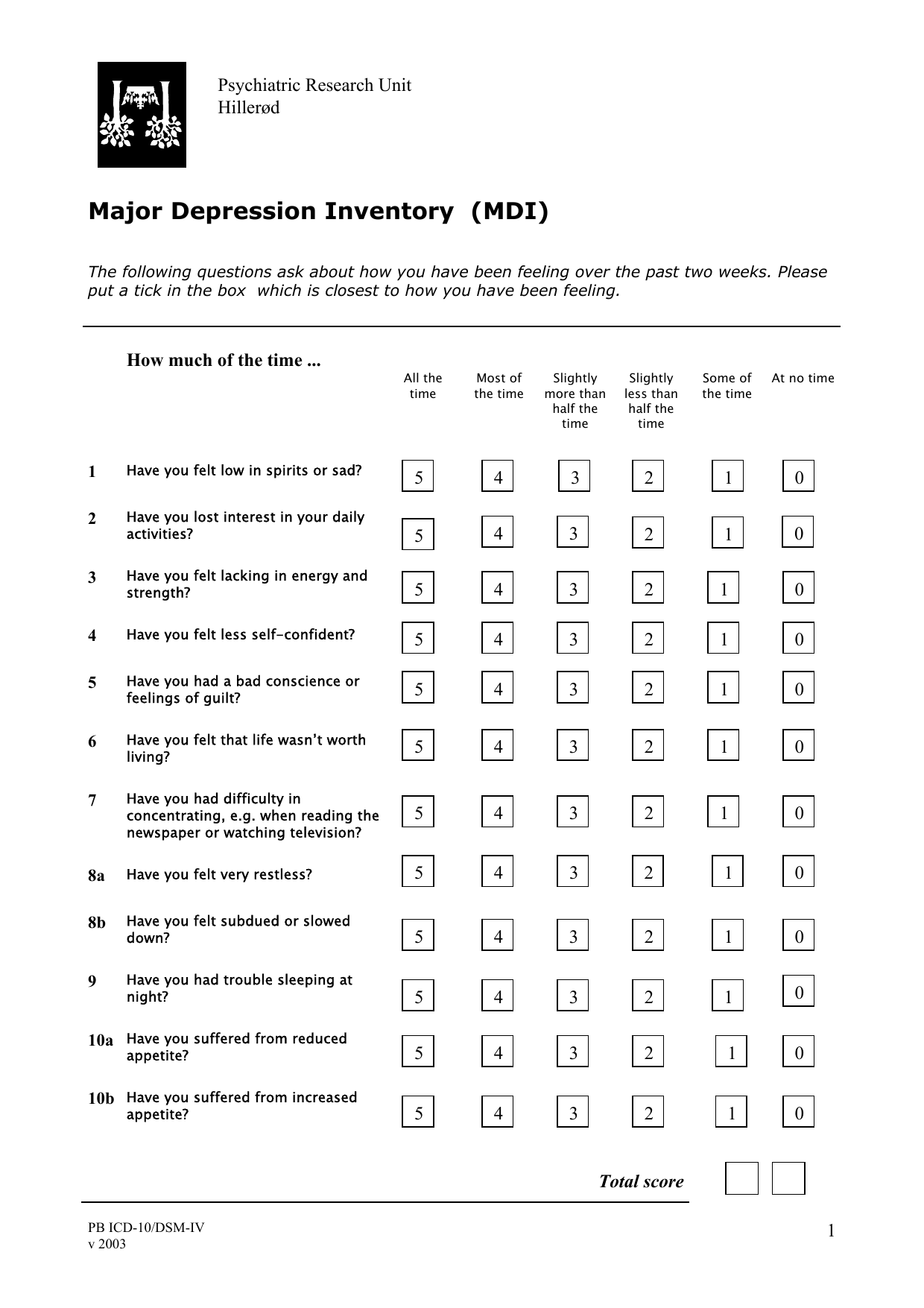
The Major Depression Inventory (MDI) is a self-report questionnaire that screens for depression and measures severity. Aligned with ICD-10 criteria, it functions as both a diagnostic tool and a rating scale. It helps clinicians monitor symptom changes, making it a practical choice for daily mental health assessment.
Category
Disease
Source
What is Major Depression Inventory (MDI)

The Major Depression Inventory (MDI) is a trusted self rating tool designed to assess mood disorders. It helps clinicians identify depression severity with accuracy. This questionnaire features ten specific items covering the diagnostic criteria for depression found in both ICD-10 and DSM-IV manuals, serving as a versatile instrument for mental health checks. Patients rate how they have felt over the past two weeks using a scale of six points ranging from 0 to 5, or "at no time" to "all the time." The smart scoring system allows professionals to either calculate a total sum or use an algorithm for a formal diagnosis. It is simple to administer in primary care settings and takes only a few minutes to complete. Since it is free to use, it is a popular choice for tracking treatment progress over time. Clinicians value its ability to distinguish between mild, moderate, and severe depressive states effectively.
The Major Depression Inventory can be scored using two main approaches: as a diagnostic tool or a severity measure. 1. Diagnostic Tool: This method uses ICD 10 rules to spot depression types. It checks if core symptoms like low mood exist with other signs. For items with two parts, you stick with the highest rating. 2. Severity Measure: Here, you simply add up the scores from the 10 items to get a total between 0 and 50. Remember to use the higher value for the paired questions. A score over 20 usually suggests mild depression, while anything above 30 indicates a severe state.

Advantages

Enables precise identification of patient health status.
.svg)
Measures healthcare intervention results systematically.
.svg)
Quick completion with minimal burden.
.svg)
Strengthens evidence through systematic measurement approaches.
.png)

Related Instruments

Digital counterpart
Digital biomarkers that measure the same thing with sensors rather than a questionnaire.
Collect Major Depression Inventory data with WeGuide, the all-in-one platform
.jpg)

Support Your patient in no time - all under your own brand
Our platform combines the knowledge of 100+ digital health solutions built, letting you easily build your patient engagement app for research or clinical use. Collect PROMs, support patients on waiting lists, or gather vital signs data. This is how:
Learn More.png)
Program Builder
.png)
.png)
Whitelabelling
.svg)
.svg)
.png)
Turn on components, dependent on your usecase
.svg)
.png)
Support The Full Journey
.png)
.png)
%20(1).png)
.png)
It’s your turn
Every WeGuide project, saves researchers and clinicians - 9 months and $450,000 - creating impactful digital health solutions.
