


TAPQOL: Assessing Quality of Life in Preschool Children
The TAPQOL assesses quality of life in preschool children aged 1 to 5 years. Parents complete this survey to help doctors understand physical, social, and emotional functioning.


TNO-AZL Preschool Children Quality of Life Questionnaire (TAPQOL)
Designed for children aged 1 to 5, the TAPQOL measures health-related quality of life across physical, social, and emotional domains. Parents complete this questionnaire to help clinicians understand the specific impact of illness on a preschooler's daily functioning and wellbeing.
Category
Disease
Source
What is TNO-AZL Preschool Children Quality of Life Questionnaire (TAPQOL)

The TNO-AZL Preschool Children Quality of Life Questionnaire (TAPQOL) helps measure health-related quality of life in young children aged one to five. This reliable parent-report survey covers forty-three items across twelve specific scales. It looks at physical, social, emotional, and cognitive functioning to give a full picture. Parents note how often specific complaints happen and how the child feels about them. The scales cover things like sleeping, appetite, lungs, and stomach issues alongside motor functioning and social behaviour. It captures both the problem and the emotional impact. It is great for clinical trials or routine care because it spots differences between healthy kids and those with chronic conditions. The form is easy to finish in about ten minutes, making it practical for busy clinics. Using this data helps care teams plan better support for little ones and their families.
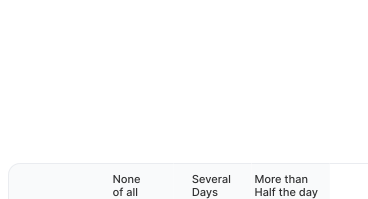
The TAPQOL can be scored using a straightforward calculation method that converts item responses into scale scores. 1. Scale Calculation: You calculate scores for 12 scales covering areas like sleeping, social functioning, and motor functioning. First, recode the item responses based on the frequency of complaints and the child's wellbeing. 2. Transformation: Add up the item scores within each scale and convert them to a 0 to 100 range. A higher score means better quality of life with fewer complaints. This helps clinicians track health changes over time.
Advantages
.svg)
Measures treatment effectiveness through standardised tools.
.svg)
Provides consistent measurements for clinical research.
.svg)
Applicable across multiple diseases and conditions.
.svg)
Analyzes outcomes across diverse patient groups.
.png)

Related Instruments

Digital counterpart
Digital biomarkers that measure the same thing with sensors rather than a questionnaire.
Collect TAPQOL data with WeGuide, the all in one patient engagement platform
.jpg)

Support Your patient in no time - all under your own brand
Our platform combines the knowledge of 100+ digital health solutions built, letting you easily build your patient engagement app for research or clinical use. Collect PROMs, support patients on waiting lists, or gather vital signs data. This is how:
Learn More.png)
Program Builder
.png)
.png)
Whitelabelling
.svg)
.svg)
.png)
Turn on components, dependent on your usecase
.svg)
.png)
Support The Full Journey
.png)
.png)
%20(1).png)
.png)
It’s your turn
Every WeGuide project, saves researchers and clinicians - 9 months and $450,000 - creating impactful digital health solutions.
