


Dermatology Life Quality Index (DLQI) Assessment
The DLQI measures how skin conditions impact a patient's daily life. This self-report survey helps doctors track progress and determine if treatments are improving quality of life.


Dermatology Life Quality Index (DLQI)
The Dermatology Life Quality Index (DLQI) is a ten-question survey measuring how skin issues impact a patient's life. Assessing symptoms, feelings, and daily activities over the last week, this tool helps clinicians track treatment success. It's a simple way to understand the real burden of skin conditions.
Category
Disease
Source
What is Dermatology Life Quality Index (DLQI)

The Dermatology Life Quality Index (DLQI) is a handy tool for checking how skin issues affect daily life. It helps doctors track the impact of conditions. This ten-item questionnaire is straightforward to use and focuses on the patient's experience over the last week. It covers different parts of living with a skin disease. Questions look at symptoms like itchiness and feelings of embarrassment. It also asks about shopping, choosing clothes, social activities, and work or study. Each question is scored from zero to three, giving a total score out of thirty to show severity. Clinicians can hand this out during a standard consult because it only takes a few minutes to finish. It is suitable for adults in clinical practice or research trials. The final score gives a clear picture of how much the skin problem gets in the way, helping guide treatment choices effectively.
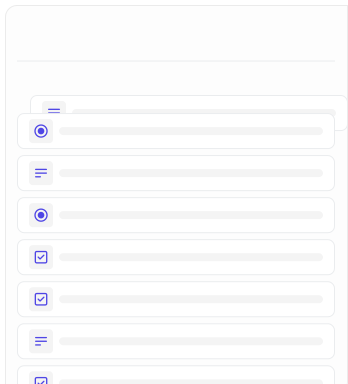
The Dermatology Life Quality Index can be scored using one main approach: calculating a total sum score. This involves ten questions where patients pick a response ranging from 0, meaning 'not at all', to 3, meaning 'very much'. You just sum these up to get a final score between 0 and 30. A higher total indicates the skin disease is causing more trouble in daily life. Clinicians often group these scores into bands, where 0 to 1 shows no effect and 21 to 30 suggests an extremely large effect on a patient's wellbeing. It is a reliable method to monitor treatment progress.
Advantages

Develops personalised strategies based on assessment data.
.svg)
Streamlines research data gathering process.
.svg)
Applicable across multiple diseases and conditions.
.svg)
Meets international clinical assessment requirements.
.png)

Related Instruments

Digital counterpart
Digital biomarkers that measure the same thing with sensors rather than a questionnaire.
Collect DLQI data with WeGuide, the all in one patient engagement platform
.jpg)

Support Your patient in no time - all under your own brand
Our platform combines the knowledge of 100+ digital health solutions built, letting you easily build your patient engagement app for research or clinical use. Collect PROMs, support patients on waiting lists, or gather vital signs data. This is how:
Learn More.png)
Program Builder
.png)
.png)
Whitelabelling
.svg)
.svg)
.png)
Turn on components, dependent on your usecase
.svg)
.png)
Support The Full Journey
.png)
.png)
%20(1).png)
.png)
It’s your turn
Every WeGuide project, saves researchers and clinicians - 9 months and $450,000 - creating impactful digital health solutions.
