


STarT Back Screening Tool (SBST): Back Pain Risk
The STarT Back Screening Tool helps clinicians identify patients at risk of persistent back pain. It groups individuals by risk level to match them with the right treatment for their needs.

STarT Back Screening Tool (SBST)
The STarT Back Screening Tool (SBST) assists clinicians in assessing the risk of persistent disability for low back pain. By sorting patients into low, medium, or high risk groups, this questionnaire directs specific treatment pathways. It's a practical method to ensure individuals receive the right level of care.
Category
Disease
Source
What is STarT Back Screening Tool (SBST)

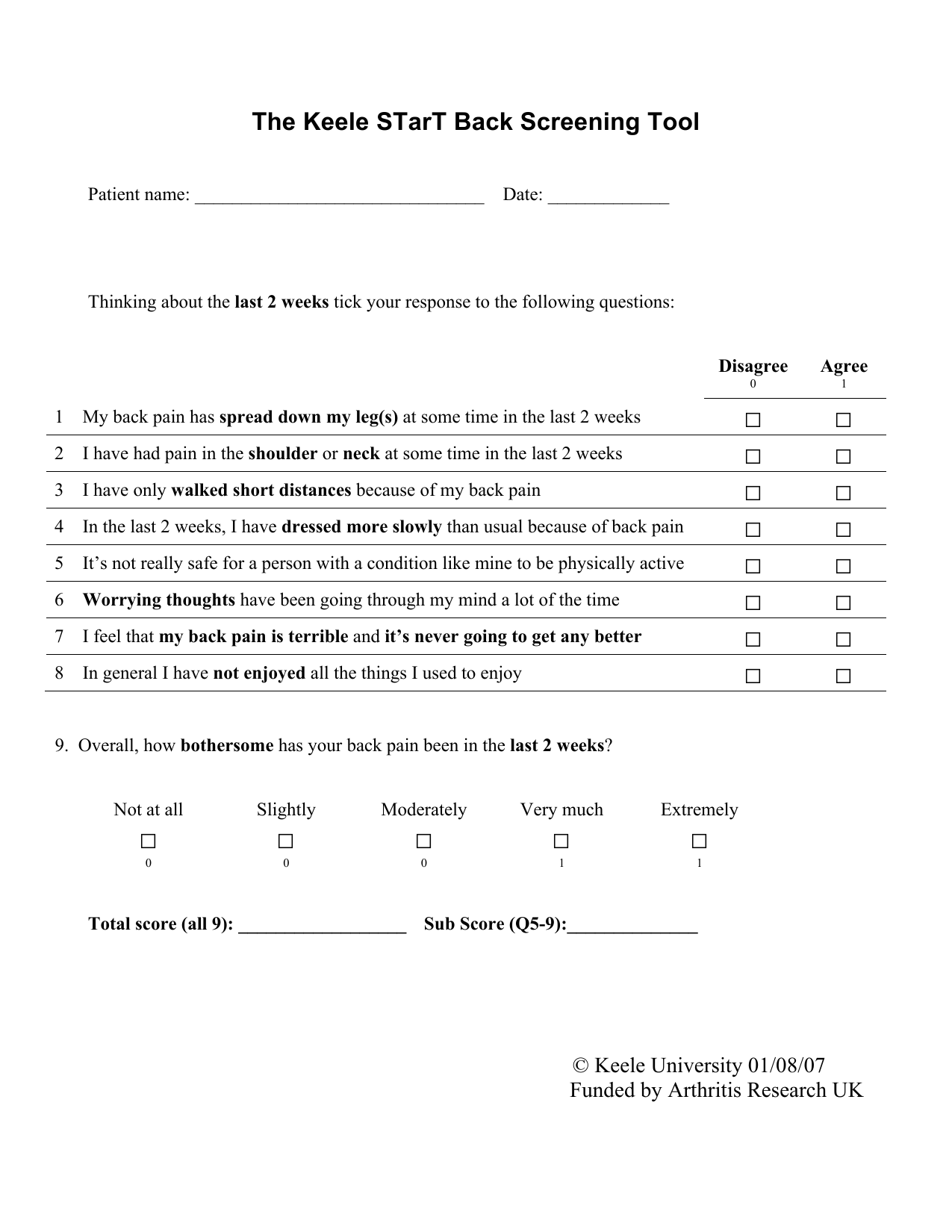
The STarT Back Screening Tool (SBST) helps clinicians sort low back pain patients by risk of ongoing issues. It is handy for primary care triage. This simple questionnaire uses nine items to check for physical and psychosocial factors. It looks at referred leg pain, comorbid pain, and general disability levels. Patients answer yes or no to questions about bothersome pain and anxiety. The total score plus a psychosocial subscore splits people into low, medium, or high risk groups. This stratification guides the right treatment path and stops you from over-treating cases. You can finish this paper assessment in under two minutes, making it easy to fit into busy clinic schedules. It points low-risk patients to advice and high-risk ones to complex care. Using this matched care approach improves health outcomes and saves valuable resources in the long run.
The STarT Back Screening Tool can be scored using a total score and a subscore to group patients. First, tally all 9 items for a Total Score between 0 and 9. Items 1 to 8 are yes or no, while item 9 checks bothersomeness. Next, work out the Psychosocial Subscore by adding items 5 through 9. Finally, use these numbers to sort folks into risk groups. A Total Score under 4 is low risk. If it is 4 or higher, check the subscore; under 4 is medium risk, but 4 or more signals high risk, helping physios choose the right treatment path.
Advantages

Develops personalised strategies based on assessment data.
.svg)
Quick completion with minimal burden.
.png)

Related Instruments

Digital counterpart
Digital biomarkers that measure the same thing with sensors rather than a questionnaire.
Collect STarT Back Screening Tool data with WeGuide, the all in one patient engagement platform
.jpg)

Support Your patient in no time - all under your own brand
Our platform combines the knowledge of 100+ digital health solutions built, letting you easily build your patient engagement app for research or clinical use. Collect PROMs, support patients on waiting lists, or gather vital signs data. This is how:
Learn More.png)
Program Builder
.png)
.png)
Whitelabelling
.svg)
.svg)
.png)
Turn on components, dependent on your usecase
.svg)
.png)
Support The Full Journey
.png)
.png)
%20(1).png)
.png)
It’s your turn
Every WeGuide project, saves researchers and clinicians - 9 months and $450,000 - creating impactful digital health solutions.
