


Patient Health Questionnaire-2 (PHQ-2) Depression Screener
This short survey helps doctors quickly screen patients for depression during routine visits. It asks two key questions about mood and interest to see if more detailed support is needed.


Patient Health Questionnaire-2 (PHQ-2)
The Patient Health Questionnaire-2 (PHQ-2) serves as a rapid first-step screening for depression. By asking just two questions about mood and interest levels, it helps clinicians decide if further assessment is needed. It’s highly effective for ruling out depression quickly in busy primary care environments.
Category
Disease
Source
What is Patient Health Questionnaire-2 (PHQ-2)

The Patient Health Questionnaire-2 (PHQ-2) serves as a quick first-step screen for depression. It helps clinicians spot potential mood disorders early on. Derived from the longer PHQ-9, this brief inquiry focuses on the two core signs of major depressive disorder. It looks specifically at low mood and a distinct loss of interest. Patients indicate how often they have been bothered by these problems over the past two weeks. Responses range from "not at all" to "nearly every day" on a simple scale. A total score of three or higher usually suggests the need for further evaluation. Since it takes less than a minute, it fits perfectly into busy general practice clinics. It acts as a "rule out" test where low scores save time, and high scores prompt a full check. This efficiency makes it a top choice for routine mental health monitoring in primary care settings.
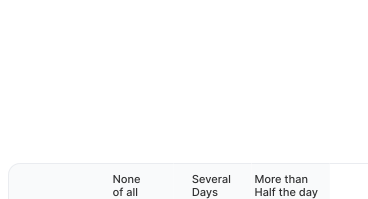
The Patient Health Questionnaire-2 (PHQ-2) can be scored using a single summation approach that is quick to apply in practice. To get the total, you just add the values from the two items, which are rated on a scale from 0 (not at all) to 3 (nearly every day). This produces a final score between 0 and 6. Generally, a score of 3 or higher is the threshold for potential major depressive disorder. When a patient scores in this range, it is a strong signal to conduct further assessment using the more detailed PHQ-9 or a thorough clinical interview.
Advantages
.svg)
Quick completion with minimal burden.
.svg)
Streamlines research data gathering process.
.svg)
Simple to understand and complete for patients.
.png)

Related Instruments

Digital counterpart
Digital biomarkers that measure the same thing with sensors rather than a questionnaire.
Collect PHQ-2 data with WeGuide, the all in one patient engagement platform
.jpg)

Support Your patient in no time - all under your own brand
Our platform combines the knowledge of 100+ digital health solutions built, letting you easily build your patient engagement app for research or clinical use. Collect PROMs, support patients on waiting lists, or gather vital signs data. This is how:
Learn More.png)
Program Builder
.png)
.png)
Whitelabelling
.svg)
.svg)
.png)
Turn on components, dependent on your usecase
.svg)
.png)
Support The Full Journey
.png)
.png)
%20(1).png)
.png)
It’s your turn
Every WeGuide project, saves researchers and clinicians - 9 months and $450,000 - creating impactful digital health solutions.
