


General Self-Efficacy Scale (GSE): Measuring Coping
The GSE assesses a person's belief in their ability to handle difficult situations. This short survey helps professionals understand coping skills and resilience in adults.

General Self-Efficacy Scale (GSE)
The General Self-Efficacy Scale (GSE) is a 10-item tool assessing a person's belief in their ability to cope with daily challenges. It helps clinicians predict how well patients might manage health behaviours or recover from surgery, making it a key resource for understanding individual coping mechanisms.
Category
Disease
Source
What is General Self-Efficacy Scale (GSE)

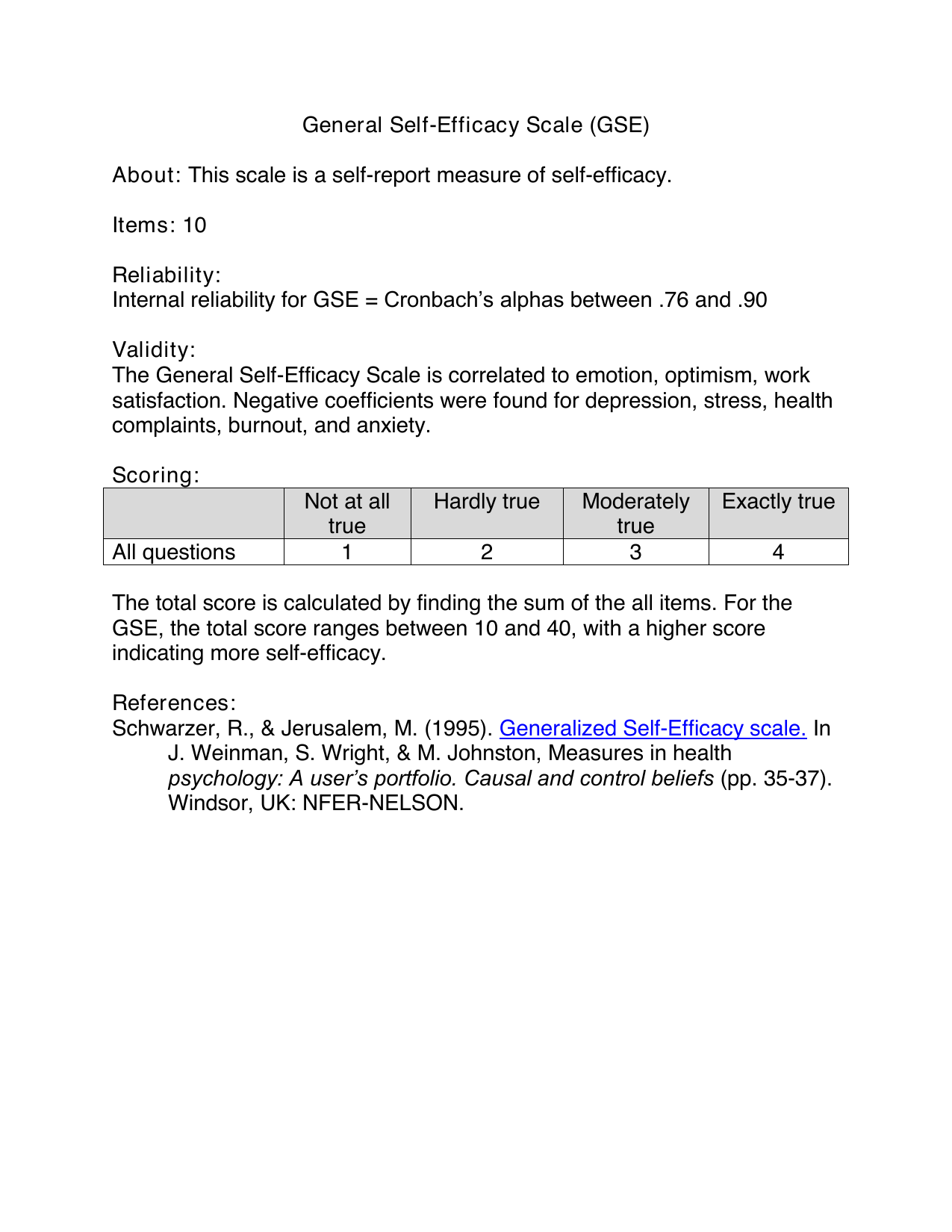
The General Self-Efficacy Scale (GSE) is a trusted tool for measuring a person's belief in their ability to handle difficult situations and setbacks. Developed by Schwarzer and Jerusalem, this ten-item questionnaire assesses how well individuals cope with daily hassles and stressful life events across various contexts. Participants rate statements on a simple four-point scale ranging from not at all true to exactly true. The total score ranges from 10 to 40 to reflect perceived competence, where higher numbers mean more confidence in dealing with unexpected troubles. It takes roughly four minutes to finish, making it a handy option for busy clinical practice and research studies. It works well for tracking changes in health behaviours or rehabilitation progress. Clinicians often use the results to spot patients who might need extra support building resilience skills.
The General Self-Efficacy Scale can be scored using a single summation approach that keeps things simple. Since the GSE is unidimensional, you do not need to worry about subscales. You just add up the responses from all ten items to calculate a final composite score. Each question uses a four point scale, ranging from 1 for Not at all true to 4 for Exactly true. The total result sits anywhere between 10 and 40. Higher numbers suggest a stronger belief in your ability to handle life's curveballs. This total gives clinicians a clear picture of coping skills, making it easy to track changes in personal resilience over time.
Advantages
.svg)
Serves diverse clinical needs effectively.
.svg)
Streamlines research data gathering process.
.svg)
Meets international clinical assessment requirements.
.svg)
Strengthens evidence through systematic measurement approaches.
.png)

Related Instruments

Digital counterpart
Digital biomarkers that measure the same thing with sensors rather than a questionnaire.
Collect General Self-Efficacy Scale data with WeGuide, the all in one patient engagement platform
.jpg)

Support Your patient in no time - all under your own brand
Our platform combines the knowledge of 100+ digital health solutions built, letting you easily build your patient engagement app for research or clinical use. Collect PROMs, support patients on waiting lists, or gather vital signs data. This is how:
Learn More.png)
Program Builder
.png)
.png)
Whitelabelling
.svg)
.svg)
.png)
Turn on components, dependent on your usecase
.svg)
.png)
Support The Full Journey
.png)
.png)
%20(1).png)
.png)
It’s your turn
Every WeGuide project, saves researchers and clinicians - 9 months and $450,000 - creating impactful digital health solutions.
