


The Strengths and Difficulties Questionnaire (SDQ)
This brief screening tool assesses mental health in children and adolescents. Parents, teachers, and youth use the SDQ to identify emotional and behavioural strengths or needs.


Strengths and Difficulties Questionnaire (SDQ)
The Strengths and Difficulties Questionnaire (SDQ) is a brief behavioural screening tool for children and adolescents. It assesses emotional health, conduct, and peer relationships. Used by clinicians and educators, this survey helps identify mental health risks early to ensure kids get the right support.
Category
Disease
Source
What is Strengths and Difficulties Questionnaire (SDQ)

The Strengths and Difficulties Questionnaire (SDQ) is a brief screening tool for young people. It helps clinicians spot mental health issues early on. This smart tool covers 25 attributes divided between positive and negative traits. It is much shorter than other checklists but works just as well for screening. Items are grouped into five scales covering emotional symptoms, conduct problems, hyperactivity, peer issues and prosocial behaviour. Respondents rate each item as not true, somewhat true or certainly true to generate a total difficulties score. With versions for parents, teachers and self-reporting for older kids, the SDQ is super versatile. It is great for clinical assessment, evaluating outcomes and research. It gives a clear picture of a child's psychosocial functioning without taking ages to finish, making it a handy choice for busy clinics.
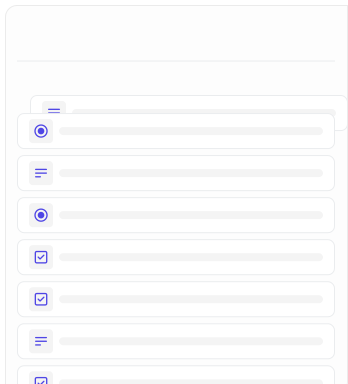
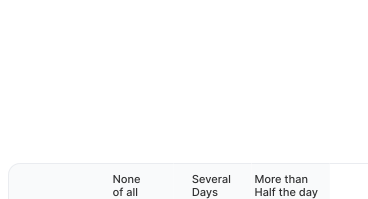
The Strengths and Difficulties Questionnaire can be scored using two main approaches: 1. Symptom Scores: You rate 25 items on a three point scale from not true to certainly true. These group into five scales like emotional symptoms and conduct problems. Summing four of these gives a Total Difficulties Score between 0 and 40, indicating overall stress. 2. Prosocial Score: This separate scale measures positive behaviours like sharing. Unlike the others, a higher score here is good. Clinicians use these totals to spot kids who might need extra support or a closer look.
Advantages
.svg)
Streamlines research data gathering process.
.svg)
Measures healthcare intervention results systematically.
.svg)
Applicable across multiple diseases and conditions.
.png)

Related Instruments

Digital counterpart
Digital biomarkers that measure the same thing with sensors rather than a questionnaire.
Collect SDQ data with WeGuide, the all in one patient engagement platform
.jpg)

Support Your patient in no time - all under your own brand
Our platform combines the knowledge of 100+ digital health solutions built, letting you easily build your patient engagement app for research or clinical use. Collect PROMs, support patients on waiting lists, or gather vital signs data. This is how:
Learn More.png)
Program Builder
.png)
.png)
Whitelabelling
.svg)
.svg)
.png)
Turn on components, dependent on your usecase
.svg)
.png)
Support The Full Journey
.png)
.png)
%20(1).png)
.png)
It’s your turn
Every WeGuide project, saves researchers and clinicians - 9 months and $450,000 - creating impactful digital health solutions.
