


The Patient and Observer Scar Assessment Scale (POSAS)
The POSAS evaluates scar quality by combining patient feedback with a doctor's exam. It tracks pain, itchiness, and thickness to give a complete picture of the healing process.


Patient and Observer Scar Assessment Scale (POSAS)
The Patient and Observer Scar Assessment Scale (POSAS) assesses scar quality through two lenses. It pairs a clinician's objective rating with the patient's input on pain, itch, and colour. This dual approach offers a complete view of healing, helping doctors track progress and adjust treatments effectively.
Category
Disease
Source
What is Patient and Observer Scar Assessment Scale (POSAS)

The Patient and Observer Scar Assessment Scale (POSAS) is a reliable tool for evaluating scar quality. It combines clinical views with patient input. Unlike older tools, this system uses two distinct parts to capture a full picture. It pairs a clinician's objective check with the patient's own subjective rating. Observers look at vascularity, pigmentation, and thickness, while patients rate pain, itchiness, and stiffness. Each item gets scored from one for normal skin up to ten for the worst imaginable scar, creating a clear total score that reflects the true severity of the injury. This dual approach makes it a top choice for burn centres and plastic surgery clinics. It is easy to use during routine check-ups and helps track healing over time. By listening to the patient's voice, doctors can better manage symptoms and improve long-term recovery outcomes effectively.
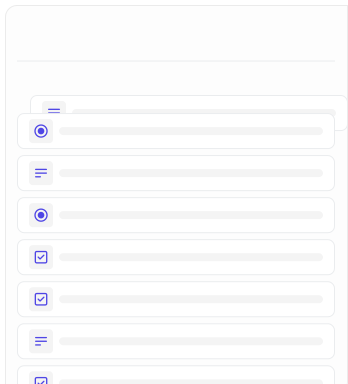
The Patient and Observer Scar Assessment Scale can be scored using two main approaches: the Observer Scale and the Patient Scale.1. Observer Scale: A clinician rates six items, including vascularity and pliability, on a ten point scale. A score of 1 means normal skin, while 10 is the worst scar imaginable. You sum these for a total between 6 and 60.2. Patient Scale: Here, patients rate six symptoms like pain and itchiness. Using the same one to ten format, you add these up for a total score. Both parts also feature a separate overall opinion rating to track progress over time.
Advantages
.svg)
Promotes active participation in healthcare assessment.
.svg)
Measures healthcare intervention results systematically.
.svg)
Provides consistent measurements for clinical research.

Develops personalised strategies based on assessment data.
.png)

Related Instruments

Digital counterpart
Digital biomarkers that measure the same thing with sensors rather than a questionnaire.
Collect POSAS data with WeGuide, the all in one patient engagement platform
.jpg)

Support Your patient in no time - all under your own brand
Our platform combines the knowledge of 100+ digital health solutions built, letting you easily build your patient engagement app for research or clinical use. Collect PROMs, support patients on waiting lists, or gather vital signs data. This is how:
Learn More.png)
Program Builder
.png)
.png)
Whitelabelling
.svg)
.svg)
.png)
Turn on components, dependent on your usecase
.svg)
.png)
Support The Full Journey
.png)
.png)
%20(1).png)
.png)
It’s your turn
Every WeGuide project, saves researchers and clinicians - 9 months and $450,000 - creating impactful digital health solutions.
