


Mini Balance Evaluation Systems Test (Mini-BESTest)
The Mini-BESTest evaluates dynamic balance and functional mobility. This clinician-administered tool helps therapists identify specific balance issues to guide effective rehabilitation.

Mini Balance Evaluation Systems Test (Mini-BESTest)
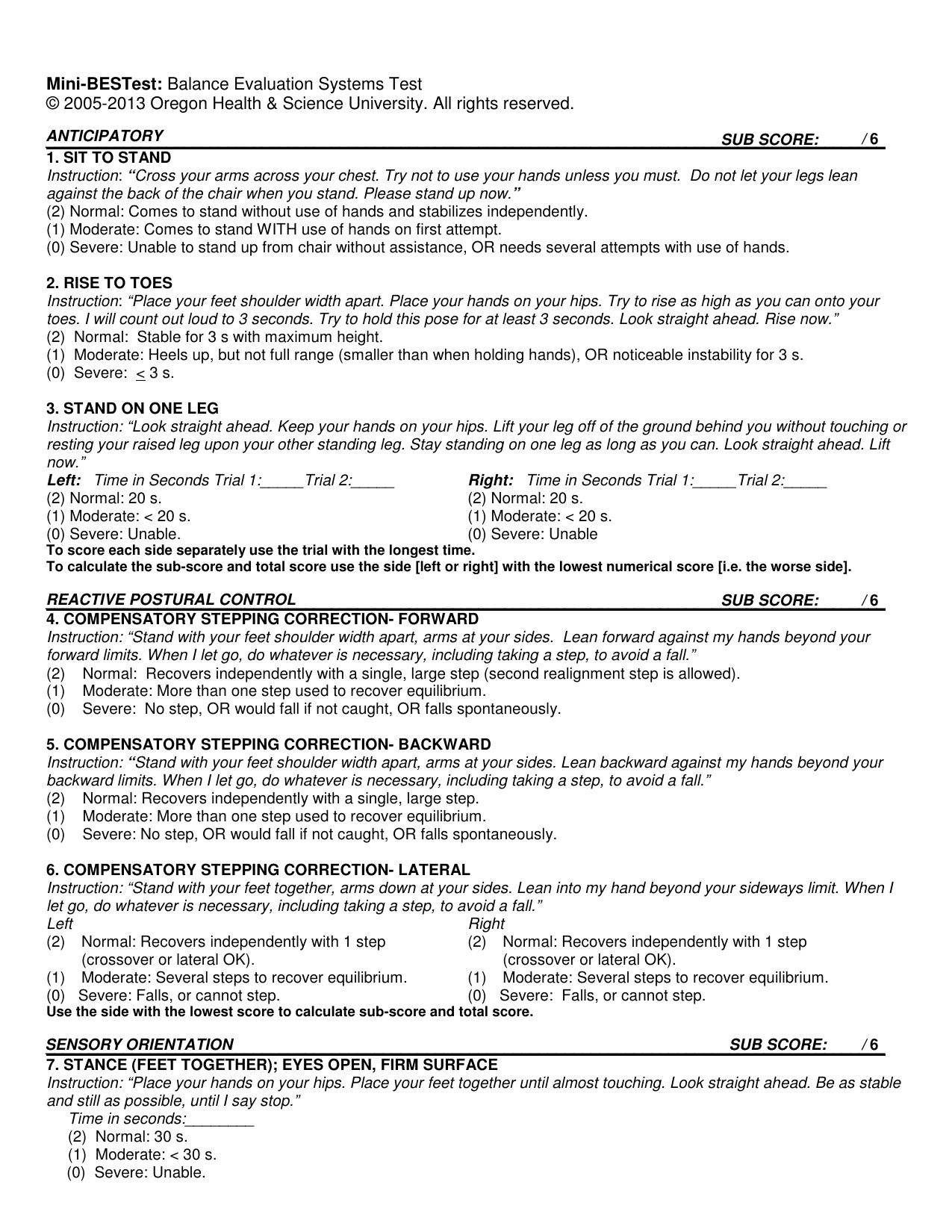
The Mini Balance Evaluation Systems Test (Mini-BESTest) is a clinical tool for assessing dynamic balance. It targets four specific control systems to help therapists spot deficits in patients with neurological conditions. It’s a reliable way to measure stability and fall risk during rehabilitation.
Category
Disease
Source
What is Mini Balance Evaluation Systems Test (Mini-BESTest)

The Mini Balance Evaluation Systems Test (Mini-BESTest) is a trusted clinical tool for assessing dynamic balance and mobility deficits in adults. This condensed version of the original BESTest focuses on dynamic balance control. It targets four specific systems including anticipatory adjustments and reactive control. Clinicians evaluate fourteen items using a simple three-point ordinal scale. Scores range from zero for severe impairment to two for normal function, creating a total possible score of twenty-eight. This helps identify specific postural control problems clearly. Administration is quick and usually takes about fifteen minutes, making it practical for busy clinics. It is highly effective for predicting fall risk in patients with Parkinson's disease or stroke. Since it requires minimal equipment like a foam pad, it fits well into routine rehab assessments to guide therapy.
The Mini Balance Evaluation Systems Test can be scored using a straightforward total summation approach. Clinicians rate 14 specific tasks on a 3 level ordinal scale ranging from 0 to 2. Here, 0 represents severe impairment or needing help, while 2 shows normal performance. You add these up across four subscales, covering areas like sensory orientation and dynamic gait, to get a total out of 28 points. Higher totals suggest better balance stability. It is a solid way to spot fall risks and track rehab progress, making it easier to see how a patient is going with their mobility goals.
Advantages

Enables precise identification of patient health status.

Develops personalised strategies based on assessment data.
.svg)
Quick completion with minimal burden.
.svg)
Measures healthcare intervention results systematically.
.png)

Related Instruments

Digital counterpart
Digital biomarkers that measure the same thing with sensors rather than a questionnaire.
Collect Mini-BESTest data with WeGuide, the all in one patient engagement platform
.jpg)

Support Your patient in no time - all under your own brand
Our platform combines the knowledge of 100+ digital health solutions built, letting you easily build your patient engagement app for research or clinical use. Collect PROMs, support patients on waiting lists, or gather vital signs data. This is how:
Learn More.png)
Program Builder
.png)
.png)
Whitelabelling
.svg)
.svg)
.png)
Turn on components, dependent on your usecase
.svg)
.png)
Support The Full Journey
.png)
.png)
%20(1).png)
.png)
It’s your turn
Every WeGuide project, saves researchers and clinicians - 9 months and $450,000 - creating impactful digital health solutions.
