


Communication Effectiveness Index (CETI) for Aphasia
Partners use the CETI to rate how well adults with aphasia communicate in daily life. This tool helps clinicians track functional recovery following a stroke through simple observations.

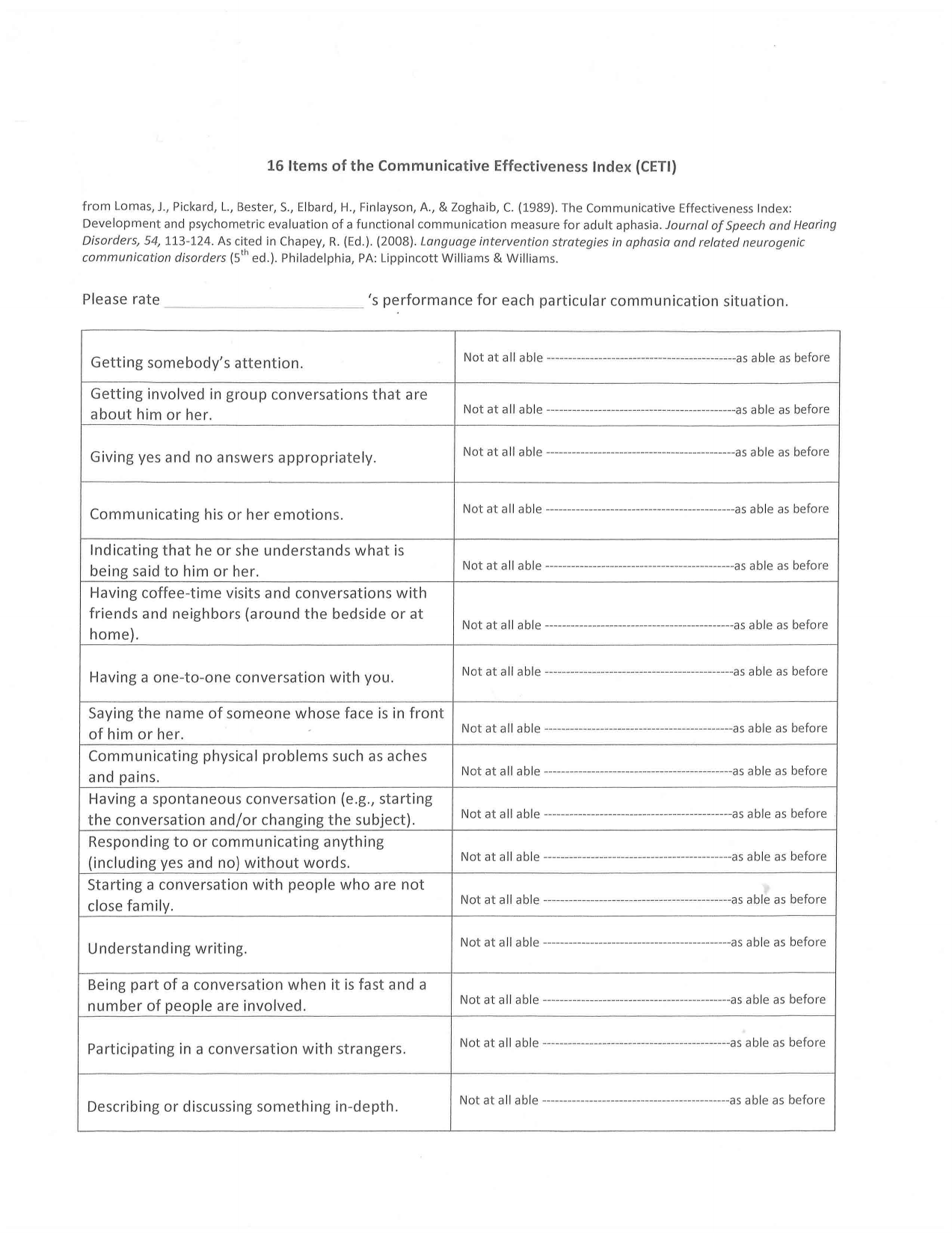
Communication Effectiveness Index (CETI)
The Communication Effectiveness Index (CETI) assesses functional communication in adults with aphasia. Partners complete this sixteen-item scale to rate performance in daily life, like expressing physical needs. It's a practical way for clinicians to track recovery and changes in social interaction over time.
Category
Disease
Source
What is Communication Effectiveness Index (CETI)

The Communication Effectiveness Index (CETI) tracks functional communication recovery after a stroke. It helps clinicians spot real-world changes. This questionnaire relies on partners or caregivers to rate performance across 16 specific situations. It focuses on basic needs and social interactions rather than just grammar. Raters use a simple visual analogue scale to mark how well the person communicates now compared to before their injury. They look at tasks like getting attention, having a one-on-one chat, or understanding a conversation within a group setting. Since it takes only ten minutes to finish, the CETI is great for busy clinics. It gives speech pathologists a clear picture of recovery over time and helps set meaningful therapy goals. By involving family members, it ensures the treatment plan matches what truly matters most at home.
The Communication Effectiveness Index can be scored using one main approach: a visual analogue scale. Partners look at 16 everyday situations and mark a 100 millimetre line to show ability, ranging from not able at all to as able as before. To get the score, you measure the distance from the left end in millimetres for each item. Then, add these up and divide by 16 to find the average rating out of 100. Higher numbers mean better communication skills. It's a handy way to track how well someone is getting back into the swing of things after a stroke.
Advantages
.svg)
Measures treatment effectiveness through standardised tools.

Develops personalised strategies based on assessment data.
.svg)
Promotes active participation in healthcare assessment.
.svg)
Simple to understand and complete for patients.
.png)

Related Instruments

Digital counterpart
Digital biomarkers that measure the same thing with sensors rather than a questionnaire.
Streamline Communication Effectiveness Index (CETI) assessments with WeGuide
.jpg)

Support Your patient in no time - all under your own brand
Our platform combines the knowledge of 100+ digital health solutions built, letting you easily build your patient engagement app for research or clinical use. Collect PROMs, support patients on waiting lists, or gather vital signs data. This is how:
Learn More.png)
Program Builder
.png)
.png)
Whitelabelling
.svg)
.svg)
.png)
Turn on components, dependent on your usecase
.svg)
.png)
Support The Full Journey
.png)
.png)
%20(1).png)
.png)
It’s your turn
Every WeGuide project, saves researchers and clinicians - 9 months and $450,000 - creating impactful digital health solutions.
