


Eating Assessment Tool (EAT-10): Measuring Dysphagia
The EAT-10 is a simple self-report survey that helps patients identify swallowing difficulties. Clinicians use this validated tool to screen for dysphagia and track symptom changes over time.


Eating Assessment Tool (EAT-10)
The Eating Assessment Tool (EAT-10) is a rapid, self-administered survey designed to screen for dysphagia. By measuring swallowing difficulties across ten specific scenarios, it helps clinicians track symptom severity and treatment progress. It's an essential resource for identifying patients at risk of aspiration.
Category
Disease
Source
What is Eating Assessment Tool (EAT-10)

The Eating Assessment Tool (EAT-10) is a reliable self-report survey used to screen for swallowing difficulties and measure symptom severity. It is widely used to help clinicians spot patients at risk of aspiration or malnutrition quickly. The tool is made up of ten straightforward questions regarding specific swallowing troubles. Patients rate each item on a scale from zero to four, where zero means no problem and four points to a severe issue. A total score of three or higher usually suggests the need for further testing, covering both physical symptoms and emotional impacts. This survey is super easy to use in clinics or hospitals and takes less than two minutes to finish. Doctors and speech pathologists use it to track changes over time or check if therapy is working effectively. It is a practical way to catch issues early so patients get the right support for safe eating and better health.
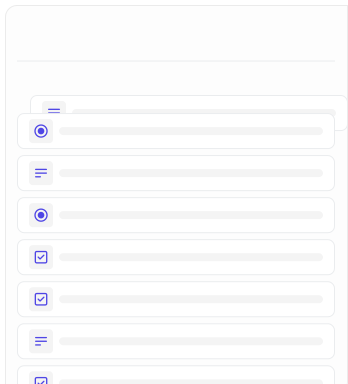
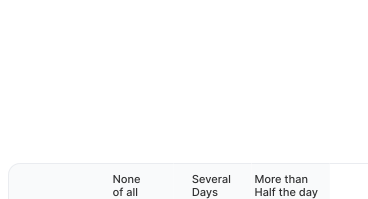
The Eating Assessment Tool (EAT-10) can be scored using one main approach: a direct summation technique. 1. Total Score Calculation: Patients rate ten items regarding swallowing troubles on a scale from 0 (no problem) to 4 (severe problem). You simply add the responses together to get a total ranging from 0 to 40. Higher numbers point to worse dysphagia symptoms. It is worth noting that a score of 3 or higher is abnormal. This cut off helps clinicians decide if a patient needs a referral for a detailed swallowing assessment to manage aspiration risks.
Advantages
.svg)
Streamlines research data gathering process.
.svg)
Measures healthcare intervention results systematically.
.svg)
Provides consistent measurements for clinical research.
.png)

Related Instruments

Digital counterpart
Digital biomarkers that measure the same thing with sensors rather than a questionnaire.
Collect EAT-10 data with WeGuide, the all in one patient engagement platform
.jpg)

Support Your patient in no time - all under your own brand
Our platform combines the knowledge of 100+ digital health solutions built, letting you easily build your patient engagement app for research or clinical use. Collect PROMs, support patients on waiting lists, or gather vital signs data. This is how:
Learn More.png)
Program Builder
.png)
.png)
Whitelabelling
.svg)
.svg)
.png)
Turn on components, dependent on your usecase
.svg)
.png)
Support The Full Journey
.png)
.png)
%20(1).png)
.png)
It’s your turn
Every WeGuide project, saves researchers and clinicians - 9 months and $450,000 - creating impactful digital health solutions.
