


Nottingham Extended Activities of Daily Living Index (NEADL)
The NEADL evaluates a person's ability to perform extended daily activities like housework. It is used in stroke rehabilitation to check how well patients manage independent living.


Nottingham Extended Activities of Daily Living Index (NEADL)
The Nottingham Extended Activities of Daily Living Index (NEADL) assesses patient independence in instrumental tasks like cooking and travel. Often used in stroke rehabilitation, this scale evaluates mobility, domestic, and leisure activities. It helps clinicians monitor recovery progress beyond simple self-care requirements.
Category
Disease
Source
What is Nottingham Extended Activities of Daily Living Index (NEADL)

The Nottingham Extended Activities of Daily Living Index (NEADL) helps clinicians assess independence levels in stroke recovery and rehab settings. It goes beyond basic self-care to measure broader independence. The scale covers twenty-two specific activities split into four distinct sections to capture a patient's real ability. These key areas include mobility, kitchen tasks, domestic chores and leisure activities. Patients report if they have performed tasks recently, with scoring based on what they actually do rather than what they simply think they can do. You can use it as a postal survey or a face-to-face interview, making it flexible for busy clinics. It is quick to complete and offers a clear picture of recovery over time. This helps therapists plan better discharge support and spot exactly where a patient needs extra help managing life at home.
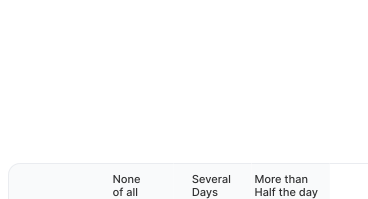
The Nottingham Extended Activities of Daily Living Index can be scored using two main approaches: 1. Likert Scale: You rate 22 items from 0 to 3 based on how much help is needed. A 0 means not at all, while 3 means on your own. Scores range from 0 to 66, with higher totals showing better independence across mobility and kitchen tasks. 2. Dichotomous Method: This simpler way gives a 1 if you do tasks alone and 0 if you need help. The total sits between 0 and 22. It is a solid choice for tracking daily life skills in rehab settings.
Advantages
.svg)
Measures healthcare intervention results systematically.

Develops personalised strategies based on assessment data.
.svg)
Strengthens evidence through systematic measurement approaches.
.svg)
Streamlines research data gathering process.
.png)

Related Instruments

Digital counterpart
Digital biomarkers that measure the same thing with sensors rather than a questionnaire.
Collect Nottingham Extended ADL data with WeGuide, the all in one patient engagement platform
.jpg)

Support Your patient in no time - all under your own brand
Our platform combines the knowledge of 100+ digital health solutions built, letting you easily build your patient engagement app for research or clinical use. Collect PROMs, support patients on waiting lists, or gather vital signs data. This is how:
Learn More.png)
Program Builder
.png)
.png)
Whitelabelling
.svg)
.svg)
.png)
Turn on components, dependent on your usecase
.svg)
.png)
Support The Full Journey
.png)
.png)
%20(1).png)
.png)
It’s your turn
Every WeGuide project, saves researchers and clinicians - 9 months and $450,000 - creating impactful digital health solutions.
