

Digital biomarkers for insomnia
Defined by how a person experiences their sleep, which makes it an unusual target for objective measurement.
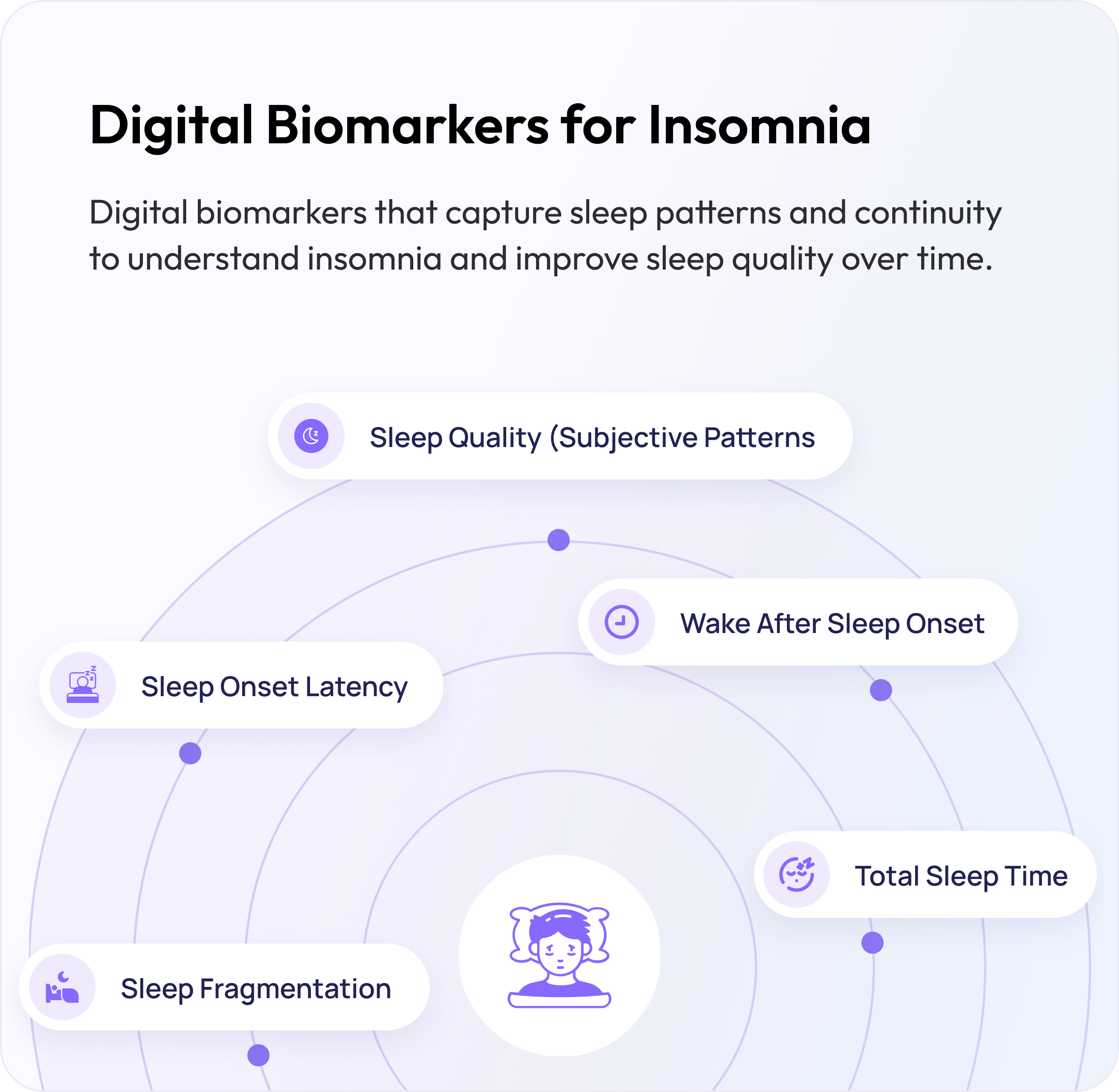
Insomnia is defined by how a person experiences their sleep, which makes it an unusual target for objective measurement. The diagnosis rests on difficulty falling or staying asleep together with daytime consequences, and the outcome that matters is distress and daytime impairment rather than any particular number of minutes.
That creates a specific tension. Objective and subjective sleep estimates diverge systematically in insomnia, and the direction of the divergence is consistent: people with insomnia tend to underestimate how long they sleep and overestimate how long they took to fall asleep. This is a documented feature of the condition rather than a measurement error to be corrected.
The measures collected here are therefore used to complement rather than replace the questionnaires that define the condition. Sleep onset latency, wake after sleep onset, total sleep time and sleep efficiency describe what a device can detect across many consecutive nights, which is something no single laboratory study and no retrospective questionnaire can provide. The value is in the pattern over weeks, and in observing change within a person, rather than in any absolute value on any single night.
Digital biomarkers used in insomnia research
How these measures are used
In insomnia trials, wake after sleep onset and sleep onset latency are the conventional endpoints, because they map directly onto the two ways the condition presents: trouble getting to sleep and trouble staying asleep. Both are collected objectively and by self report, and both are expected to be reported, since a treatment that improves the sensor value without changing how the person experiences their nights has not achieved what the patient came for.
Continuous measurement also supports cognitive behavioural therapy for insomnia, where sleep restriction protocols depend on an accurate picture of time in bed against time asleep. Objective data reduces reliance on diaries in a therapy that is sensitive to how accurately that gap is estimated.
A third use is variability. Night to night inconsistency is characteristic of insomnia and invisible in an average, and it can only be described by recording many consecutive nights, which is exactly what wearables make practical.
What the evidence supports today
The professional evidence position is clear enough to state directly. The American Academy of Sleep Medicine's 2018 clinical practice guideline supports actigraphy for assessing sleep in specific clinical situations including insomnia, which is the strongest endorsement objective sleep measurement holds. Validated questionnaires remain the primary outcome measures in insomnia trials.
Device accuracy has a known and awkward pattern in this population. Wearables tend to overestimate sleep and underestimate wakefulness, and that bias is largest in people with disturbed sleep, meaning accuracy is worst exactly where the condition is most severe. Sleep onset latency is particularly difficult, since it depends on the device correctly identifying when the person got into bed intending to sleep.
The practical conclusion is that these measures are dependable for within person change across many nights and unreliable as absolute values. A trial designed around change from baseline on a single device is on defensible ground; one comparing absolute values between devices is not.
Common questions
Why do wearable results differ from what people with insomnia report?
Because the two measure different things and the gap is a feature of the condition. Sensors estimate physiological sleep from movement and heart rate; self report captures perceived sleep, which is shaped by how distressing the night felt. In insomnia this divergence is systematic and documented, with people typically underestimating their sleep.
Which measures are used as endpoints in insomnia trials?
Wake after sleep onset and sleep onset latency are the conventional objective endpoints, since they correspond to the two presentations of the condition. Total sleep time and sleep efficiency are reported alongside them, together with a validated questionnaire such as the Insomnia Severity Index.
Can a wearable diagnose insomnia?
No. The diagnosis requires the person's report of difficulty sleeping together with daytime consequences, neither of which a sensor observes. A device can show that sleep is fragmented, but fragmented sleep without distress or daytime impairment is not insomnia.
How many nights should be recorded?
Substantially more than for a laboratory study. Night to night variability is high and is itself part of the clinical picture, so a few nights gives an unstable estimate. Two weeks is a common minimum, and studies interested in variability as an outcome record longer.
Run a study on these measures
WeGuide captures wearable data and patient reported outcomes in one platform, from screening through to analysis.
