

.svg)
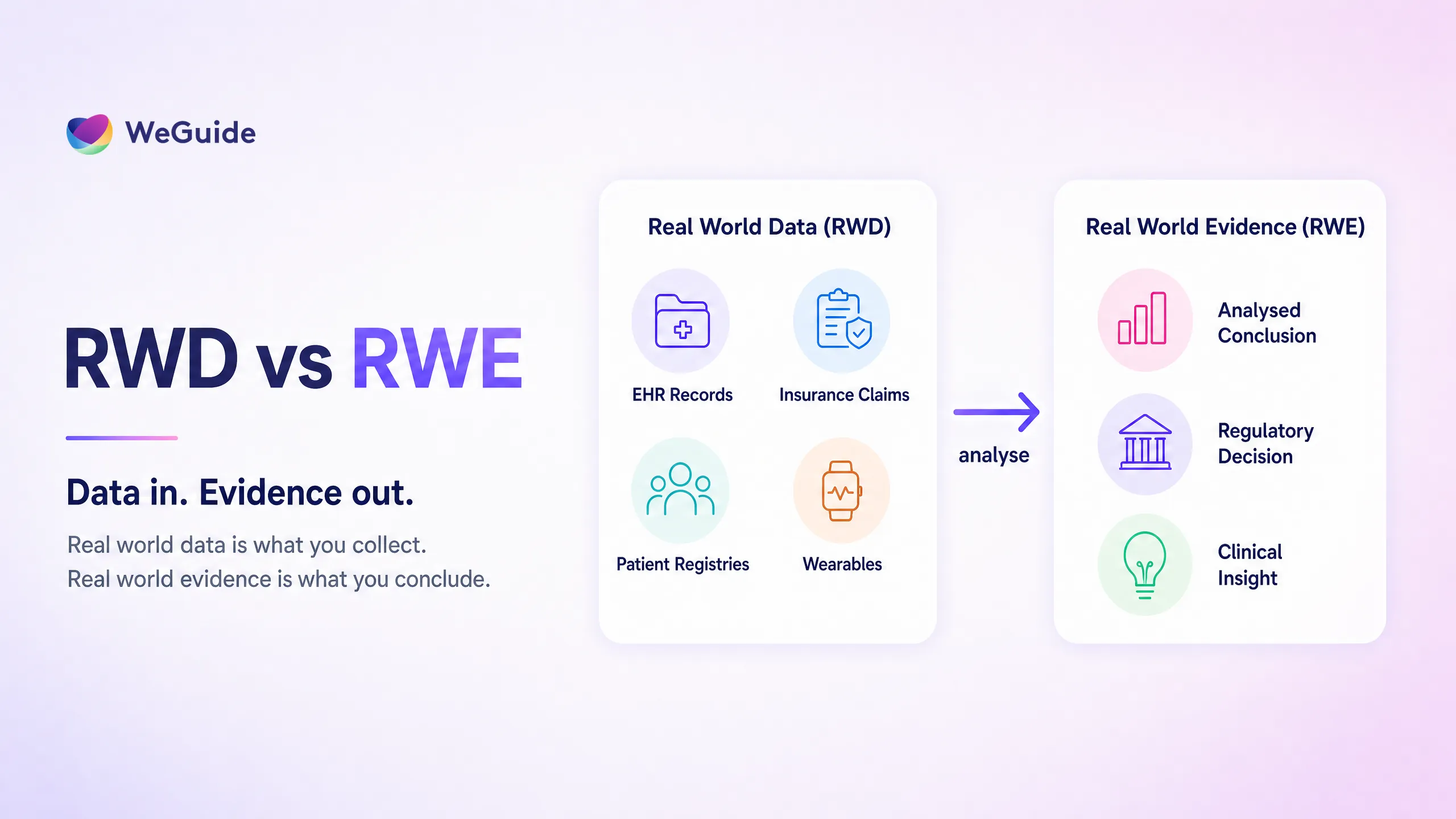


Real world data (RWD) is the raw health information collected outside traditional clinical trials, from sources like electronic health records, claims, registries, and wearables. Real world evidence (RWE) is the clinical conclusion you reach after analysing that data. Put simply, the real world data vs real world evidence distinction comes down to one thing: data is the input, evidence is the output.
The two terms get used interchangeably, and that causes real problems. Regulators treat them differently. A sponsor who promises "real world evidence" but hands over a spreadsheet of claims data has delivered RWD, not RWE. Knowing which is which changes how you design a study, what you tell the FDA, and how you brief your team.
This guide defines both terms, sets them side by side, and walks through how raw data turns into evidence that supports regulatory and clinical decisions. We've helped research teams collect real world data at scale, including GenV, one of the largest longitudinal studies in the world, so we'll keep this practical rather than academic.
Key Takeaways
- Real world data (RWD) is the raw information; real world evidence (RWE) is the conclusion drawn from analysing it. Data in, evidence out.
- RWD sources include electronic health records, insurance claims, patient registries, wearables, and patient reported outcomes collected outside a trial setting.
- RWE is what regulators like the FDA actually use to support approvals, label expansions, and post market safety decisions.
- You can't generate credible RWE without high quality, well governed RWD. Data provenance and audit trails matter for every regulatory submission.
- The real world data vs real world evidence gap is a process: collect, curate, analyse, conclude. Each step needs the right tools and controls.
What Is Real World Data (RWD)?
Real world data is health information gathered during routine care or daily life, not inside a controlled clinical trial. The FDA defines RWD as data relating to patient health status or the delivery of care from a range of everyday sources.
It's the unprocessed material. On its own, RWD doesn't tell you whether a treatment works. It just records what happened.
Common sources of real world data
- Electronic health records (EHRs): diagnoses, lab results, prescriptions, and visit notes from routine care.
- Insurance and billing claims: large datasets showing treatments delivered and at what cost.
- Patient registries: structured, disease specific data collected over months or years.
- Wearables and sensors: continuous data on heart rate, sleep, movement, and activity.
- Patient reported outcomes (PROMs): symptoms and quality of life reported directly by patients, often through a mobile app.
The strength of RWD is breadth. It captures diverse patients in real settings, including the older adults, multimorbid patients, and culturally diverse communities that strict trial criteria often exclude. The weakness is that it's messy. Records are incomplete, formats differ, and quality varies between sources.
Want to collect research grade data from real world settings? See how WeGuide's real world evidence platform brings EHR, wearable, and patient reported data into one place.
What Is Real World Evidence (RWE)?
Real world evidence is the clinical evidence about a treatment's use, benefits, or risks that comes from analysing real world data. RWE is the answer, the insight, the conclusion. It's what you present when someone asks whether a therapy works in everyday practice.
The difference is the analysis step. You take RWD, apply statistical methods, control for confounding factors, and produce a finding. That finding is the evidence.
For example, a hospital's EHR holds thousands of records for patients on a particular medication. That's real world data. When a research team analyses those records to show the medication reduces hospital readmissions by a measurable amount, they've generated real world evidence.
RWE has moved from a niche idea to a mainstream tool. Under the 21st Century Cures Act, the FDA built a formal programme to evaluate RWE for regulatory decisions, including new indications for approved drugs and post market safety studies. A 2024 review in The Lancet describes RWE as a way to bridge the gap between tightly controlled trials and messy clinical practice.
Real World Data vs Real World Evidence: The Key Differences
The cleanest way to hold the real world data vs real world evidence distinction in your head is a side by side comparison. Data is what you collect. Evidence is what you conclude.
| Dimension | Real World Data (RWD) | Real World Evidence (RWE) |
|---|---|---|
| What it is | Raw information about health and care | Clinical conclusions drawn from that information |
| Stage in the workflow | The input | The output |
| Examples | EHR records, claims, registry entries, wearable readings, PROMs | "Drug X reduced readmissions by 18%", a safety signal, a comparative effectiveness finding |
| Form | Datasets, often unstructured or incomplete | Analysed findings, reports, regulatory submissions |
| Primary users | Data managers, data engineers, study coordinators | Regulators, sponsors, payers, clinical and HEOR teams |
| Value on its own | Limited until analysed | The decision making asset |
The relationship is one directional. You can have real world data without evidence, a pile of unanalysed records. You cannot have real world evidence without data underneath it. This is why the quality of your RWD sets a ceiling on the credibility of your RWE.
How Real World Data Becomes Real World Evidence
Turning data into evidence is a process with clear stages. Skip a step and the evidence won't hold up to regulatory scrutiny.
- Collection: gather RWD from EHRs, registries, wearables, claims, or patient reported outcomes. The goal is relevant, well defined data tied to a research question.
- Curation and quality control: clean the data, resolve missing values, standardise formats, and check for errors. Poor data quality here undermines everything downstream.
- Analysis: apply statistical methods, adjust for confounding, and test the research question against the data.
- Evidence and decision: produce the finding, document the methods, and use it to support a regulatory submission, clinical guideline, or payer decision.
Data provenance matters at every step. For evidence to count in a regulatory setting, you need to show where each data point came from and that it hasn't been altered. That means audit trails, version control, and security controls that meet standards like 21 CFR Part 11. WeGuide supports this kind of traceable data collection, though your regulatory adviser should confirm the requirements for your specific submission.
Real time dashboards help here too. Being able to watch data quality and completeness as it arrives, rather than discovering gaps months later, protects the evidence you'll eventually generate. That's the role a good analytics dashboard plays in an RWE workflow.
For a deeper walk through this pipeline inside an active study, see our guide on real world data in clinical trials.
Clean data is where evidence starts
RWE is only as good as the data behind it. WeGuide captures clean, traceable participant data at scale, ready for analysis.
Why Real World Data vs Real World Evidence Matters for Sponsors and CROs
Getting the real world data vs real world evidence distinction right isn't academic hair splitting. It shapes regulatory strategy, study budgets, and team conversations.
Regulatory submissions. The FDA and other regulators accept RWE, not raw RWD, as support for decisions. They want to see the analysis, the methods, and the controls, not just the underlying records.
If you scope a project around "collecting real world data" without planning the evidence generation, you've only done half the job. The same gap trips up internal conversations. When a stakeholder asks for "the real world evidence," check whether they want the dataset or the conclusion. The answer changes who does the work and how long it takes.
Study design. Knowing you need RWE tells you to plan the analysis before you collect a single record. What's the research question? What confounders will you adjust for? What data sources give you a population broad enough to draw a credible conclusion? These decisions belong at the design stage, alongside choices about observational study design.
Complementing trials. RWE doesn't replace randomised controlled trials. It complements them. An RCT shows whether a treatment can work under ideal conditions. RWE shows whether it does work in everyday practice, across the broad patient groups trials often exclude. The two answer different questions, and the strongest evidence packages use both. We cover the trial side in our overview of randomised controlled trials.
The practical payoff comes from data collection that's built for evidence from the start. In GenV, one of the largest longitudinal studies of its kind, more than 100,000 families contribute data through the WeGuide platform. That scale and consistency is exactly what makes downstream evidence generation possible. Collect data that's broad, clean, and traceable, and the evidence step becomes far more straightforward.
Ready to build a data foundation that produces credible evidence?Book a demo to see how WeGuide captures real world data across EHR, wearables, and patient reported outcomes.
Frequently Asked Questions
Is there a difference between data and evidence?
Yes. Data is raw, unprocessed information, the records of what happened. Evidence is the conclusion you reach after analysing that data. In research terms, real world data is the input and real world evidence is the analysed output that supports a decision.
What is the difference between RWE and RWD?
RWD (real world data) is the raw health information collected outside clinical trials, such as EHRs, claims, registries, and wearable readings. RWE (real world evidence) is the clinical finding produced by analysing that data. You need RWD to generate RWE, but the two are not the same thing.
What is the difference between RWE and RCT?
A randomised controlled trial (RCT) tests a treatment under tightly controlled, experimental conditions to show whether it can work. Real world evidence comes from observing treatments in routine practice and shows whether they do work across broader, real patient populations. RCTs answer efficacy questions, RWE answers effectiveness questions, and good evidence packages often use both.
Can real world data and evidence replace traditional clinical trials?
Not entirely. RWE complements clinical trials rather than replacing them. Regulators increasingly accept RWE for specific purposes, such as label expansions and post market safety monitoring, but randomised trials remain the standard for establishing efficacy. The trend is toward using both together.
Conclusion
The real world data vs real world evidence distinction is simple once it clicks: data is what you collect, evidence is what you conclude from it. RWD is the raw material from EHRs, claims, registries, and wearables. RWE is the analysed finding that regulators, payers, and clinical teams actually act on.
Three points worth keeping:
- You can't generate credible real world evidence without high quality, well governed real world data underneath it.
- RWE complements clinical trials, showing whether treatments work in everyday practice, not just under ideal trial conditions.
- Evidence is only as trustworthy as the data's provenance, so audit trails, data quality, and traceability matter from day one.
If you're planning a study that depends on real world data, the smartest move is to build for evidence from the start. WeGuide helps research teams collect clean, traceable data at scale, ready for the analysis that turns it into evidence. For the foundations, our explainer on what is real world evidence is a good next read.
Capture data ready for real-world evidence
See how WeGuide helps research teams collect clean, traceable participant data at scale, the foundation real-world evidence depends on.
Book a demoNo pressure, just a conversation.

