


Oswestry Disability Index (ODI): Back Pain Assessment
The Oswestry Disability Index is a self-report survey measuring how low back pain impacts daily life. Clinicians use it to track functional disability and monitor recovery in spinal patients.

Oswestry Disability Index (ODI)
The Oswestry Disability Index (ODI) is the gold standard for measuring disability caused by low back pain. This questionnaire assesses how pain impacts daily habits like sleeping or lifting. It’s a key tool for clinicians to track a patient's recovery and see how well a treatment plan is working.
Category
Disease
Source
What is Oswestry Disability Index (ODI)

The Oswestry Disability Index (ODI) is widely seen as the gold standard for measuring how permanent functional disability from low back pain impacts daily life. This questionnaire features ten distinct sections that look at how back trouble stops people from managing their normal daily activities. Topics cover pain intensity plus personal care, lifting, walking, sitting, standing, sleeping, sex life, social life, and travelling. Each item is scored from zero to five, where higher numbers mean more severe disability and physical limitations. It usually takes just five minutes to finish, giving clinicians a clear percentage score to track recovery progress. This makes it incredibly handy for spotting changes over time in rehab settings. It helps healthcare teams and patients agree on the best path for getting back to movement and better health.
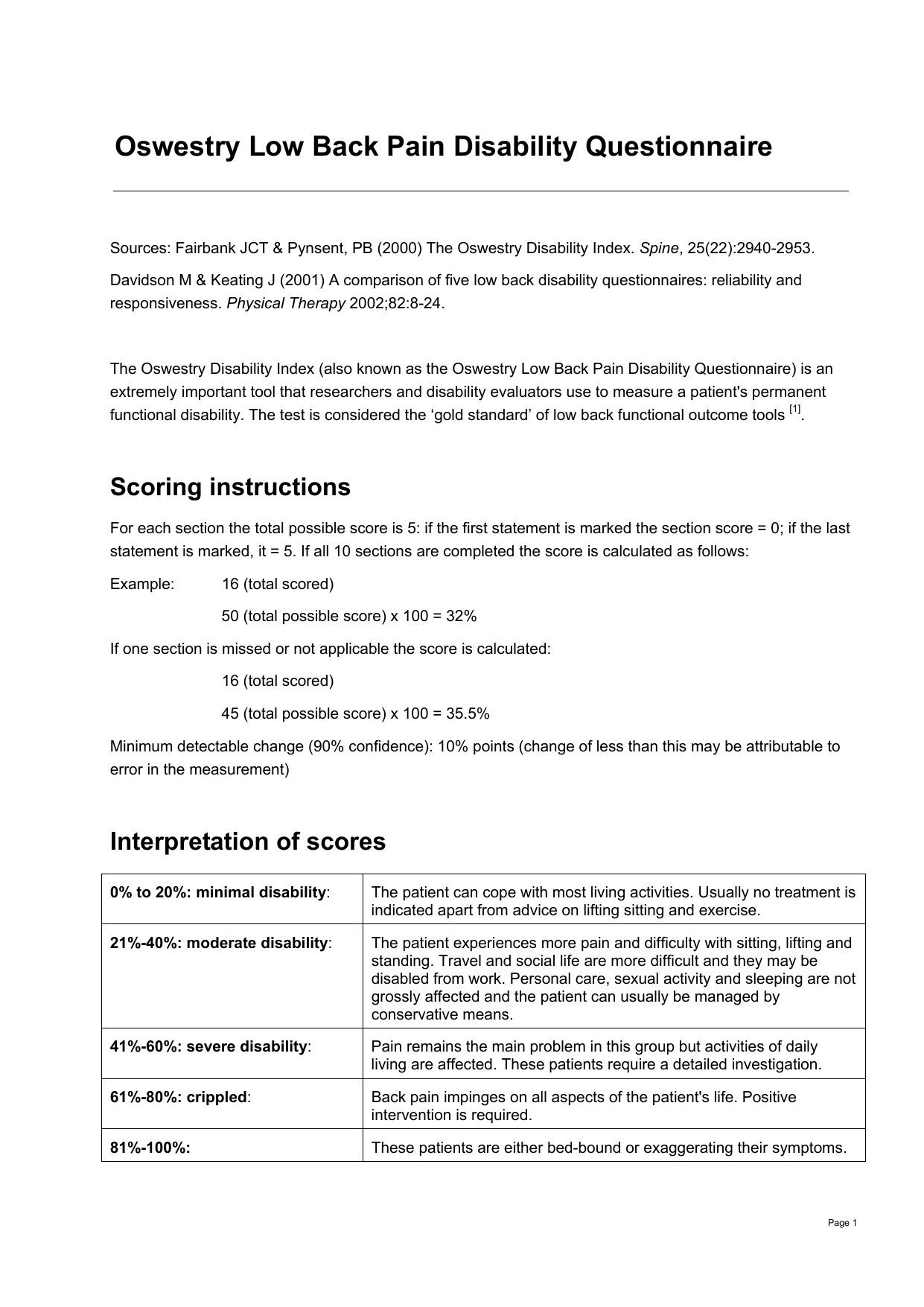
The Oswestry Disability Index can be scored using one main approach that converts raw points into a percentage. You start by summing the scores from ten sections, where each item is rated from 0 to 5. The top score is 50 if all questions are answered. To get the final percentage, divide your total by the maximum possible score and multiply by 100. If a patient skips a section, just reduce the denominator by 5. The result ranges from 0 percent for no disability to 100 percent for bed bound patients, helping clinicians track back pain recovery over time.

Advantages
.svg)
Measures healthcare intervention results systematically.
.svg)
Meets international clinical assessment requirements.

Develops personalised strategies based on assessment data.
.svg)
Provides consistent measurements for clinical research.
.png)

Related Instruments

Digital counterpart
Digital biomarkers that measure the same thing with sensors rather than a questionnaire.
Collect Oswestry Disability Index data with WeGuide, the all in one patient engagement platform
.jpg)

Support Your patient in no time - all under your own brand
Our platform combines the knowledge of 100+ digital health solutions built, letting you easily build your patient engagement app for research or clinical use. Collect PROMs, support patients on waiting lists, or gather vital signs data. This is how:
Learn More.png)
Program Builder
.png)
.png)
Whitelabelling
.svg)
.svg)
.png)
Turn on components, dependent on your usecase
.svg)
.png)
Support The Full Journey
.png)
.png)
%20(1).png)
.png)
It’s your turn
Every WeGuide project, saves researchers and clinicians - 9 months and $450,000 - creating impactful digital health solutions.
