



Beighton Hypermobility Score: Assessing Joint Laxity
The Beighton Hypermobility Score measures joint flexibility to identify hypermobility. This physical test checks nine joints to help doctors diagnose connective tissue disorders.

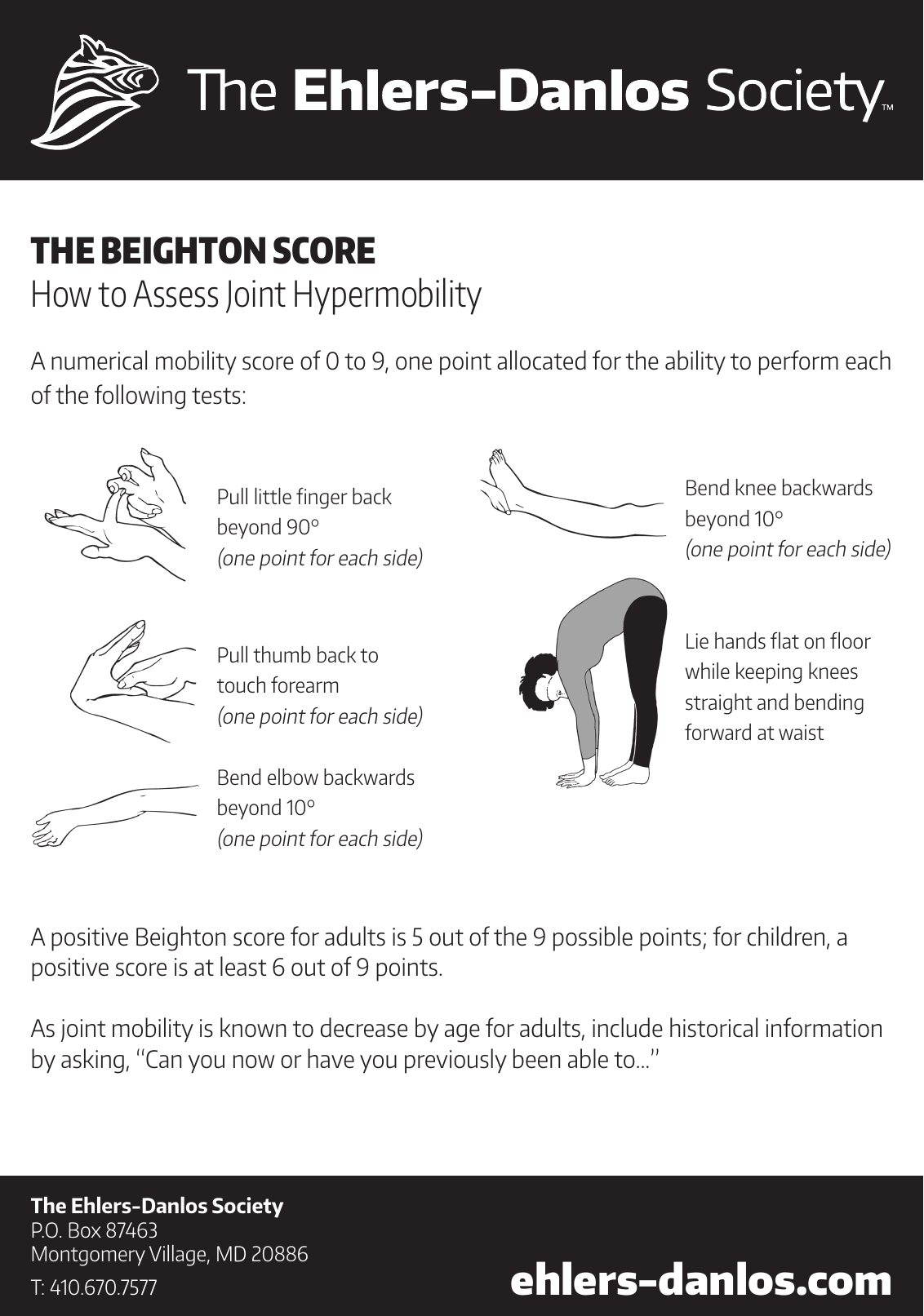
Beighton Hypermobility Score
The Beighton Hypermobility Score is a practical screening tool for measuring joint flexibility. By checking nine specific points, including the knees, elbows, and spine, it helps clinicians assess generalised hypermobility. It's often used to identify conditions like Ehlers-Danlos Syndrome, providing a reliable way to evaluate a patient's range of motion.
Category
Disease
Source
What is Beighton Hypermobility Score

The Beighton Hypermobility Score is a quick screening tool used to check for generalised joint hypermobility. It helps doctors spot overly flexible joints quite easily. This straightforward nine-point scale looks at five specific body parts. It involves performing basic movements to see how far your joints can stretch beyond the normal range. You get points for bending your little fingers back past ninety degrees and touching your thumbs to your forearms. It also checks if your elbows and knees extend backwards too much, plus if you can place your palms flat on the floor while standing straight. Clinicians use this test often because it is fast and needs no special gear. It is really useful for spotting conditions like Ehlers-Danlos syndrome. Getting a clear score helps physios plan better exercises to keep joints stable and stop future injuries in active people effectively.

The Beighton Hypermobility Score can be scored using one main approach: a cumulative point system based on nine specific joints. Clinicians evaluate five maneuvers to check flexibility limits. You award one point for each side if the thumb touches the forearm, the little finger bends back past 90 degrees, or the elbows and knees extend beyond 10 degrees. The final point comes from placing palms flat on the floor with straight legs. Scores range from 0 to 9, where a total of 4 or 5 usually indicates generalised joint hypermobility, helping doctors spot connective tissue issues early on.

Advantages

Enables precise identification of patient health status.
.svg)
Meets international clinical assessment requirements.
.svg)
Simple to understand and complete for patients.
.png)

Related Instruments

Digital counterpart
Digital biomarkers that measure the same thing with sensors rather than a questionnaire.
Streamline Beighton Hypermobility Score assessments with WeGuide
.jpg)

Support Your patient in no time - all under your own brand
Our platform combines the knowledge of 100+ digital health solutions built, letting you easily build your patient engagement app for research or clinical use. Collect PROMs, support patients on waiting lists, or gather vital signs data. This is how:
Learn More.png)
Program Builder
.png)
.png)
Whitelabelling
.svg)
.svg)
.png)
Turn on components, dependent on your usecase
.svg)
.png)
Support The Full Journey
.png)
.png)
%20(1).png)
.png)
It’s your turn
Every WeGuide project, saves researchers and clinicians - 9 months and $450,000 - creating impactful digital health solutions.
