


Incontinence Severity Index: Assessing Urinary Symptoms
The Incontinence Severity Index helps doctors measure the severity of urinary incontinence. This simple patient survey looks at leakage frequency and amount to guide effective treatment plans.


Incontinence Severity Index
The Incontinence Severity Index is a reliable tool for assessing urinary leakage. By multiplying frequency and volume scores, it categorises severity from slight to very severe. This simple method helps doctors guide treatment plans and track patient progress, ensuring accurate management of the condition.
Category
Disease
Source
What is Incontinence Severity Index

The Incontinence Severity Index (ISI) is a simple tool used to measure urinary leakage. It helps doctors understand the problem's impact quickly. This handy questionnaire relies on just two core questions to get the job done. It looks at how often accidents happen and how much fluid is actually lost during these episodes. Patients choose answers about frequency, ranging from less than once a month to every day. They also rate the amount, from drops to heavier wetting. By multiplying these scores, clinicians get a clear index value that categorises the severity level. Since it is so short, the ISI is perfect for quick screenings in busy clinics or large health studies. It is easy to score and helps track changes over time, making it a practical choice for guiding treatment plans. It gives a reliable snapshot of a patient's condition without taking up too much time.
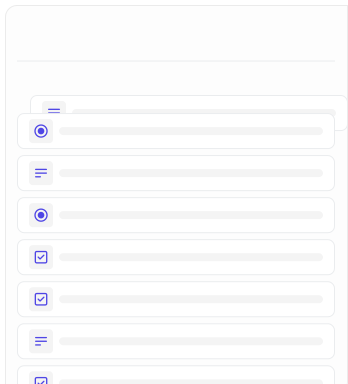
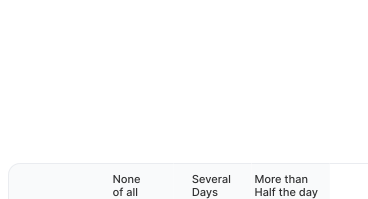
The Incontinence Severity Index can be scored using a straightforward calculation that combines frequency and volume. You simply multiply the points for frequency (1 to 4) by the points for amount (1 to 3). This gives a total index value ranging from 1 to 12. Based on the final number, severity is grouped into four distinct levels: slight (1-2), moderate (3-6), severe (8-9), and very severe (12). It is a really handy way for clinicians to quickly spot how much leakage impacts a patient's daily life without needing complex tests.
Advantages
.svg)
Streamlines research data gathering process.

Enables precise identification of patient health status.

Develops personalised strategies based on assessment data.
.svg)
Simple to understand and complete for patients.
.png)

Related Instruments

Digital counterpart
Digital biomarkers that measure the same thing with sensors rather than a questionnaire.
Collect Incontinence Severity Index data with WeGuide, the all in one patient engagement platform
.jpg)

Support Your patient in no time - all under your own brand
Our platform combines the knowledge of 100+ digital health solutions built, letting you easily build your patient engagement app for research or clinical use. Collect PROMs, support patients on waiting lists, or gather vital signs data. This is how:
Learn More.png)
Program Builder
.png)
.png)
Whitelabelling
.svg)
.svg)
.png)
Turn on components, dependent on your usecase
.svg)
.png)
Support The Full Journey
.png)
.png)
%20(1).png)
.png)
It’s your turn
Every WeGuide project, saves researchers and clinicians - 9 months and $450,000 - creating impactful digital health solutions.
