


Child Behavior Checklist: Assessing Youth Behaviour
This parent-completed survey assesses emotional and behavioural issues in children. It helps clinicians identify specific problems and plan effective support for young people.

Child Behavior Checklist
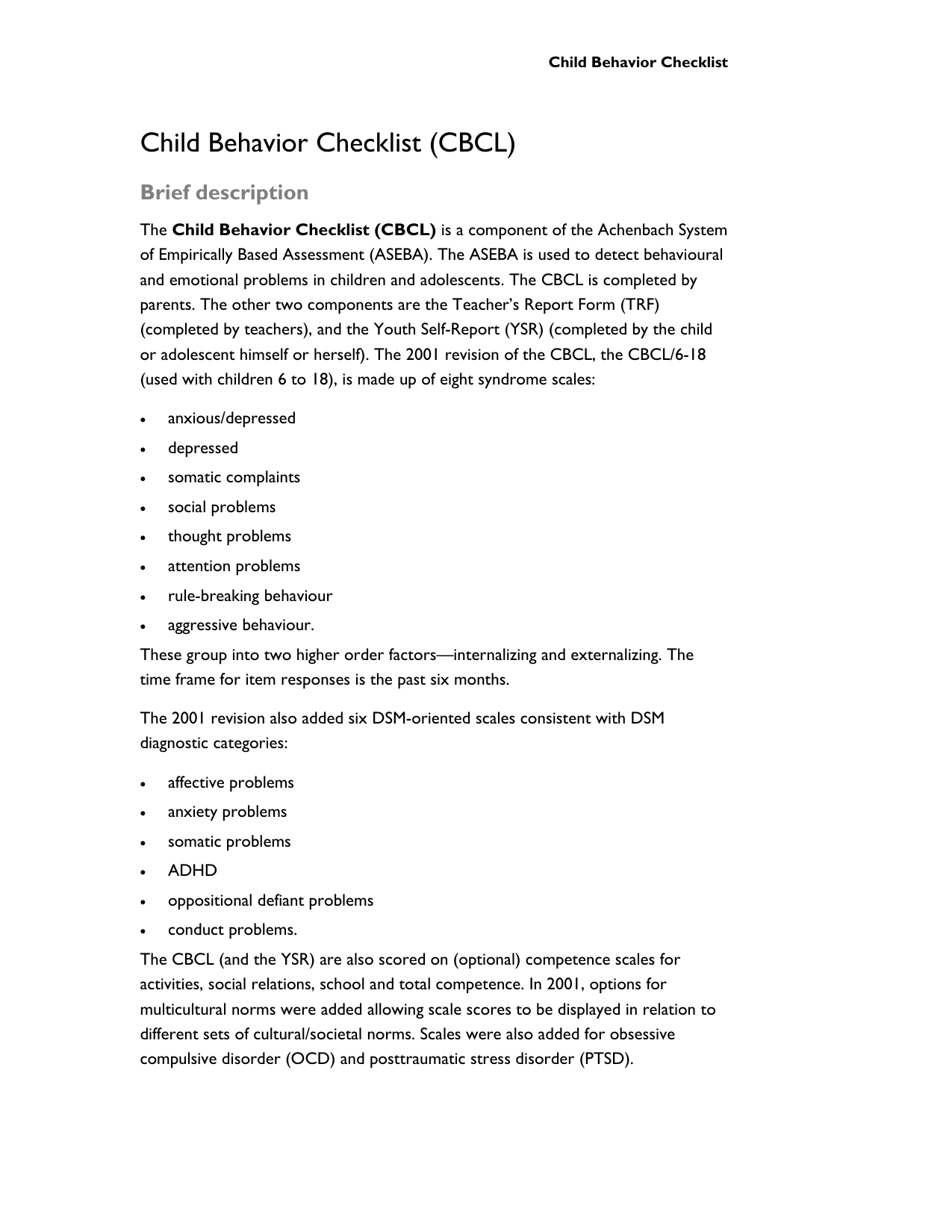
The Child Behavior Checklist (CBCL) is a standardised questionnaire for parents to rate a child's competencies and behavioural problems. It helps clinicians identify internalising and externalising issues, making it essential for assessing youth mental health and guiding effective support strategies.
Category
Disease
Source
What is Child Behavior Checklist

The Child Behavior Checklist (CBCL) is a key tool for spotting emotional and behavioural issues in kids. It helps experts understand a child's specific needs. Part of the Achenbach System of Empirically Based Assessment (ASEBA), this form relies on parent reports. It looks at a child's strengths and competencies alongside problem areas. The checklist groups behaviours into internalising patterns, like anxiety or withdrawal, and externalising ones, such as aggression. Parents rate specific items on a simple scale from 'not true' to 'very true', giving a clear picture of symptom severity. Clinicians use the CBCL to screen for disorders and track progress. It's easy to hand out in clinics or schools, making it practical for busy professionals. By comparing results to standard norms, you can plan better support strategies that truly help young people thrive in their daily lives.
The Child Behavior Checklist can be scored using a structured three point rating system across competence and problem scales. 1. Item Scoring: Parents rate 113 specific behaviours as 0 for Not True, 1 for Somewhat True, or 2 for Very True. You add these values to generate raw scores for Syndrome Scales like Anxious Depressed, plus broad Internalising and Externalising groups. 2. Normative Comparison: These raw totals convert to T scores using age and gender norms. A T score above 63 places a child in the clinical range, while 60 to 63 sits in the borderline range, helping pros map out the best support plan.
Advantages

Enables precise identification of patient health status.
.svg)
Serves diverse clinical needs effectively.
.svg)
Meets international clinical assessment requirements.
.svg)
Strengthens evidence through systematic measurement approaches.
.png)

Related Instruments

Digital counterpart
Digital biomarkers that measure the same thing with sensors rather than a questionnaire.
Collect Child Behavior Checklist data with WeGuide, the all in one patient engagement platform
.jpg)

Support Your patient in no time - all under your own brand
Our platform combines the knowledge of 100+ digital health solutions built, letting you easily build your patient engagement app for research or clinical use. Collect PROMs, support patients on waiting lists, or gather vital signs data. This is how:
Learn More.png)
Program Builder
.png)
.png)
Whitelabelling
.svg)
.svg)
.png)
Turn on components, dependent on your usecase
.svg)
.png)
Support The Full Journey
.png)
.png)
%20(1).png)
.png)
It’s your turn
Every WeGuide project, saves researchers and clinicians - 9 months and $450,000 - creating impactful digital health solutions.
