


Barthel Index: Measuring Activities of Daily Living
The Barthel Index tracks how well patients handle daily tasks like eating and bathing. Doctors use it to measure independence and monitor recovery progress during rehabilitation.

Barthel Index
The Barthel Index is a trusted scale for assessing functional independence in activities of daily living (ADL). It tracks performance in ten areas, including feeding and mobility, which is key for rehabilitation planning. This tool helps teams monitor patient progress and determine discharge needs accurately.
Category
Disease
Source
What is Barthel Index

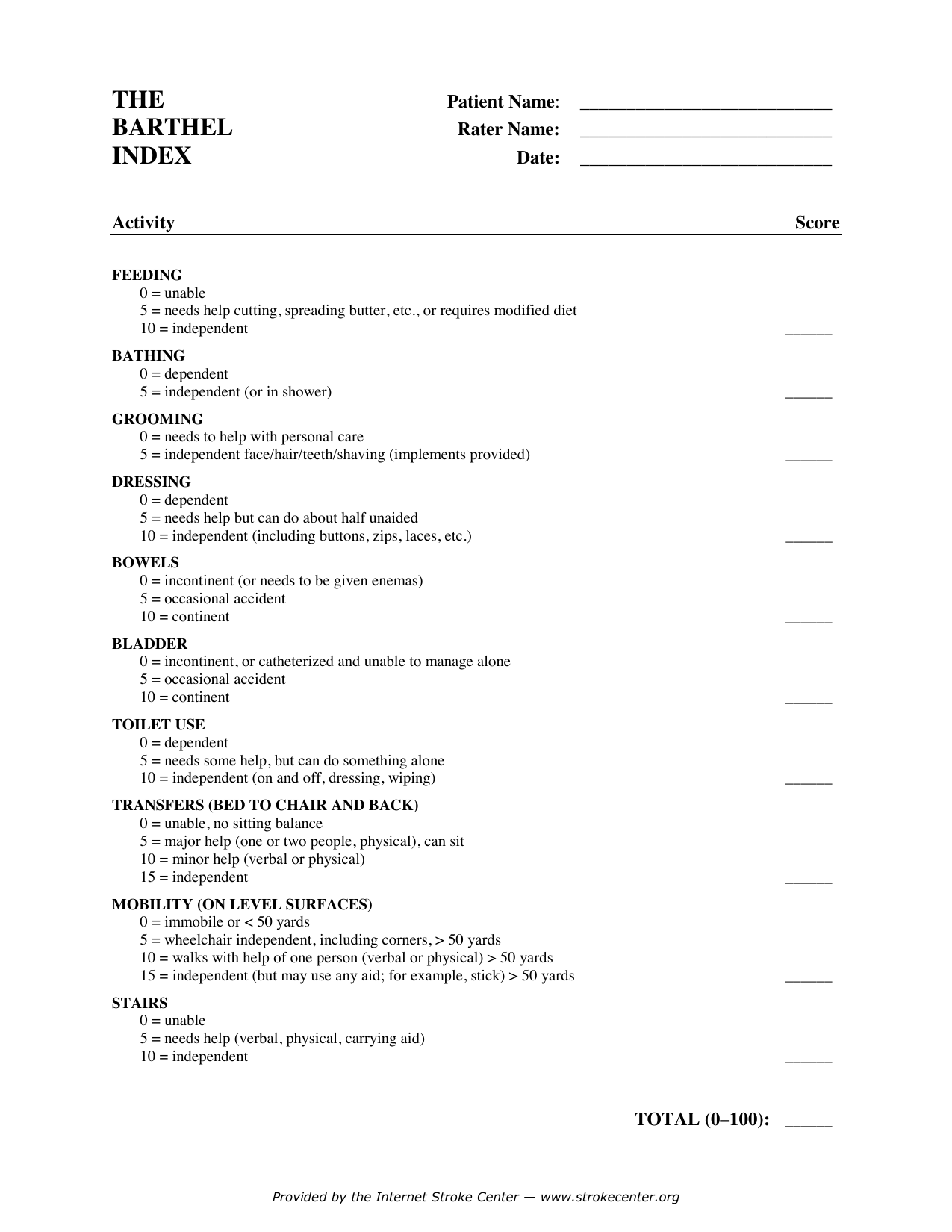
The Barthel Index (BI) is a trusted tool for assessing independence in activities of daily living. It helps clinicians track functional changes over time. This scale looks at ten specific tasks related to personal care and mobility, focusing on what a patient actually does day to day rather than what they might be able to do. Items cover feeding, bathing, grooming, dressing, bowel and bladder control, toilet use, transfers, walking, and climbing stairs. Scores generally range from 0 to 100, where higher numbers mean better independence and less need for physical help. It is quick to use, taking only a few minutes for nurses or therapists to complete through direct observation or by asking the patient. The results are helpful for planning discharge and checking if rehabilitation is working. It gives a clear picture of how much care someone needs to manage safely at home.
The Barthel Index can be scored using a standard approach that sums weighted points for ten daily activities. You will rate items like feeding, bathing, and mobility with values of 0, 5, 10, or 15 based on how much help a patient needs. These points are added up to get a total between 0 and 100 in five point steps. A score of 0 suggests total dependence, while a higher number shows more independence. A score of 100 means the patient is physically independent, but it is worth noting this does not guarantee they can live alone safely without any social support.
Advantages
.svg)
Measures healthcare intervention results systematically.

Develops personalised strategies based on assessment data.
.svg)
Streamlines research data gathering process.
.svg)
Meets international clinical assessment requirements.
.png)

Related Instruments

Digital counterpart
Digital biomarkers that measure the same thing with sensors rather than a questionnaire.
Collect Barthel Index data with WeGuide, the all in one patient engagement platform
.jpg)

Support Your patient in no time - all under your own brand
Our platform combines the knowledge of 100+ digital health solutions built, letting you easily build your patient engagement app for research or clinical use. Collect PROMs, support patients on waiting lists, or gather vital signs data. This is how:
Learn More.png)
Program Builder
.png)
.png)
Whitelabelling
.svg)
.svg)
.png)
Turn on components, dependent on your usecase
.svg)
.png)
Support The Full Journey
.png)
.png)
%20(1).png)
.png)
It’s your turn
Every WeGuide project, saves researchers and clinicians - 9 months and $450,000 - creating impactful digital health solutions.
